Rhyolite Ghost Town
In the desert east of Death Valley, the ruins of a city stand in the silence. Rhyolite was founded in 1905 after gold was discovered in the Bullfrog Hills. Within three years, the town had 10,000 residents, three-story buildings, electric lights, telephones, an opera house, a stock exchange, and a red-light district. Then the Panic of 1907 dried up investment; the mines began failing; by 1910, Rhyolite was dying. By 1920, it was abandoned. The desert reclaimed most of the town, but several buildings survived: the bank with its impressive facade, the railroad depot, and the famous Bottle House built from 50,000 beer and whiskey bottles. Today Rhyolite stands as one of the best-preserved boom-and-bust ghost towns in the American West.
The Boom
In August 1904, prospector Shorty Harris discovered gold in the Bullfrog Hills, naming the district for the greenish rock that held the ore. Word spread; by 1905, thousands were arriving. Rhyolite - named for the volcanic rock beneath it - became the main town, its population exploding to 10,000 by 1908. The town attracted serious investment: the John S. Cook Bank built a three-story building, the Overbury Building housed the stock exchange, and the Las Vegas & Tonopah Railroad extended a line to the mines. The town had electricity before many eastern cities, three newspapers, competing hotels, and all the services a mining camp required. Rhyolite was to be permanent.
The Bust
The Panic of 1907 - a national financial crisis - cut off investment in speculative mining ventures. Rhyolite's mines were real, but they required capital to develop; capital vanished. By 1908, the richest ore was exhausted; lower-grade ore needed expensive processing. One by one, the mines closed. The railroad, which had just arrived, considered pulling out. Population dropped as fast as it had risen - 5,000 in 1909, 700 in 1910, 14 in 1920. The post office closed in 1919. Buildings were stripped for lumber; machinery was salvaged. The desert began erasing what the boom had built.
The Ruins
Several structures survived Rhyolite's abandonment. The John S. Cook Bank, a two-story reinforced concrete building, stands remarkably intact - its facade still impressive against the desert sky. The Las Vegas & Tonopah Railroad depot, restored as a visitor center, anchors the town site. Tom Kelly's Bottle House, built in 1906 from an estimated 50,000 bottles cemented together, was restored by Paramount Pictures for a 1925 film. The Overbury Building walls remain standing. Foundation outlines mark where other buildings stood. The ruins achieved fame as a movie location and tourist attraction; Death Valley's proximity draws visitors who detour to see what gold fever built and abandoned.
The Sculpture Garden
In 1984, Belgian artist Albert Szukalski created 'The Last Supper' - ghostly white figures depicting the biblical scene - on private land near Rhyolite. Other artists added works over the years, creating the Goldwell Open Air Museum. The sculptures - including a giant prospector and miner, a woman emerging from a block of stone, and a ghost-like figure - complement the ghost town's atmosphere. The museum operates on donations; the sculptures are visible from the road. The art and the ruins create an unlikely cultural destination in the desert - contemporary art beside Victorian ambition, both strange against the barren landscape.
Visiting Rhyolite
Rhyolite is located 4 miles west of Beatty, Nevada, on Highway 374 (Daylight Pass Road) leading to Death Valley. The site is unattended; admission is free. The railroad depot serves as a small visitor center and museum (seasonal hours). The bank building, bottle house, and other ruins are accessible on foot. Goldwell Open Air Museum is adjacent. Death Valley National Park is a few miles west via Daylight Pass. Beatty has motels, restaurants, and gas. Las Vegas is 115 miles southeast. Summer temperatures are extreme (above 110°F); visit in spring, fall, or winter. The ruins are on Bureau of Land Management land; leave artifacts in place.
From the Air
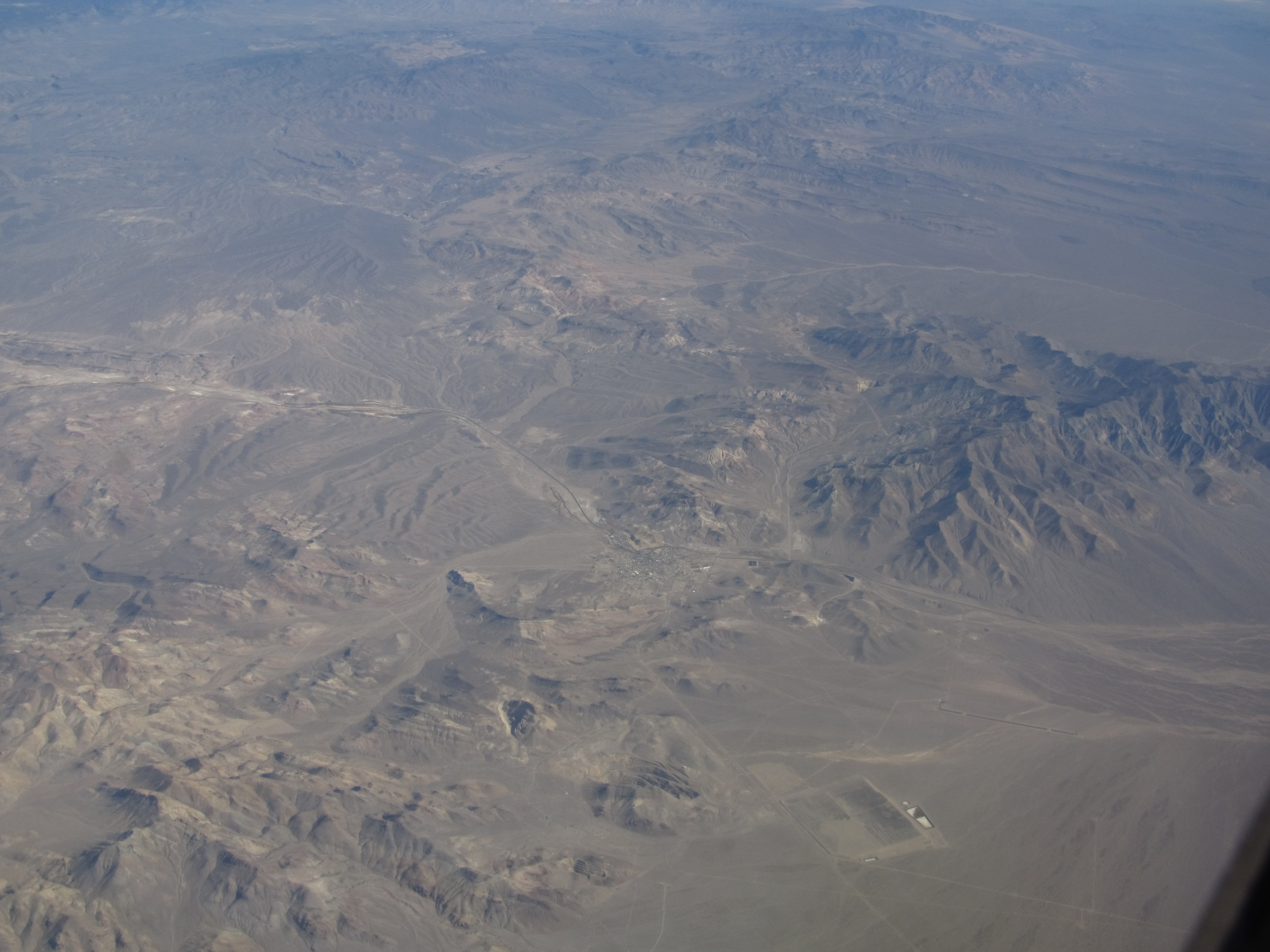
Located at 36.90°N, 116.83°W in the Bullfrog Hills of Nevada, just east of Death Valley. From altitude, Rhyolite appears as scattered ruins on desert terrain - the bank building and depot are the most visible structures. The Amargosa Desert extends east toward Beatty. Death Valley's mountain wall rises to the west. The terrain is classic Basin and Range - alluvial fans, dry washes, and barren mountains. Mining scars are visible in the surrounding hills. Highway 374 passes through, connecting Beatty to Death Valley. The isolation that killed Rhyolite is visible from any altitude - there is nothing else for miles.