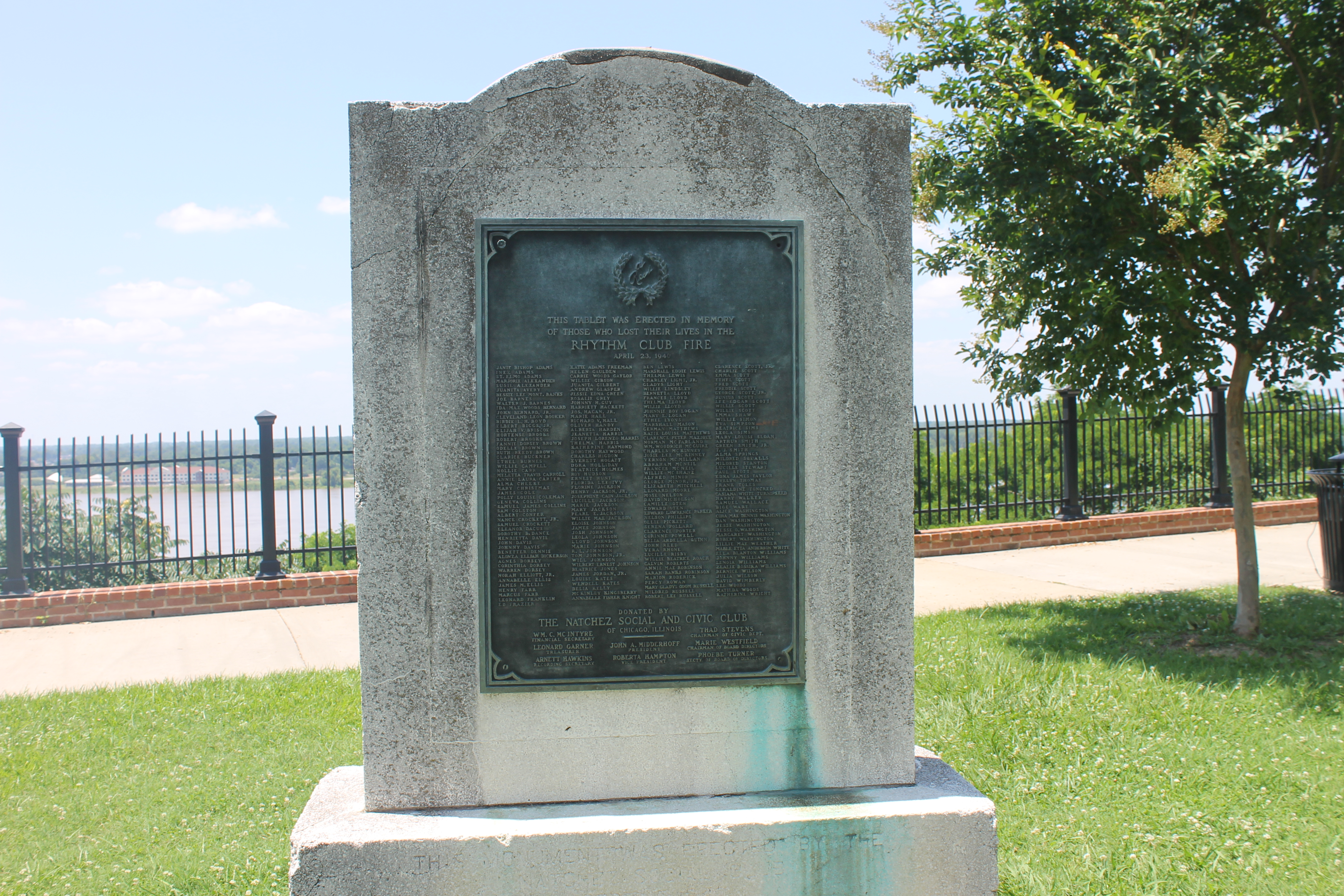
Rhythm Club Fire
Walter Barnes and His Royal Creolians were playing to a packed house when the Spanish moss caught fire. It was April 23, 1940, a Tuesday night at the Rhythm Night Club on St. Catherine Street in Natchez, Mississippi, and 746 people were crowded into a converted blacksmith shop with metal walls and boarded-up windows. The moss had been draped from the rafters as decoration and sprayed with Flit, a petroleum-based insecticide, to keep the bugs out. When it ignited near the front entrance around eleven o'clock, the flames raced across the ceiling like a burning curtain. Within minutes, 209 people were dead. It was the fourth deadliest assembly fire in American history, and every single victim was Black.
A Night of Music Turned to Smoke
The Rhythm Night Club was not supposed to have Walter Barnes that evening. Tiny Bradshaw and his orchestra had been the original booking, but a scheduling conflict opened the door for Barnes, a well-known bandleader from Chicago who traveled with a fourteen-piece orchestra called the Royal Creolians. The club recorded 577 paid admissions and issued 150 passes, and with the band's nineteen members and staff, at least 746 people filled the one-story building. Twenty-one of the twenty-four windows had been boarded shut to prevent people outside from watching or listening without paying. The front door was the only functioning exit, and it swung inward. When fire erupted near that entrance around eleven o'clock, the Spanish moss that decorated the ceiling -- dry, saturated with petroleum-based insecticide -- became a river of flame overhead. Burning clumps dropped onto the dance floor, igniting clothing and hair, forming a wall of fire between the crowd and the only way out.
An Oven of Metal and Steam
The building's construction turned the fire into a death trap of particular cruelty. The walls were clad in corrugated metal, which held heat inside like an oven and offered no ventilation for the smoke. Blinding darkness filled the room as the lights failed. Survivors remembered the chaos of bodies pressing toward the rear of the building, away from the flames at the entrance, only to find the back door padlocked and boarded shut. The Natchez Fire Department did not yet exist -- the city relied on two volunteer companies with a single full-time firefighter. The Phoenix Fire Station, four blocks away, received its first call about the fire at 11:15 p.m. Engines arrived within minutes, but when water from the fire hoses struck the metal siding, it generated scalding steam that burned survivors still trapped inside. Doctors who examined the dead found that most had been suffocated by smoke or crushed in the stampede toward the rear. Bodies were stacked to shoulder height near the bandstand.
The Bandleader Who Kept Playing
Walter Barnes did not run. According to survivors and contemporary accounts, the bandleader attempted to calm the panicking crowd, continuing to play as smoke filled the room. Nine of his bandmates died alongside him: John Reed Jr., James Coles, Clarence Porter, Henry Walker, Paul Scott, Calvin Roberts, Jesse Washington, and vocalist Juanita Avery. More than fifteen thousand mourners attended Barnes's funeral in Chicago, a staggering outpouring of grief for a musician whose last act was trying to hold back chaos with music. The day after the fire, five men were arrested after reports they had drunkenly threatened to burn the building down in an argument. Charges were later dropped. A hotel employee named Ernest Wright, who had been standing by the entrance, reported hearing two women arguing, one accusing the other of setting the fire. All later investigations concluded the cause was accidental -- most likely a carelessly dropped cigarette that reached the moss.
A Generation Vanishes
The Rhythm Club fire devastated the Black community of Natchez in ways that went beyond the death toll. In a city where the Black population numbered in the thousands, the loss of 209 people -- almost all of them young adults out for an evening of dancing -- erased a generation. Local victims were buried at the Watkins Street Cemetery. The Natchez Social and Civic Club of Chicago raised money for victims' families and for a memorial. At the time, there were no building occupancy restrictions in Mississippi. The fire directly led to new laws limiting the number of people allowed in a structure and requiring exit doors to swing outward. These codes, born from the Natchez disaster, became standard across the country and have saved countless lives in the decades since.
Blues for the Rhythm Club
The disaster entered the bloodstream of American music. Blues artists memorialized the fire in song after song: the Lewis Bronzeville Five recorded "Mississippi Fire Blues" and "Natchez Mississippi Blues," Gene Gilmore sang "The Natchez Fire," Leonard Caston recorded "The Death of Walter Barnes," Howlin' Wolf cut "The Natchez Burnin'," and John Lee Hooker released "Natchez Fire." In 2010, the Rhythm Club Museum opened on the site, and a historical marker now stands where the building once stood. Playwright Danese Frazier Turner, granddaughter of the club operator Ed Frazier, wrote and co-directed a play called Death by Dancing to commemorate the tragedy. The site on St. Catherine Street is quiet now, a small museum where visitors can learn about the night the music stopped and an entire community was changed forever.
From the Air
The Rhythm Club fire site is at 31.559N, 91.398W on St. Catherine Street in Natchez, Mississippi. The site is within the Natchez city grid, identifiable from the air as part of the residential neighborhoods east of the downtown bluff. Hardy-Anders Field/Natchez-Adams County Airport (KHEZ) is 6nm northeast. Baton Rouge Metropolitan Airport (KBTR) lies to the south and Alexandria International Airport (KAEX) to the west. The Mississippi River and Natchez bluffs provide unmistakable landmarks for orientation.