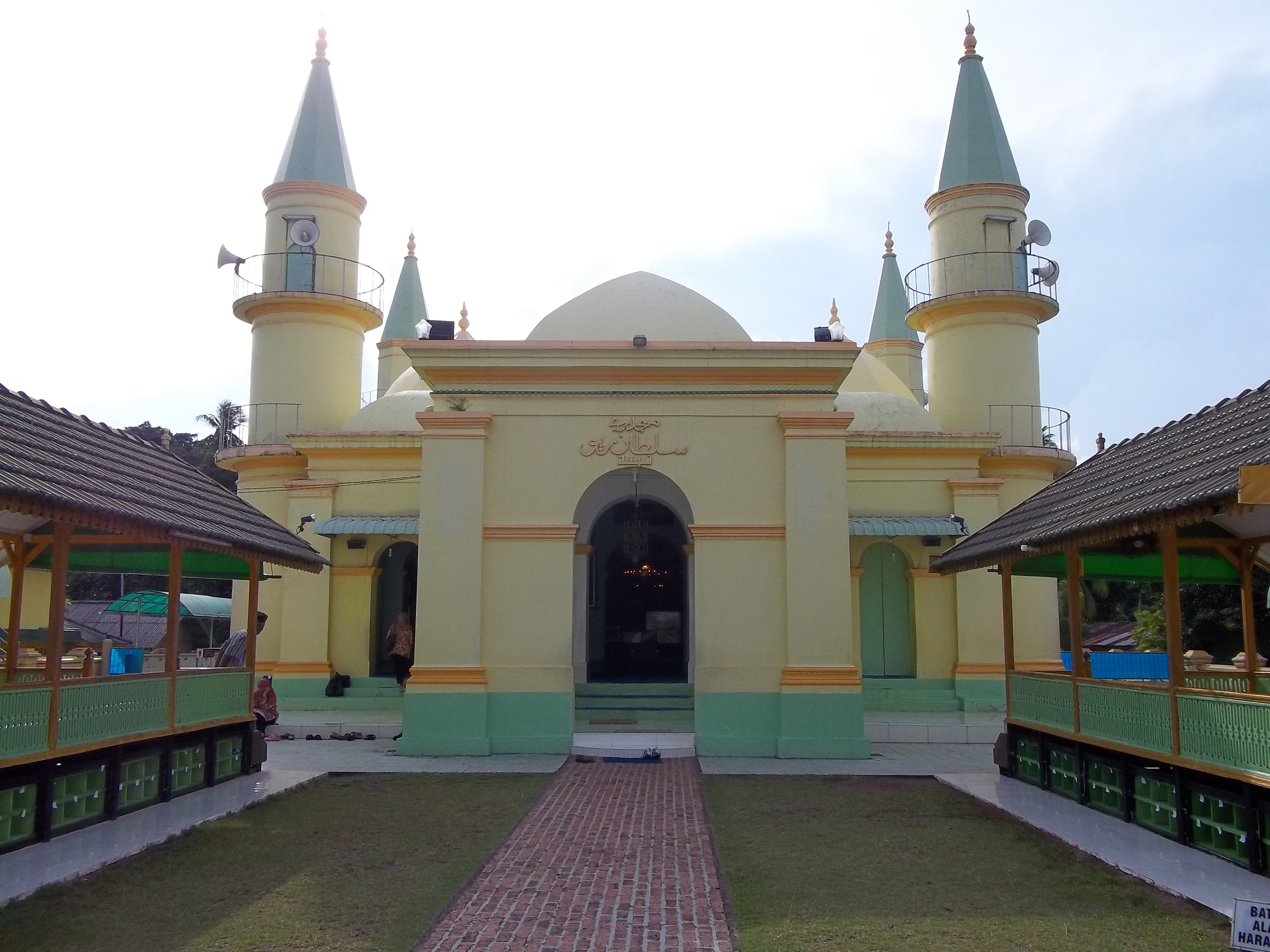
Riau-Lingga Sultanate
The royal regalia would not cooperate. In the chaos following the death of Sultan Mahmud III in 1812, the legitimate succession of the Johor-Riau Empire hinged on a crown, a set of ceremonial objects, and the consent of one furious queen. Engku Puteri Hamidah, holder of the Cogan -- the royal regalia without which no sultan could be lawfully installed -- refused to endorse the candidate the colonial powers preferred. So the Dutch seized the regalia by force, crowned their man anyway, and in doing so set in motion the partition of one of Southeast Asia's oldest Malay kingdoms. The Riau-Lingga Sultanate that emerged from this fracture would spend the next 87 years navigating between colonial domination and stubborn self-determination, until Dutch warships finally ended the contest in 1911.
An Empire Divided by Treaty
The roots of the Riau-Lingga Sultanate reach back to the fall of Malacca in 1511 and the Johor Sultanate that inherited its mantle. At its height, the Johor-Riau Empire stretched across half the Malay Peninsula, eastern Sumatra, Singapore, and the Riau Islands -- a maritime domain that controlled the vital Strait of Malacca trade routes. In 1673, the Laksamana of Johor founded a settlement on Bintan Island at Sungai Carang, which grew into the entrepot known as Riau Lama and served as the imperial capital from 1722 to 1787. When Britain and the Netherlands carved up the region through the Anglo-Dutch Treaty of 1824, they split this single polity in two: everything north of the Singapore Strait, including Singapore and Johor, went to Britain; everything south -- the Riau and Lingga archipelagos -- fell to the Dutch. Two rival sultans, each backed by a different European power, now ruled fragments of what had been one kingdom. Both were, in practice, puppet monarchs.
Tin, Spice, and a Distant Queen's Defiance
The new sultanate's wealth came from the sea. Tin from mines in Singkep, pepper and spices from across the archipelago, and the strategic position of the Riau Islands on trade routes linking India, China, and the Malay world sustained the kingdom. Under Sultan Badrul Alam Syah II, the capital at Daik on Lingga Island found unexpected prosperity in the mid-nineteenth century. The sultan encouraged rice cultivation and introduced sago from the Moluccas as a more reliable staple crop. A small armada promoted trade, and Daik attracted merchants from China, Celebes, Borneo, the Malay Peninsula, Java, and Pahang. This commercial vitality alarmed the Dutch, who feared the sultanate might accumulate enough resources to challenge their control. Meanwhile, the island of Penyengat -- initially a royal dowry for Engku Puteri Hamidah, the queen who had refused to surrender the regalia -- developed into the seat of the Yang di-Pertuan Muda, the powerful Bugis viceroy. With its palace, mosque, and fortifications, Penyengat became the intellectual and cultural heart of the Malay world.
Scholars, Poets, and the First Malay Dictionary
The literary flowering that took place on Penyengat in the nineteenth century shaped the Malay language itself. Raja Ali Haji, of mixed Bugis and Malay ancestry, produced works considered masterpieces of Malay literature: the historical chronicle Tuhfat al-Nafis, the Gurindam Dua Belas -- twelve verses of moral poetry -- and the Kitab Pengetahuan Bahasa, the first Malay dictionary. In 1895, intellectuals at the royal court founded the Roesidijah Club, the first modern association in the Dutch East Indies. Initially a literary circle devoted to religious, cultural, and intellectual development, the club evolved into something more dangerous: a vehicle for political resistance. Raja Aisyah's Hikayat Syamsul Anwar, completed in 1890, stands as one of the earliest feminist works in Malay literature, telling the story of a heroine who disguises herself as a man to prove women could achieve on equal terms. The culture that produced these works was not merely decorative. It was building an argument -- in elegant Malay prose -- for why the sultanate deserved to be sovereign.
Passive Resistance and the Flag That Wouldn't Rise
By the turn of the twentieth century, the Roesidijah Club had transformed from literary salon to political movement. Inspired by Pan-Islamic ideas flowing through cosmopolitan Singapore and the newly accessible Middle East -- the Suez Canal had cut the journey to Mecca to a fortnight -- the Riau intelligentsia began articulating a vision of an independent homeland. The movement adopted non-violence and passive resistance. Its signature tactic was symbolic: members refused to raise the Dutch flag on government vessels. On 1 January 1903, the Dutch Colonial Resident arrived at the royal palace to find no Dutch flag flying. Sultan Abdul Rahman II, the Resident reported with barely contained fury, "acted as if he was a sovereign king and he raises his own flag." Diplomatic missions were dispatched to the Ottoman Empire in 1883, 1895, and 1905 seeking protection, and later to Japan. Christiaan Snouck Hurgronje, the Dutch advisor on native affairs, compared the situation to the Aceh War and advocated crushing the movement. The Dutch demanded the sultan sign a new agreement declaring his kingdom a mere "loan" from the Dutch government. After consulting his fellow rulers, he refused.
The Morning the Warships Came
On the morning of 11 February 1911, while the sultan and his court were in Daik performing the Mandi Safar purification ritual, Dutch naval vessels -- the Java, the Tromp, and the Koetai torpedo boat -- anchored off Penyengat Island. Hundreds of soldiers deployed to lay siege to the royal court. A Dutch official read out the letter deposing Sultan Abdul Rahman II, branding the crown prince and members of the Roesidijah Club as individuals harboring animosity against the Dutch colonial government. To prevent seizure of official buildings and their contents, members of the court set fire to their own structures. Rather than risk civilian bloodshed, the sultan and his queen boarded the royal vessel Sri Daik and sailed for Singapore. The crown prince and resistance leaders followed days later. A mass exodus of civilians and officials to Johor and Singapore emptied the island. The Dutch annexed the sultanate outright in 1913, imposing direct rule over the archipelago. The deposed sultan lived in exile in Singapore until his death in 1930. His kingdom's literary traditions, its dictionary, its poetry, and its stubborn insistence on sovereignty survived him -- woven into the fabric of the Malay and Indonesian languages that millions speak today.
From the Air
Located at approximately 0.98N, 104.55E in the Riau Islands of Indonesia. The sultanate's historical center was Penyengat Island, a small island visible near Tanjung Pinang on the south coast of Bintan Island. The Riau Archipelago consists of over 3,200 islands spread across the waters south of Singapore. Recommended viewing altitude: 5,000-10,000 feet for the island chain perspective. Nearest airports: Raja Haji Fisabilillah Airport (WIDN) at Tanjung Pinang, Hang Nadim International Airport (WIDD) at Batam. Singapore Changi Airport (WSSS) is approximately 40 nm to the north across the Singapore Strait.