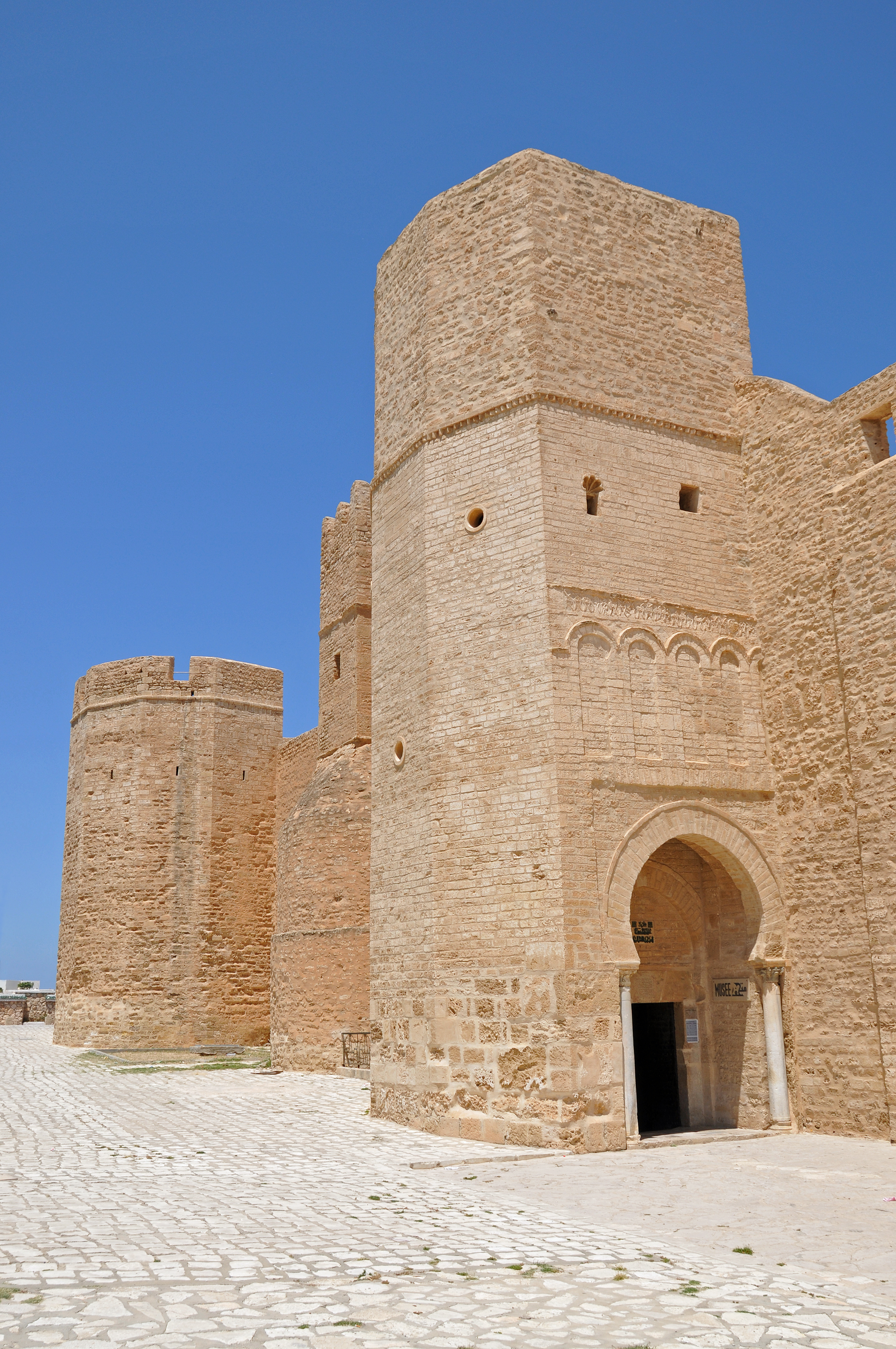
Ribat of Monastir
If the walls of the Ribat of Monastir could narrate their own history, the story would begin with prayer and end with a stoning. Founded in 796, this is the oldest ribat built by the Arab conquerors during the Muslim conquest of the Maghreb. Nearly twelve hundred years later, in 1978, the Monty Python comedy troupe arrived and filmed the stoning scene of Life of Brian along its outside wall. Between those two events lies a building that has served as fortress, monastery, lighthouse, and movie set, never quite losing its original gravity despite the absurdity of its later career.
Warriors at Prayer
A ribat was not simply a fortress. It was a place where military service and religious devotion merged. The warriors garrisoned here, called mujahideen, combined coastal defense with prayer and meditation. The Ribat of Monastir was founded by Harthama ibn A'yan, the Abbasid governor of Ifriqiya, at a moment when the newly conquered North African coast needed protection from Byzantine naval attacks and piracy. Small rooms throughout the complex were dedicated to the worshipping soldiers who performed their spiritual obligations during military duty. The ribat contains two mosques, the larger of which today houses a collection of medieval worship materials and traditional industrial artifacts.
Shape-Shifter in Stone
The building has changed shape repeatedly over the centuries. Its original form was quadrilateral, but expansions transformed it into a composition of four interconnected buildings surrounding two inner courtyards. Abu al-Qasim ibn Tammam carried out a major expansion in 966. Watchtowers were added between the eleventh and thirteenth centuries, and again between the seventeenth and nineteenth centuries, as the nature of coastal defense evolved to accommodate artillery. A spiral staircase of roughly a hundred steps leads to the main watchtower, which once exchanged visual signals at night with the towers of neighboring ribats along the coast, forming an early warning network that could relay the approach of enemy ships across hundreds of kilometers.
The View from the Top
The towers remain climbable today, and the view from their summits offers the best perspective on what the ribat was designed to protect. To the east lies the Mediterranean, the direction from which attacks came. To the west, the city of Monastir spreads inland. The golden dome of the Bourguiba Mausoleum catches the light nearby. From the tower, you can trace the coastline in both directions and understand why this particular point was chosen for defense: it commands a stretch of shore where an invading fleet would need to land. The ribat was not placed for beauty. Its position was strategic, and the beauty it acquired over twelve centuries was incidental.
Life of Brian, Life of Stone
According to Michael Palin, the first scene the Monty Python team filmed at the Ribat of Monastir was the stoning sequence, staged along the outside wall. The fortress's sun-baked stone and austere geometry made it a convincing stand-in for ancient Jerusalem, and several scenes from the 1979 film were shot here. The ribat took its Hollywood moment in stride. It had already survived twelve centuries of conquest, renovation, and repurposing. A few weeks of British comedians throwing rubber rocks at each other was, by the standards of its history, a minor episode. The building remains Monastir's most prominent monument, outlasting every regime that has garrisoned it and every film crew that has borrowed its walls.
From the Air
Located at 35.776N, 10.833E on the coast of Monastir, Tunisia. The ribat is visible from the air as a square stone fortress at the tip of a promontory, directly adjacent to the Mediterranean. The golden dome of the Bourguiba Mausoleum is visible nearby. Nearest airport: Monastir Habib Bourguiba International (DTMB), less than 5 km southwest. Recommended viewing altitude: 1,500-3,000 feet AGL for best perspective on the fortress's relationship to the coastline.