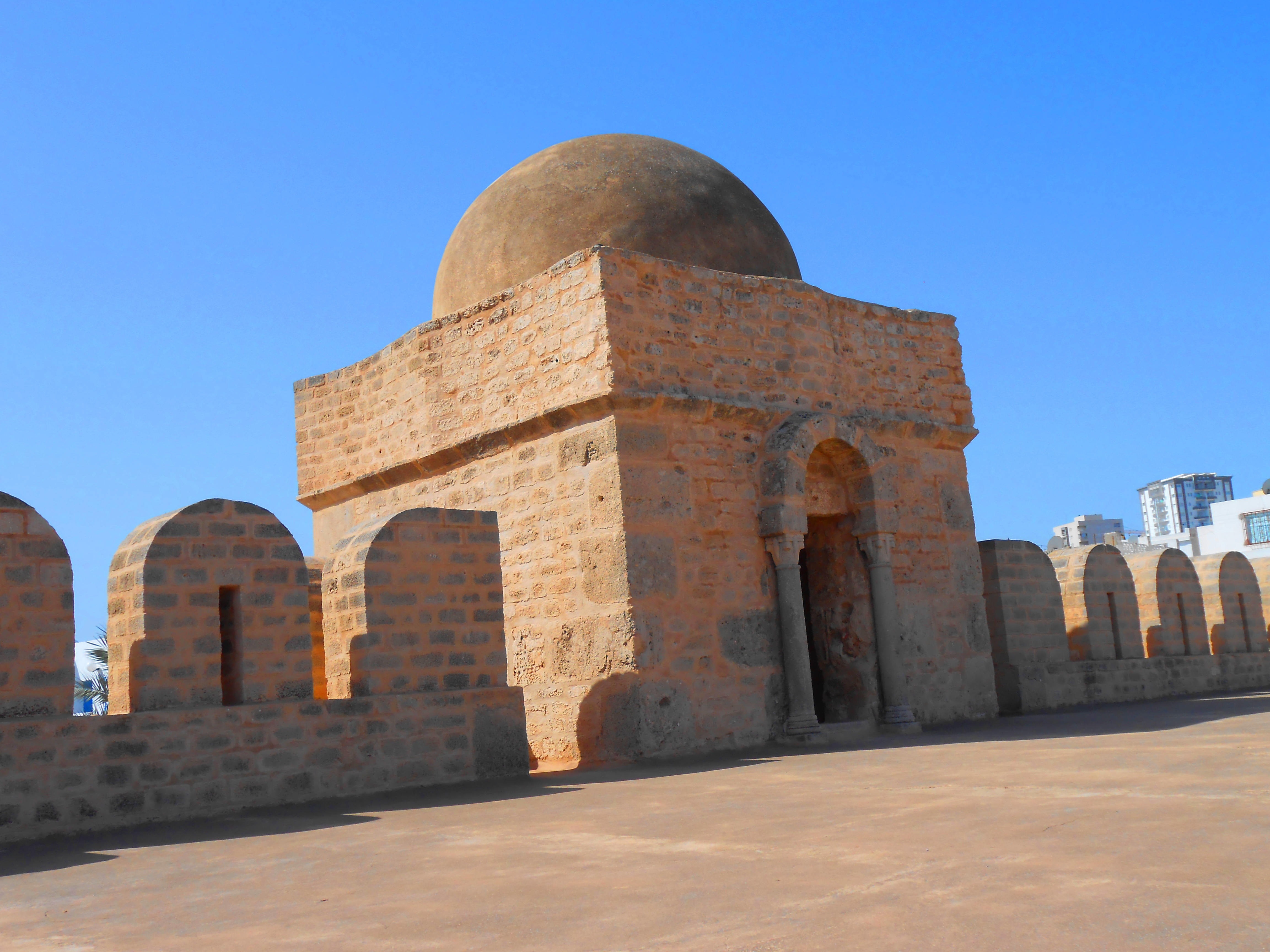
Ribat of Sousse
The marble columns in the Ribat of Sousse were looted from churches on Malta. After the Aghlabid dynasty captured the Byzantine city of Melite, modern Mdina, in 870, plundered marble and columns were shipped across the Mediterranean and incorporated into this coastal fortress in Sousse. It is a detail that captures the essential character of the building: pragmatic, layered with the spoils of conquest, and shaped by the realities of Mediterranean power politics in the early Islamic centuries.
A Fortress for Faith and War
The Ribat of Sousse was most likely founded in the late eighth century during the tenure of the Abbasid governor Yazid ibn Hatim al-Muhallabi, who died in 787. In the year 800, the Abbasid Caliph Harun al-Rashid granted the governorship of Ifriqiya to Ibrahim ibn al-Aghlab, founding the Aghlabid dynasty that would rule the region for a century. Under the Aghlabids, the construction of ribats proliferated along the Tunisian coast, creating a chain of combined military garrisons and religious retreats that defended the shoreline against Byzantine naval power. Although dozens of ribats were built during this period, the Ribat of Sousse is by far the best preserved, a rare survivor of a once-common building type.
The Oldest Inscription
A marble inscription plaque set above the entrance to the cylindrical southeast tower bears what scholars consider the oldest surviving Islamic-era monumental inscription in Tunisia. Some researchers have interpreted the date it records as the year of the ribat's original foundation. The inscription has been the subject of scholarly debate: does it mark the beginning of construction, a major renovation, or the completion of a specific phase? The question matters because it determines where the Ribat of Sousse sits in the timeline of Islamic architecture in North Africa. Whatever the answer, the inscription itself is a physical link to the moment when Islam was transforming from a conquering force into a governing civilization on this coast.
Architecture of Innovation
The ribat is built of stone, forming a square walled enclosure roughly 38 meters on each side and 11 meters high. Inside, two stories of galleries surround a courtyard, with rooms for garrison soldiers on the ground floor and a prayer hall on the upper level. The prayer hall contains a mihrab, the niche indicating the direction of Mecca. Above the gate, a small domed chamber contains a second mihrab, and this dome is supported on squinches, transitional structures that allow a round dome to sit atop a square room. This is the oldest known example of a dome with squinches in Islamic North Africa, a structural innovation that would become fundamental to Islamic architecture across the region.
The Tower and the Sea
The cylindrical tower rising above the southeast corner was most likely intended as a lighthouse, its elevated position making it visible to ships approaching the coast. A spiral staircase inside allows visitors to climb to the top, where the view sweeps across the medina of Sousse and out over the Mediterranean. The walls are crowned with crenellations on both inner and outer edges, designed for defense from any direction. The north and east wings of the interior were rebuilt or restored in 1722, but the overall form remains faithful to the Aghlabid original. In 1988, the ribat was inscribed alongside the Medina of Sousse as a UNESCO World Heritage Site, recognition that this square stone fortress contains architectural firsts that shaped the built environment of an entire civilization.
From the Air
Located at 35.828N, 10.639E on the coast of Sousse, Tunisia. The ribat is visible from the air as a square stone fortress at the edge of the medina, directly facing the Mediterranean. The cylindrical southeast tower is its most distinguishing feature. Nearest airport: Monastir Habib Bourguiba International (DTMB), approximately 20 km south. Recommended viewing altitude: 1,500-3,000 feet AGL.