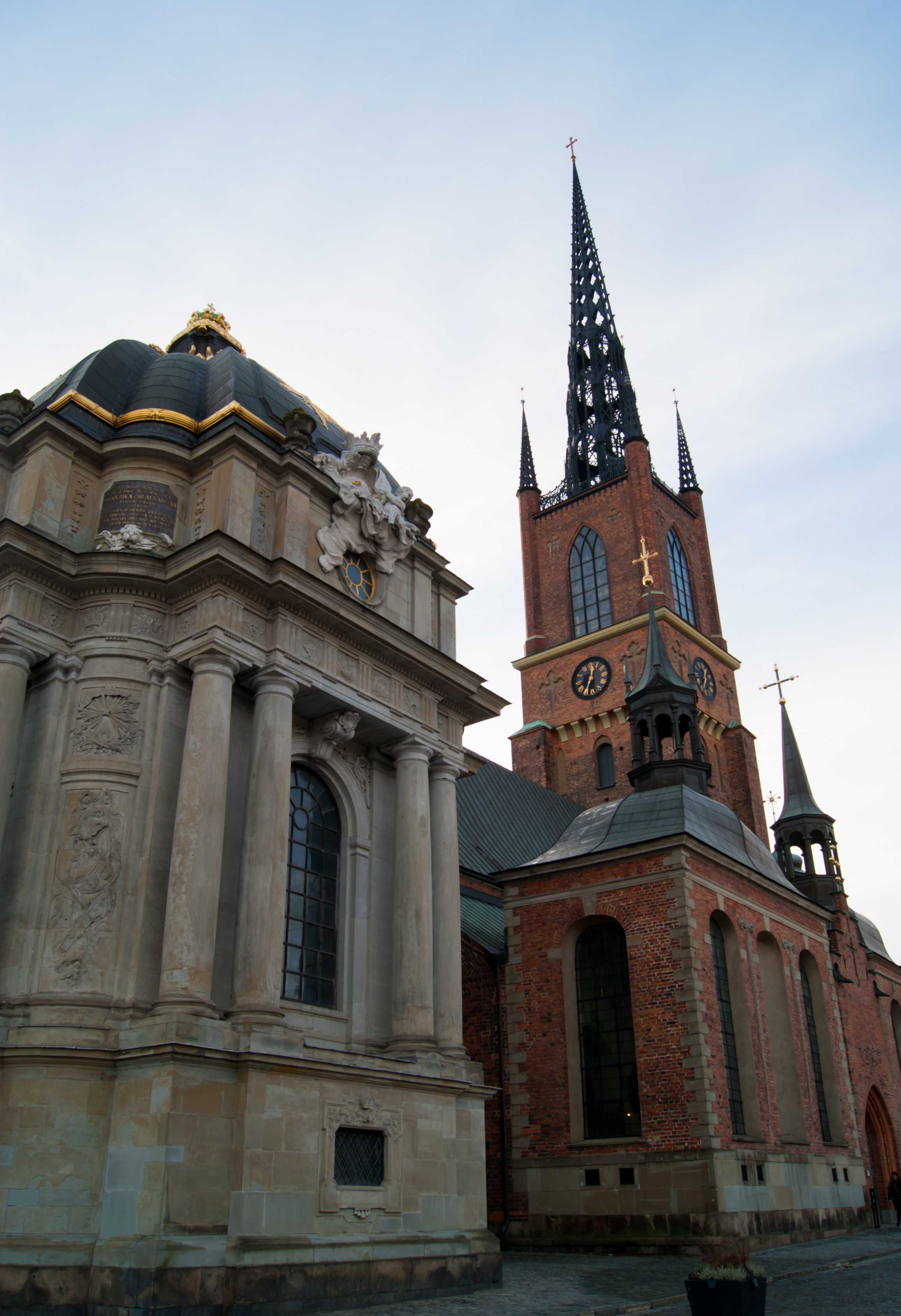
Riddarholmen Church
When a knight of the Royal Order of the Seraphim dies, church bells ring without pause for a full hour while pallbearers carry his coat of arms from the Royal Palace across the water to Riddarholmen Church. This ritual has continued for centuries in one of Stockholm's oldest buildings, a Gothic structure that began as a Franciscan monastery in the late 1200s and evolved into the final resting place of Swedish monarchs. The church's distinctive cast-iron spire, a dark needle against the northern sky, marks this island of the dead in the heart of the living city.
From Friars to Kings
Franciscan monks established their monastery on Riddarholmen in the late thirteenth century. The Greyfriars, named for their humble robes, built a church that would outlast their order by half a millennium. When the Protestant Reformation swept through Sweden, the monastery closed and the building became a Lutheran church. Its transformation from house of humble friars to mausoleum of monarchs reflects Sweden's own journey from Catholic kingdom to Protestant power. The architecture tells this story in stone: Northern European Gothic arches from the medieval period stand alongside Baroque additions from later centuries, creating an eclectic timeline in brick and mortar.
The Lightning Spire
The original spire was designed by Willem Boy, a Flemish architect who worked for King John III in the sixteenth century. It stood for over two hundred years until July 28, 1835, when lightning struck and destroyed it. The replacement spire, cast in iron rather than traditional materials, became one of Stockholm's most recognizable landmarks. This industrial-age solution to a medieval problem gave the church its current silhouette, the dark metal pointing skyward over the copper roofs of Gamla Stan. The spire's survival through nearly two centuries speaks to the durability of the unconventional choice.
Royal Resting Place
Swedish monarchs from Gustavus Adolphus, the warrior king who died at Lutzen in 1632, to Gustaf V, who reigned until 1950, lie entombed within these walls. Only one monarch from this span is missing: Queen Christina, who converted to Catholicism, abdicated her throne, and is buried in St. Peter's Basilica in Rome. Earlier kings rest here too, including Magnus Ladulas from the thirteenth century and Charles VIII from the fifteenth. The congregation was dissolved in 1807, and today the church serves only for burial and commemorative purposes. A newer Royal Cemetery now receives Sweden's monarchs, but Riddarholmen remains the historic heart of royal death.
Shields of the Seraphim
The walls of Riddarholmen Church are lined with armorial plates, hundreds of painted shields bearing the coats of arms of deceased knights of the Royal Order of the Seraphim. Sweden's highest order of chivalry, the Seraphim was founded in 1748, and its members include royalty and heads of state from around the world. When a knight dies, the bells ring from noon to one o'clock, and the coat of arms joins the growing collection on the church walls. Walking through the nave means walking through Swedish history rendered in heraldic symbollions, crowns, crossed swords, and family crests recording centuries of service and honor.
From the Air
Located at 59.32N, 18.06E on Riddarholmen island, immediately west of Gamla Stan and visible by its distinctive dark iron spire. The island sits between the Royal Palace to the east and City Hall to the northwest. Stockholm's archipelago stretches eastward into the Baltic. Stockholm Bromma Airport (ESSB) lies 7km west; Stockholm Arlanda (ESSA) is the primary international airport 40km north. The church's spire serves as an excellent visual reference point for navigating central Stockholm.