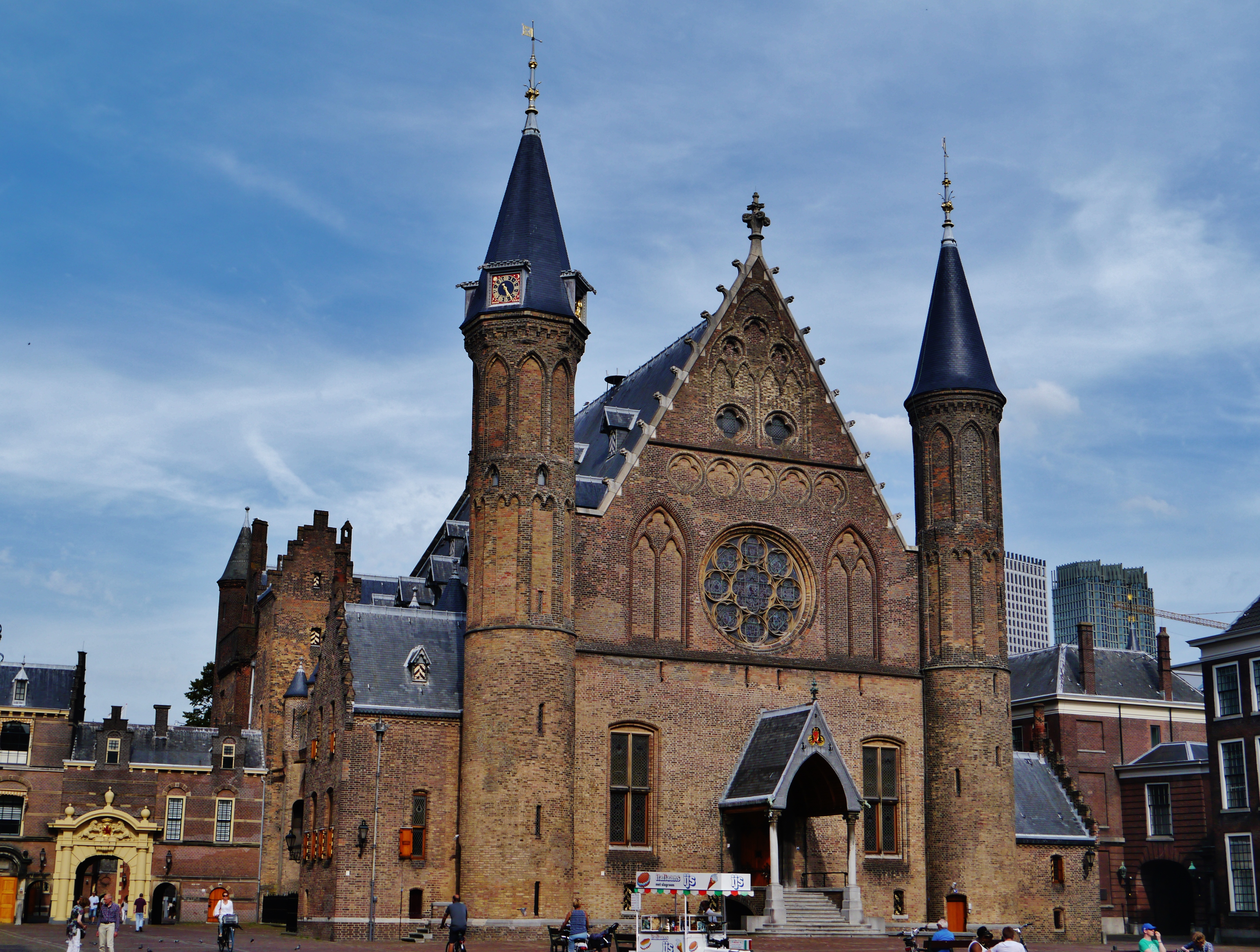
Ridderzaal
Every third Tuesday of September, the King of the Netherlands rides through The Hague in a glass coach, climbs down at the gates of the Binnenhof, walks into a Gothic hall built in the 1280s, sits on a throne, and reads his cabinet's policy plans aloud while wooden faces carved into the rafters stare down at him. The faces are called luistervinken - listeners. They are supposed to remind anyone speaking in this room that the higher powers are paying attention, and lying is unwise. This is the Ridderzaal, the Knight's Hall, and it has been doing this kind of work since before the Dutch had a country.
An Upturned Ship
Look up inside the Ridderzaal and you understand the sailors who built it. The roof is forty metres long, twenty wide, and held together by a single span of heavy oak timber arched like the keel of a ship turned upside down and laid over the room. There are no internal columns. The bare timber is dark with eight hundred years of woodsmoke and varnish. Floris IV, Count of Holland, bought the land in the 1230s. His grandson Floris V probably finished the hall in the 1280s. They were building a place for a count to receive vassals - a dining hall for nobles, a setting for the rituals that held a feudal state together. The stained glass rose window above the throne carries the coats of arms of the great Dutch noble families. The smaller windows hold the arms of cities. Walking in for the first time, you are standing inside a medieval mind's picture of what a country looked like, painted in glass and oak.
The Hall Forgets What It Was
For most of its long life the Ridderzaal was not used the way it was designed. After the counts moved on, the Dutch Republic took over and was not entirely sure what to do with a banqueting hall built for nobility nobody wanted to acknowledge anymore. In the 1600s, the room was crowded with booksellers and merchant stalls - much like Westminster Hall in London in the same period. The most important printers in The Hague kept their tables under that great timber roof. Over the following two centuries it served by turn as a market, a promenade for gentlemen on rainy afternoons, a drill hall for militia, a public records office, a hospital ward, and - improbably - the head office of the Dutch state lottery. Only between 1898 and 1904, in a major restoration, was the room cleared, scrubbed, and recommissioned for ceremony.
Where Europe Began
In May 1948 - three years after the war that nearly killed it - this same hall hosted the Congress of Europe. Seven hundred and fifty delegates filled the room, with observers from Canada and the United States looking on. Winston Churchill came. So did Konrad Adenauer, Paul-Henri Spaak, Altiero Spinelli, François Mitterrand. The conversation was about how to bind the continent so tightly together that another war between France and Germany would become not just unlikely but technically impossible. The proposals drafted in this hall - a Council of Europe, a European Court of Human Rights, an Assembly with real powers - became the bones of what is now the European Union. The next year, in 1949, the room hosted another negotiation about how empires end: the Dutch-Indonesian Round Table Conference, at which the Netherlands formally transferred sovereignty over its East Indies to the Republic of Indonesia. Two foundational events in modern political history, in the same room, eighteen months apart.
The Throne and the Coach
The throne in the Ridderzaal was designed by Pierre Cuypers - the same architect who gave Amsterdam its Central Station and the Rijksmuseum, two buildings the Dutch have made peace with at varying speeds. Every September the monarch sits on it. From 1898 until 2014 the Golden Coach carried the monarch to the gate; since 2015 the family has used the older Glass Coach instead, because of a long-running argument about a panel on the Golden Coach called Hulde der Koloniën - Tribute from the Colonies - which depicts colonised peoples kneeling in adoration before the Dutch crown. The painting reflected how nineteenth-century Dutch elites preferred to see their empire. It is not how Dutch people now want to see their monarchy. The coach is in restoration, the panel is in a museum, and the conversation about what to do with the image continues. The Ridderzaal absorbs the question and waits, as it has waited out every other question.
The Eavesdroppers
Walk to the centre of the hall and look up at the corbels that hold the great roof. Tucked into the carved foliage are the small wooden heads - the listeners. There are dozens of them. Bearded faces, smooth faces, faces with their mouths slightly open. The medieval idea was straightforward: when men gathered in a hall to swear oaths and make agreements, the higher powers were watching, and the wood was a reminder. Eight hundred years later, the room is still used to swear in monarchs, open parliaments, and host the negotiations that shape Dutch life. The faces are still up there. The lighting picks them out. Whether the King believes in them is between him and the rafters - but every politician who has stood under that ship-keel ceiling has, at some level, known the faces were there.
From the Air
Coordinates 52.0795°N, 4.3128°E, at the centre of the Binnenhof courtyard in central The Hague. The Ridderzaal is the small Gothic building with steep pitched roofs and two square turrets, in the middle of a rectangular courtyard. Recommended viewing altitude 1,500-2,500 ft. The Hofvijver pond lies immediately north. Nearest airport: Rotterdam The Hague (EHRD), about 11 nm south.