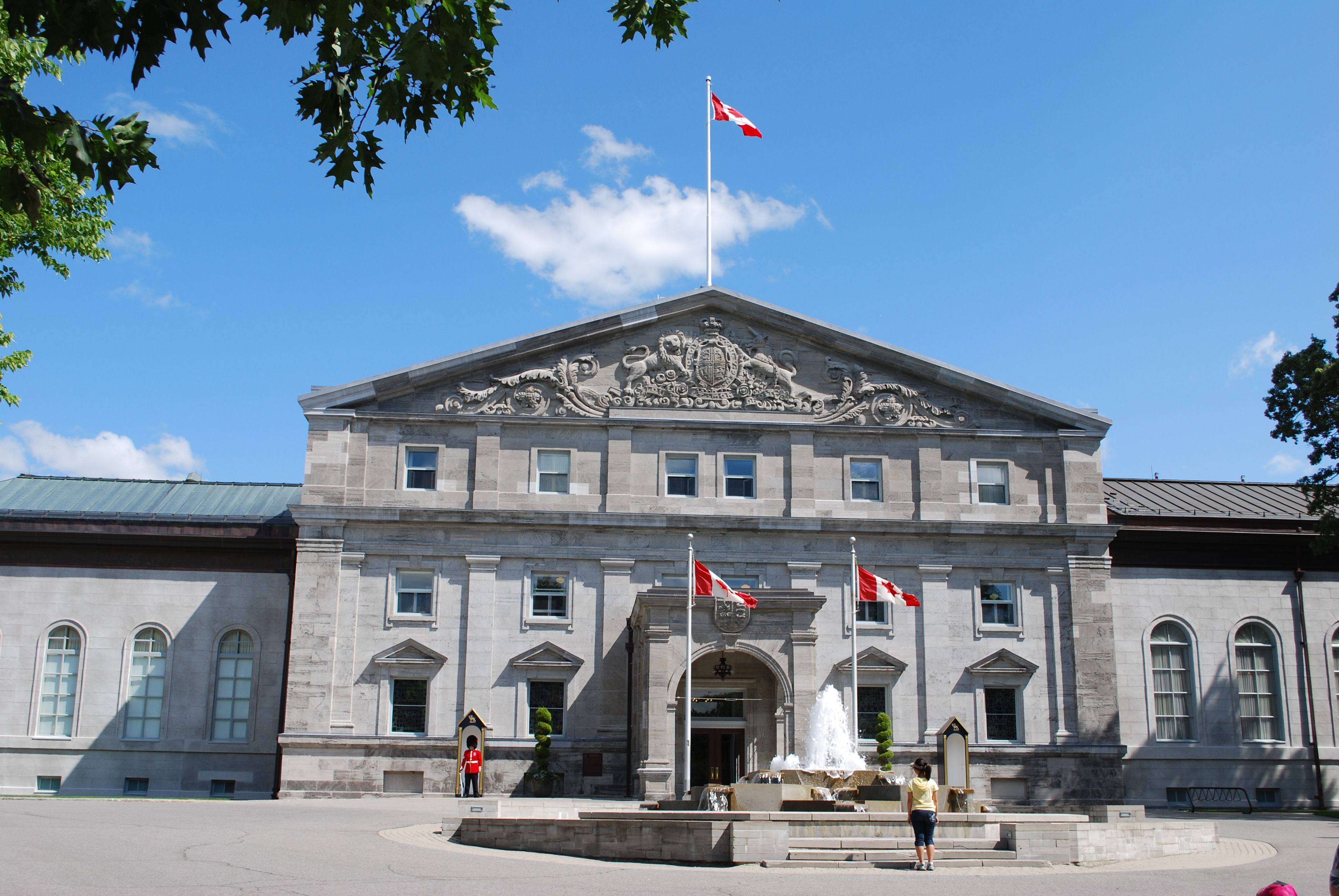
Rideau Hall
Every governor general who arrived at Rideau Hall hated it at first. The Countess of Dufferin confessed in 1872 that the sight of it "did lower our spirits just a little." Lady Stanley called it bare, lampless, cushionless. The Marchioness of Aberdeen dismissed it as a "shabby old Government House put away amongst its clump of bushes." And yet this perpetually criticized building at 1 Sussex Drive in Ottawa has served as the official residence of the monarch's representative in Canada since 1864 -- originally leased as a temporary arrangement for $4,000 a year, never replaced, and today a 175-room National Historic Site that welcomes 200,000 visitors annually.
McKay's Castle
The story begins with Thomas McKay, a stonemason who immigrated from Perth, Scotland, to Montreal in 1817 and became the main contractor on the Rideau Canal. After the canal was completed, McKay built mills at Rideau Falls, founded the neighborhood of New Edinburgh, and with his new wealth purchased a sweeping estate overlooking the Ottawa and Rideau Rivers. There, in 1838, he built a two-storey stone villa with a distinctive curved central bay -- a shape his stonemasons crafted specifically to demonstrate their advanced skills. Locals called it McKay's Castle. After Bytown was chosen as capital and cost overruns torpedoed plans for a proper Government House, the Crown leased McKay's villa in 1864 and purchased it outright in 1868 for $82,000. Prime Minister John A. Macdonald complained that more had been spent patching the place up than it would have cost to build a proper royal palace from scratch.
A Palace in Spite of Itself
Despite the grumbling, Rideau Hall steadily grew into the social center of Canada. The Marquess of Lorne and Princess Louise moved in as the first royal residents in 1878, and Lorne declared it "much superior to Kensington" for its thick walls and abundant heat. The ballroom went up in 1872, followed by a tennis court, and in 1913 the Mappin block unified the mismatched wings with a Florentine limestone facade bearing the largest rendition of the Royal Arms of the United Kingdom in the Commonwealth. Each generation's consort redecorated to her taste. The interiors shifted from heavy Victorian Rococo to predominantly Georgian with Adam and Palladian elements. Today the long gallery houses Chinoiserie artifacts collected by the Marchioness of Willingdon in 1926 and a Steinway baby grand piano that once belonged to Glenn Gould. Sterling silver on display in the state dining room is on loan from Buckingham Palace.
Wartime Refuge
When King George VI and Queen Elizabeth arrived at Rideau Hall on May 19, 1939, historian Gustave Lanctot declared that "the Statute of Westminster had assumed full reality: the King of Canada had come home." Within months, the world was at war, and the hall became a refuge for displaced European royals. Crown Prince Olav and Crown Princess Martha of Norway, Grand Duchess Charlotte of Luxembourg, King Peter II of Yugoslavia, King George II of Greece, Empress Zita of Austria, and Queen Wilhelmina of the Netherlands with her daughter Princess Juliana and granddaughters all found shelter under its roof. Princess Alice, Countess of Athlone, put the royal ladies to work sewing clothes for Blitz victims. In December 1941, Winston Churchill arrived and ran British Cabinet meetings by telephone from his bed. He returned in 1952, where -- sprawled on a sofa with a cigar in one hand and a brandy in the other -- he persuaded the governor general to leave Ottawa and join the British Cabinet.
Open Gates, Closed Gates
The grounds have been open to the public since 1921, when Lord Byng of Vimy's aide-de-camp resolved to admit "all who had a right to be there," outraging traditionalists. That tradition ended abruptly in 1984, when Governor General Jeanne Sauve closed the gates on security grounds -- despite having earlier promised they would stay open. A protest group calling itself the Canada Unlock the Gate Group formed, accusing Sauve of a "bunker mentality." Her successor, Ray Hnatyshyn, reopened the grounds. In 2020, during pandemic closures, a former soldier drove his truck through a pedestrian gate, hid in the rose garden, and was arrested near the greenhouses while armed -- reportedly intending to "arrest" the Prime Minister. Neither the governor general nor the Prime Minister, who lives in nearby Rideau Cottage while 24 Sussex Drive is renovated, was on the property.
The Second Most Photographed Room in Canada
The ballroom of Rideau Hall is where prime ministers take their oaths, where the Order of Canada is bestowed, and where the governor general swears in the Cabinet. It is the second most photographed and televised room in the country, behind only the House of Commons. Adrienne Clarkson restored its powder blue walls with beige marbleized pilasters and gilt highlights between 1999 and 2005, stripping away a monochrome scheme from the 1970s to bring the room closer to its original 1872 appearance. Of the palace's 9,500 square metres, only 500 are dedicated to private living quarters. The rest belongs to affairs of state: some 200 events each year, from investitures and diplomatic audiences to garden parties where children trick-or-treat on Halloween. It remains the only one of Canada's six official residences in the National Capital Region open to the public -- the perpetual temporary arrangement that became permanent, the house nobody loved that became indispensable.
From the Air
Located at 45.444N, 75.686W on a large wooded estate at 1 Sussex Drive, Ottawa. The property's 27 outbuildings and extensive grounds are visible from the air east of Parliament Hill, between the Ottawa and Rideau Rivers. Nearby airports include Ottawa/Macdonald-Cartier International (CYOW, 10 km south) and Gatineau-Ottawa Executive (CYND, 8 km north). The Rideau Canal, Rideau Falls, and Parliament Hill provide strong visual navigation references. Best viewed at 2,000-3,000 feet where the estate grounds and roofline are distinguishable from surrounding New Edinburgh neighborhood.