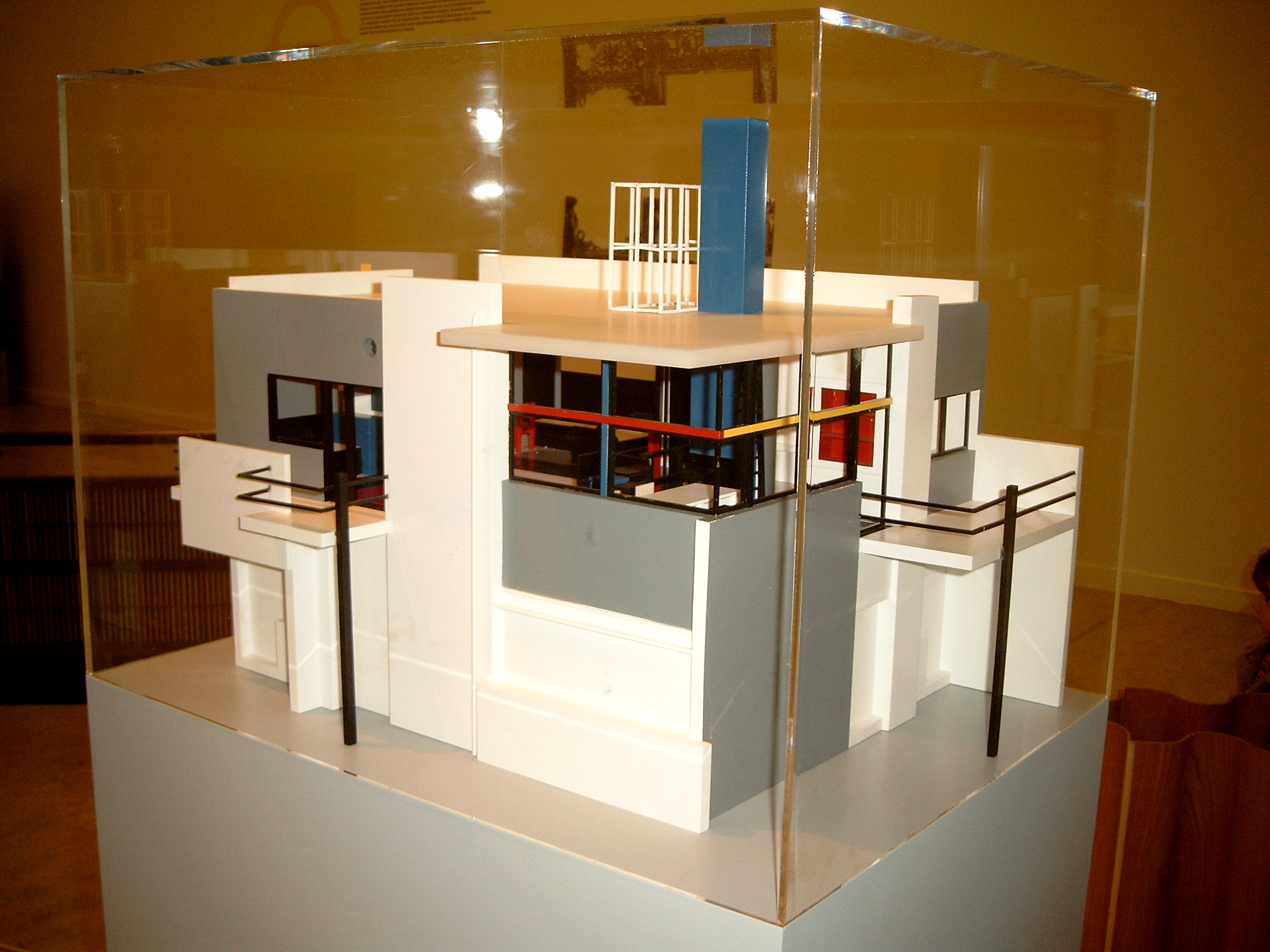
Rietveld Schröder House
Truus Schröder-Schräder, a widow raising three children in 1924 Utrecht, walked into the studio of cabinetmaker-turned-architect Gerrit Rietveld with a strange request. She wanted a house, but she preferred not to have walls. Rietveld brought her his first sketch. She was not pleased. Over months of arguments and revisions they designed the building together, sometimes Schröder at the drafting table and Rietveld at her elbow. What they finished is a small two-story house at the dead end of Prins Hendriklaan - a building that is now on the UNESCO World Heritage list, that appears on euro coins, and that almost no one builds houses like even a century later. They called it openness; the city of Utrecht called it a violation of fire code.
The Client Who Designed Her Own House
Schröder-Schräder is too often footnoted as the woman who commissioned the Rietveld Schröder House. She did not commission it so much as co-author it. Both architect and client subscribed to progressive social ideas about families - that bourgeois notions of respectability, hierarchy, and emotional containment could be undone by the spaces people lived in. Schröder wanted a house where the walls did not enforce the rules. She was specific: she wanted the inside to connect to the outside, no associations with the houses of her parents' generation, no boxes within boxes. The final design has her fingerprints all over it. She lived in the house until her death in 1985, sixty-one years after moving in.
A Second Floor That Disappeared
The trick that makes the Schröder House work was a regulatory dodge. Utrecht's planning authorities required interior walls in any residential floor; Rietveld and Schröder declared the upper floor an 'attic' to escape that rule. The 'attic' is in fact the heart of the building: a single large room subdivided by sliding and pivoting panels. With the panels open, the upper floor is one continuous space - kitchen flowing into living room flowing into the children's bedrooms. With the panels closed, it becomes a conventional plan of three bedrooms, a bathroom, and a living room. Schröder used the panels to reconfigure her family's life every evening: open during the day for shared meals and conversation, partitioned at night for privacy. A sliding wall between the living area and her son's room covered a cupboard and a light switch, so Rietveld cut a small round opening in the panel - one of the most charming workarounds in twentieth-century architecture.
De Stijl, in Three Dimensions
The facade is De Stijl made buildable. The movement - the same circle of Dutch artists that produced Piet Mondrian's grid paintings - had spent years trying to translate its principles of rectilinear lines and primary colors from canvas into the physical world. The Schröder House is widely considered the only true De Stijl building, the place where the manifestos finally became architecture. White and gray planes detach from each other as if drifting; black window frames slice across them; thin steel beams in red, yellow, and blue jut out like the brushstrokes of one of Rietveld's chairs scaled up to human size. The windows are hinged so they can only open to ninety degrees against the wall, preserving the geometry whether they are open or closed. Even the corner window opens fully outward, dissolving the building's corner so the rooms inside seem to open onto the street.
Brick Pretending to Be Concrete
For all its visual radicalism, the Schröder House is a modest building. Rietveld originally wanted to build it in poured concrete, the material of the new century. He could not afford to. Only the foundations and balconies are concrete; the walls are ordinary brick covered in plaster, the floors are wood on wooden beams, the structure is steel girders backed by wire mesh. The house cost less than many of the conventional row houses on the same street. Truus Schröder included a garage in the design - architecturally important, practically absurd, because she did not own a car. The Schröder House has been called the world's most influential small building, and it is small: just over a hundred square meters of floor space, jammed against the end of a terrace it makes no effort to harmonize with.
What Survived
Mrs. Schröder lived in the house for sixty-one years. After her death in 1985 it was restored by Bertus Mulder and transferred to the Centraal Museum, which still operates it as a museum where visitors can see the sliding panels reconfigured in real time. UNESCO inscribed it on the World Heritage list on December 2, 2000, citing criteria for outstanding universal value as the most exemplary work of De Stijl. In 2013 the Royal Dutch Mint put the house on two 5-euro coins. From the front the building still looks like a 1924 sketch that has accidentally been built at full scale - the planes still glide past each other, the windows still hinge ninety degrees, and the city it faces, now buffered by a 1960s motorway, no longer looks anything like Utrecht did when Truus Schröder asked for a house without walls.
From the Air
Located at 52.085 N, 5.148 E in eastern Utrecht, just south of Wilhelminapark and east of the city center. The site sits at the end of a terraced row on Prins Hendriklaan, hard against a 1960s motorway. From cruising altitude the building is too small to identify, but Utrecht itself is easily picked out by the Dom Tower roughly 2 km west. Nearest major airport is Amsterdam Schiphol (EHAM), about 38 km northwest. Rotterdam The Hague (EHRD) lies about 55 km southwest.