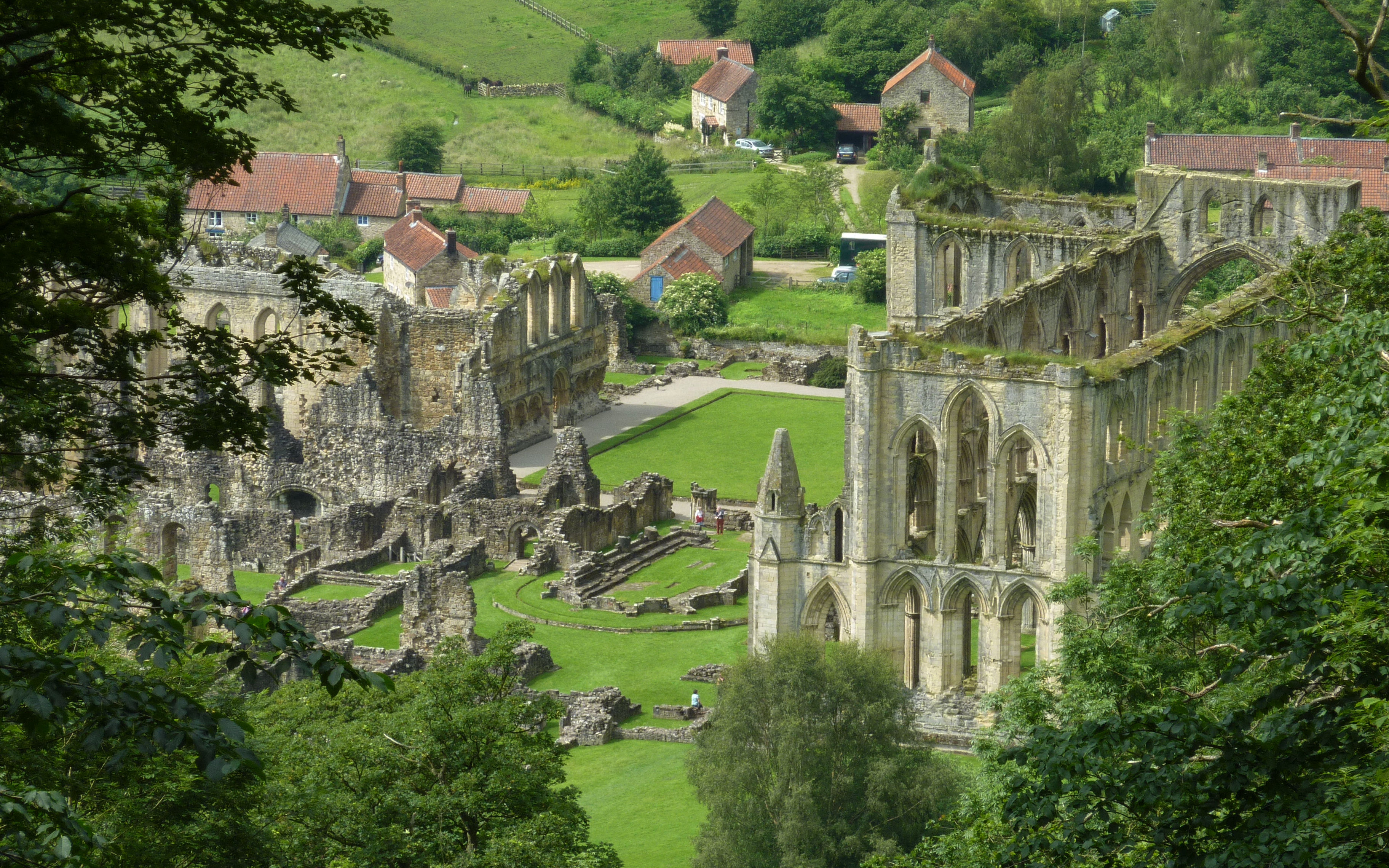
Rievaulx Abbey
Twelve monks walked into a valley in 1132 and changed the landscape. They came from Clairvaux Abbey in France, sent to establish the first Cistercian monastery in the north of England. The valley they chose, tucked beside the River Rye near Helmsley in the North York Moors, was remote, wooded, and unsuitable for farming in its natural state. They would make it suitable. Within a generation, Rievaulx Abbey would become one of the wealthiest and most influential monasteries in England.
Aelred's Abbey
The first abbot, William, started construction in the 1130s, but it was his successor who made Rievaulx extraordinary. Aelred of Rievaulx, later canonized as a saint, became abbot and transformed the community. Under his leadership, the abbey grew to approximately 140 monks and 500 lay brothers. Aelred was a writer and theologian whose works on friendship and spiritual life circulated across Europe, but he was also a practical administrator who expanded the abbey's buildings and established five daughter houses in England and Scotland. The monks needed flat ground to build on, so they diverted the River Rye to the west. They would alter its course twice more during the twelfth century. The old river channels are still visible in the abbey grounds, evidence of the technical ingenuity that characterized the Cistercian approach to landscape. What the monks could not grow, they mined: lead and iron ore from the surrounding hills. What they could raise, they sold: Rievaulx's wool, from flocks of sheep grazing six thousand acres of granted land, was exported to buyers across Europe.
The Long Decline
Prosperity did not last. By the end of the thirteenth century, the abbey had incurred debts from ambitious building projects and lost revenue to an epidemic of sheep scab that devastated its flocks. Scottish raiders struck in the early fourteenth century. Then came the Black Death. The great reduction in population across England made it nearly impossible to recruit new lay brothers for the manual labor on which the Cistercian economy depended. The abbey was forced to lease much of its land. By 1381, only fourteen choir monks, three lay brothers, and the abbot remained at Rievaulx. Buildings were reduced in size. By the fifteenth century, the strict observance according to the Rule of Saint Benedict had been quietly abandoned. The monks were permitted to eat meat. Private living quarters replaced communal dormitories. The abbot maintained a substantial personal household in what had once been the infirmary. Rievaulx was still functioning, but it was no longer the austere, self-sufficient community that Aelred had built.
Dissolution and Iron
When Henry VIII's commissioners arrived in 1538, they found 72 buildings occupied by the abbot and 21 monks, supported by 102 lay employees and an income of 351 pounds a year. Among the abbey's assets was a remarkable piece of technology: a prototype blast furnace at Laskill that produced cast iron as efficiently as any modern furnace. It was an achievement the monks would not live to see recognized. As was standard procedure, the confiscated buildings were stripped of their lead, their valuables removed, and their roofs opened to the sky to ensure they could never be used again. The site was granted to Thomas Manners, 1st Earl of Rutland, and eventually passed to the Duncombe family. In the centuries after the Dissolution, Rievaulx became an important iron-manufacturing site, the monks' industrial legacy outlasting their spiritual one.
The Valley Endures
The ruins that survive are among the most atmospheric in England. The soaring arches of the presbytery, rebuilt in the Early English Gothic style in the thirteenth century, still stand to their full height, their empty windows framing the wooded hillsides beyond. The chapter house foundations trace the space where monks gathered daily. The infirmary walls mark where the abbot eventually made his private quarters. In the twentieth century, the abbey was taken into state care and is now managed by English Heritage. A 2015 archaeological survey using aerial photography created a digital surface model of the entire precinct, revealing earthworks and structures invisible from the ground. When former Prime Minister Harold Wilson was awarded a life peerage in 1983, the Yorkshireman chose the title Baron Wilson of Rievaulx, an acknowledgment that this valley, where twelve monks once redirected a river and built an empire of wool and stone, still carries weight in the English imagination. The Cleveland Way long-distance footpath passes just south of the abbey. Walkers who pause at the viewpoint on Rievaulx Terrace, a landscaped promenade built by the Duncombes in the eighteenth century, look down on the same scene that has drawn visitors for three hundred years: grey stone arches rising from a green valley, impossibly beautiful, impossibly ruined.
From the Air
Located at 54.26N, 1.12W in a narrow wooded valley of the River Rye, near Helmsley in the North York Moors National Park. The abbey ruins are set in the valley floor and best identified from lower altitudes. Rievaulx Terrace (National Trust) overlooks from the hillside above. Nearest airports: EGNM (Leeds Bradford) approximately 35 miles southwest; EGNV (Teesside International) approximately 25 miles north. The surrounding terrain is hilly moorland and woodland.