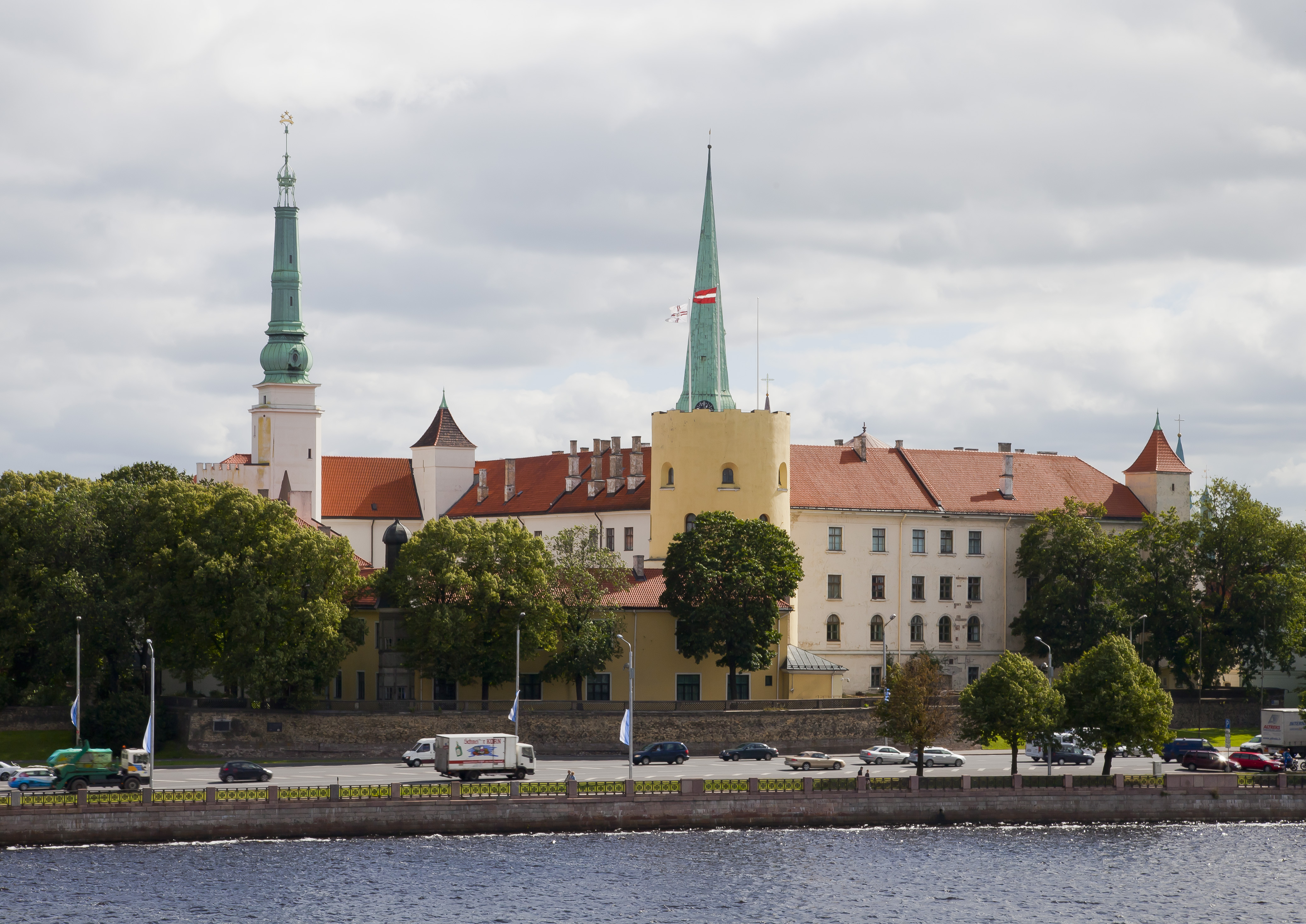
Riga Castle
On the night of 20 June 2013 — the longest day of the year — Riga Castle caught fire. Flames consumed about 3,200 square meters of the building, mostly the palace roof and attic, before 79 firefighters and a fleet of trucks finally got the blaze under control. President Andris Bērziņš called it a national tragedy. The castle had survived the Livonian Order's collapse, Polish and Swedish occupations, the artillery of the Russian Empire, two world wars, and Soviet rule. It had even survived heavy shelling by White Russian forces during the Latvian War of Independence in 1919. But on a quiet summer night, an electrical fault in an air conditioner did what centuries of war had not.
Built Beyond the Walls
Riga Castle exists because the people of Riga rebelled. In the 13th century, the citizens rose against the Livonian Order — the German military-religious organization that ruled the region — and demolished the Order's original castle in the center of town. The Order needed a new headquarters, but constant friction with the Rigans made building inside the walls impractical. So in 1330, the Order chose a site on the banks of the Daugava River just outside the city walls. The Convent of the Saint Spirit, a hospital and shelter for the poor, was relocated to the site of the demolished old castle, and the Order took over the convent's land for its new fortress. The castle served as the residence of the Master of the Livonian Order — at least until friction with the Rigans grew so persistent that the residence was moved to the Castle of Cēsis. Then in 1484 the Rigans destroyed it again. They lost the resulting fight, were forced to rebuild it themselves, and finished the work in 1515.
Five Empires
After 1561 the castle changed hands five times in three centuries. The Treaty of Vilnius dissolved the Livonian Order in that year, and the castle became Lithuanian property. By 1569 it was Polish-Lithuanian, with the formation of the Commonwealth. In 1621 the Swedes took Riga, and the castle housed the Swedish administration through the 17th century — when it was almost continually under construction, with new wings, new towers, and an Arsenal added in 1682. Russia took the city in the early 18th century during the Great Northern War, and the castle housed the administration of the Riga Governorate, which covered most of present Latvia and Estonia, and served as the residence of the Russian governors-general. Then independent Latvia emerged from the wreckage of the Russian Empire in 1918, and in 1922 the castle became the official residence of the President of Latvia. Each occupier left their mark in stone.
Soviet Pioneers, Latvian Presidents
Latvian independence ended in 1940 with Soviet occupation. The castle housed the Council of People's Commissars of the Latvian SSR for a single year before German forces took the city in 1941. The Young Pioneer organization established a Pioneers Palace in the northern wing during the Nazi occupation — the irony of children's communist youth activities operating in the castle of the former Latvian president was apparently not noted at the time. After 1945 the castle returned to Soviet use and became a museum complex through the long Soviet period. Then in 1991, when Latvian independence was restored, the northern wing once again became the President of Latvia's residence. The southern wing continued to house the National History Museum, the Foreign Art Museum, and other state collections. The arrangement worked. The castle was both a working presidential residence and a major museum, with the president sometimes walking through the museum spaces on official business.
The Fire and After
Restoration work was already underway in 2012 when fire broke out in the early hours of 21 June 2013. Workers had left at 18:45 the previous evening. By 22:21 the flames were visible. The State Fire and Rescue Service mobilized 79 rescuers, 11 tanks, three ladders, a platform, and three specialized vehicles. The fire was concentrated in the palace roof and the attic. Around 3,200 square meters of the structure were destroyed, with 2,400 of those being roof and attic above the historic halls. The National History Museum collections, which spread across most of the building, were not destroyed by the fire — but parts of them were damaged by the water used to fight it. The Telegraph called it Latvia's worst cultural disaster in decades. Rebuilding took years. Today the castle is restored and once again serves as the official residence of the President of Latvia, alongside the museums in its southern wings. From the river it presents the same silhouette it has shown for nearly seven centuries: pale walls, square and round towers, the Daugava flowing past below.
From the Air
Riga Castle stands at 56.95°N, 24.10°E, on the right bank of the Daugava River in central Riga, Latvia. From altitude the castle appears as a complex of pale walls and towers at the river edge, with the Old Town spreading to the east. The cathedral spires and the spire of St. Peter's Church dominate the immediate skyline. EVRA (Riga International Airport) is 10 km southwest. EETN (Tallinn) lies 280 km north. ULLI (St. Petersburg Pulkovo) is 480 km northeast. The Daugava River meets the Gulf of Riga about 12 km north of the castle. Best viewed at 3,000 to 5,000 ft on approach to or departure from EVRA. The river bends and the medieval street pattern of central Riga make orientation easy.