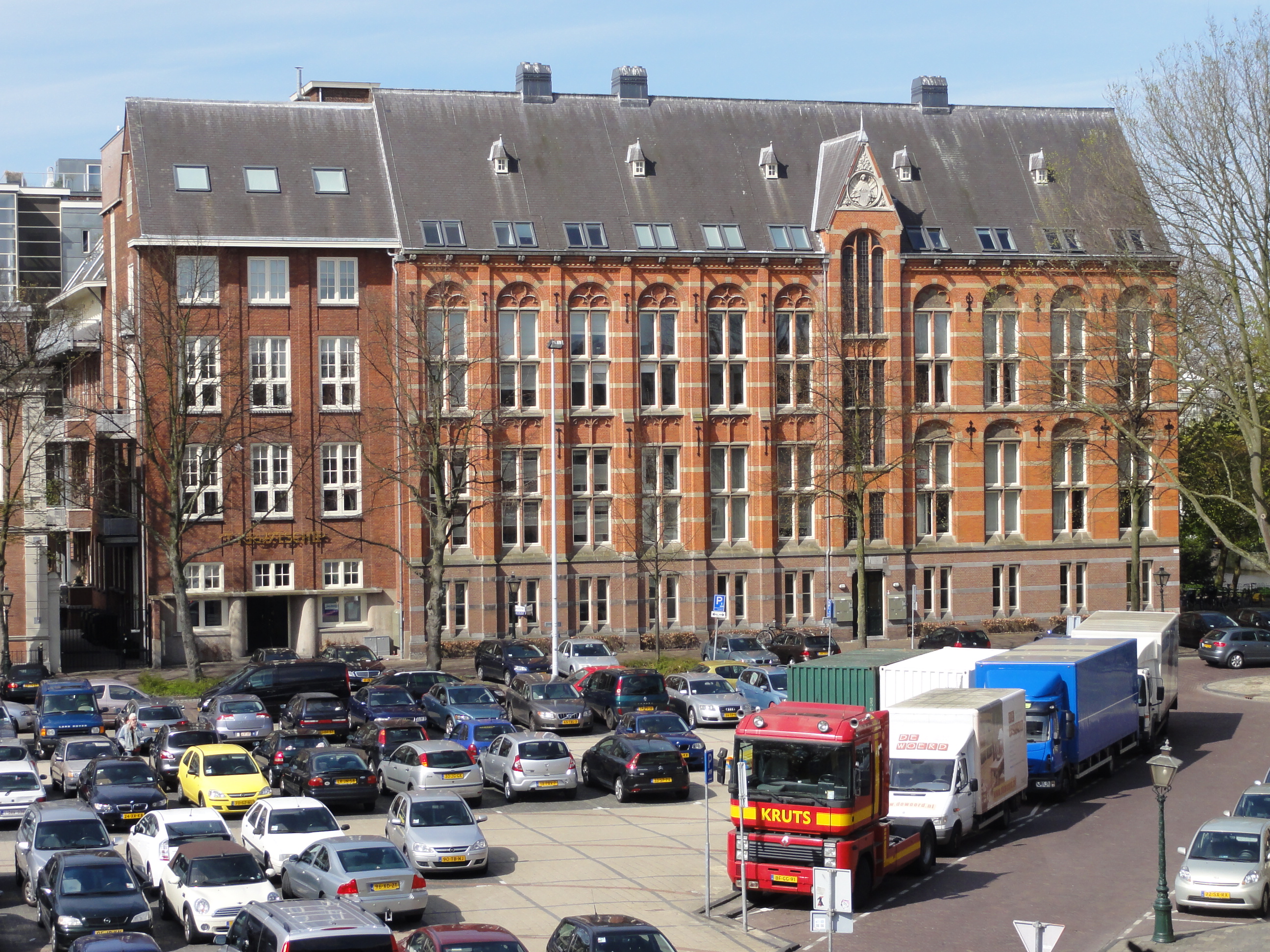
Rijksmuseum van Geologie en Mineralogie
In 1881, crates began arriving in Leiden from the Mining Survey of the Netherlands East Indies. Inside: fossils dug from Java's volcanic clays, rocks from sulfur mines on Sumatra, bryozoans from the limestone reefs of the Moluccas. They piled up in a back room of the natural history museum, where a young German geologist named Karl Martin sorted them by formation. By 1893 the geological collections had outgrown their host and moved into their own building at the Garenmarkt - and the Rijksmuseum van Geologie en Mineralogie, the Dutch national museum of geology and mineralogy, became an institution in its own right. It would stay that way for ninety-one years.
A Director Named Martin
Karl Martin was twenty-five in 1877 when Leiden offered him the chair of geology. The recommendation came from Hermann Schlegel, director of the natural history museum, who needed someone to take charge of the geological collections that had been gathering dust since 1820. Martin accepted. For the next forty-four years he ran the place. He travelled - in 1884 and 1885 he made an enormous collecting trip through Aruba, Curaçao, Bonaire, Suriname, and Venezuela, returning with over 800 specimens. Years later he went to the Moluccas in the East Indies and brought home 1,063 more. He bought what he could not collect. From Carl Semper came a Philippines suite; from various dealers came series from Java and Madura. Under Martin the museum's character set: a national collection of Dutch and colonial-era field geology, anchored in the tropical Tertiary.
The Garenmarkt Building
Independence came on a calendar date. In 1893 the collections left the natural history museum and crossed Leiden to a new home at the Van der Werffpark on the Garenmarkt. From that moment the museum was no longer a department of someone else's institution. Martin had his own walls. The building lent itself to display - geological cabinets ran along the galleries, rocks under their formations, fossils under their epochs, type specimens marked by red labels visible from across the room. It was the building where generations of Leiden geology students learned to read stratigraphy. By 1966 the collection had outgrown that building too, and moved to the Hooglandse Kerkgracht - the museum's third home in less than a century.
Escher in the Alps
The Escher who succeeded Martin in 1922 was Berend George Escher - half-brother of the artist M. C. Escher. Berend was a serious field geologist who shifted the museum's focus toward Europe. He led student excursions to the porphyry districts near Lugano, into the Bergamasc Alps, south into the Apennines and the Turin Hills. Every trip ended with specimens crated and shipped back to Leiden. Through the interwar years and after, his staff worked classical regions in Germany, France, and England. After the Second World War the geography widened: Sweden's Dalsland, the Belledonne massif of the French Alps, Spain's Cantabrian Mountains, Morocco, even Suriname. The collection grew thicker and more international with each thesis defended.
Mammals from the Mud
In 1946 a curator named A. Brouwer took charge of the paleontology department. He had a theory: the Netherlands itself was full of fossils, and someone needed to go get them. Brouwer travelled the country buying private collections from amateur geologists, going out on his own digs in the river clays of Tegelen, where the Pleistocene mammal beds preserve mastodon teeth and rhinoceros vertebrae. Two large gifts arrived in this period - A. B. van Deinse's cetacean remains from the eastern Netherlands, full of stranded-whale skulls dating back centuries, and the Steyl collection, the type material for the Tiglian, an early Pleistocene stage named for the Dutch village of Tegelen. The collection grew into one of Europe's richest archives of recent vertebrate fossils.
Beets and the National Museum
Cornelis Beets arrived as director in 1963 with a mission: make the Rijksmuseum van Geologie en Mineralogie not just a name but the actual Dutch national geological museum and center of research. He launched field campaigns in the Winterswijk-Almelo region, in the Neogene fissures of Gargano in southern Italy, and across the wider world - Canada, Jamaica, El Salvador, Algeria, Sri Lanka, Australia. Donations poured in. Shell handed over 6,300 samples and 5,000 thin sections from the Oman Mountains. Billiton donated thousands of ore samples and a thousand drilling cores from the Mbeya carbonatite of Tanzania. By the time Beets resigned in 1977 the museum was a major international research center.
Into Naturalis
In 1984 the Rijksmuseum van Geologie en Mineralogie merged with its older sibling, the Rijksmuseum van Natuurlijke Historie. Two collections that had separated in 1893 were now reunited, and together they formed the institutional core of what would eventually open in 1998 as Naturalis. The mosasaur skeletons, the Pleistocene mammals, the Tertiary fossils from Java that Karl Martin had first sorted in the 1880s - all of it now sits in the modern galleries on the eastern edge of Leiden, displayed beside the natural history collections that had once been their host. The building at the Garenmarkt still stands. The collections inside it have moved on.
From the Air
Coordinates 52.155°N, 4.492°E in Leiden, Netherlands. The former Garenmarkt building (1893-1966) and the Hooglandse Kerkgracht building (1966-1984) both lie within the old city of Leiden, with their successor Naturalis sitting on the eastern edge near the railway station. About 12 km north of The Hague (EHRD) and 30 km southwest of Schiphol (EHAM). Best viewed from 1,500-3,000 ft on approach to Schiphol from the south.