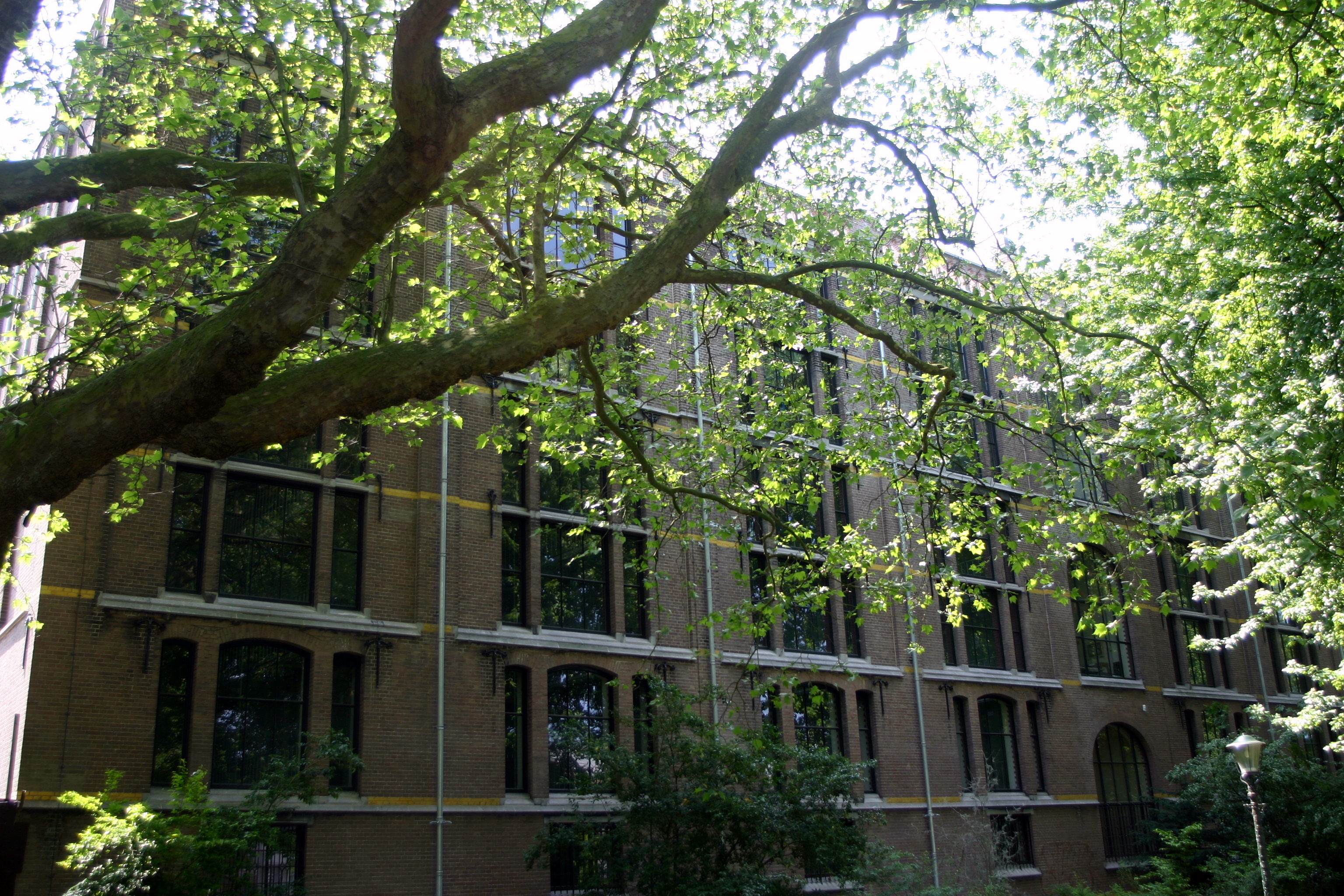
Rijksmuseum van Natuurlijke Historie
The world's most complete Tyrannosaurus rex skeleton lives in Leiden. Trix - sixty-six million years old, roughly eighty percent intact by bone volume, every major bone present including a near-perfect skull - is the headline exhibit at Naturalis, the Dutch national natural history museum. But Trix is the latest chapter in a much older story. The museum she anchors began in 1820 inside a converted Leiden hofje, when a Dutch ornithologist named Coenraad Jacob Temminck convinced King Willem I that the new kingdom needed a place to put its specimens. The collections that grew from that single room would help name dinosaurs, sort the world's birds into families, and produce one of the most famous fossil hominins ever found.
A Hofje on the Rapenburg
The site that became the museum was originally the Hof van Zessen, a hofje - one of the small almshouse courtyards that still thread through old Dutch cities. In 1815 plans began for a museum on the property, the first building in Leiden to carry the word museum on its front. It opened in 1820 by Royal Decree, merging several existing university collections with Temminck's personal one. Temminck, who served as director until 1858, saw the place primarily as a research institute for the University of Leiden, not a public attraction. Through the nineteenth century the doors opened on Sundays. Most days the collections served the scientists who worked among them, naming species, dissecting specimens, comparing the bird that just arrived from Java with the bird that arrived from Madagascar the year before.
Java Man
Eugène Dubois sent his fossils here. In 1891 and 1892, working in central Java, Dubois unearthed a skullcap, a femur, and a tooth that belonged to a hominin neither human nor ape - a creature he named Pithecanthropus erectus and the world came to call Java Man. Today the fossils are classified as Homo erectus, and they were the first early hominin remains found anywhere outside Europe. Dubois carried them home and deposited them in Leiden. They are still there. To stand in front of a small dark skullcap behind museum glass and know that this is the bone whose discovery launched the modern search for human origins - that this Dutch museum holds the first physical evidence that humans evolved somewhere east of Eden - is one of those moments where a quiet provincial building suddenly opens onto a global story.
Temminck's Network
Nineteenth-century natural history was built on networks of collectors, and Leiden's was one of the best. Philipp Franz von Siebold sent material from his years in Nagasaki, where he was nearly the only European in Japan; the Leiden collection still holds his fish, his mollusks, and the seed cases of plants he smuggled out under the noses of the Tokugawa officials. Heinrich Boie and Heinrich Christian Macklot died on expedition in the Dutch East Indies, their specimens shipped back to colleagues they would never see again. François Le Vaillant's southern African birds, Hermann von Rosenberg's New Guinea collections, and Pieter Bleeker's enormous catalog of Indian Ocean fish all came through Leiden. Behind every drawer of pinned beetles is a man who travelled in the heat for years, and behind every cabinet is a colonial supply chain - facts the museum's modern descendant now works to address honestly.
The Long Closure
Public access to the collection was always uneven. The original Sundays-only schedule lasted nearly a century. In 1913 the museum moved to a cramped new building near the Raamsteeg, and in 1950 the small remaining exhibition rooms closed entirely. For thirty-six years the Rijksmuseum van Natuurlijke Historie operated as a research collection without a public face. Stephen Jay Gould, visiting in the 1980s, described his trip to the Raamsteeg building in his essay Four Antelopes of the Apocalypse - the kind of museum where you needed permission, a key, and the right scientist's nod to walk down the corridor. A 1976 paper called Towards a New Museum proposed re-opening, but the actual reckoning came in 1984, when the Rijksmuseum van Natuurlijke Historie merged with its sister institution, the Rijksmuseum van Geologie en Mineralogie.
From Cabinet to Naturalis
The merger needed a building large enough to display two centuries of accumulated science. Construction began in the late 1980s on a new site on the eastern edge of Leiden. It opened in 1998 as Naturalis. Today the institution holds roughly 42 million specimens, making it one of the larger natural history collections in the world. Trix arrived in 2014, excavated from Montana and shipped to the Netherlands by a Dutch team that found her on private land and negotiated the purchase before any American museum could move. She is the only T. rex with its original skull mounted on its original skeleton on display in continental Europe. The Temminck building on the Rapenburg, the museum's original home, now houses the Rijksmuseum van Oudheden - the national antiquities collection. Same hofje, different cabinet.
From the Air
Coordinates 52.158°N, 4.486°E in central Leiden, Netherlands, roughly 12 km north of The Hague and 30 km southwest of Schiphol. The original 1820 building (now Rijksmuseum van Oudheden) sits along the Rapenburg canal; the modern Naturalis facility lies on the eastern edge of the old city near the railway station. Best viewed from 1,500-3,000 ft on Schiphol (EHAM) approaches from the south, or from Rotterdam-Hague (EHRD) departures.