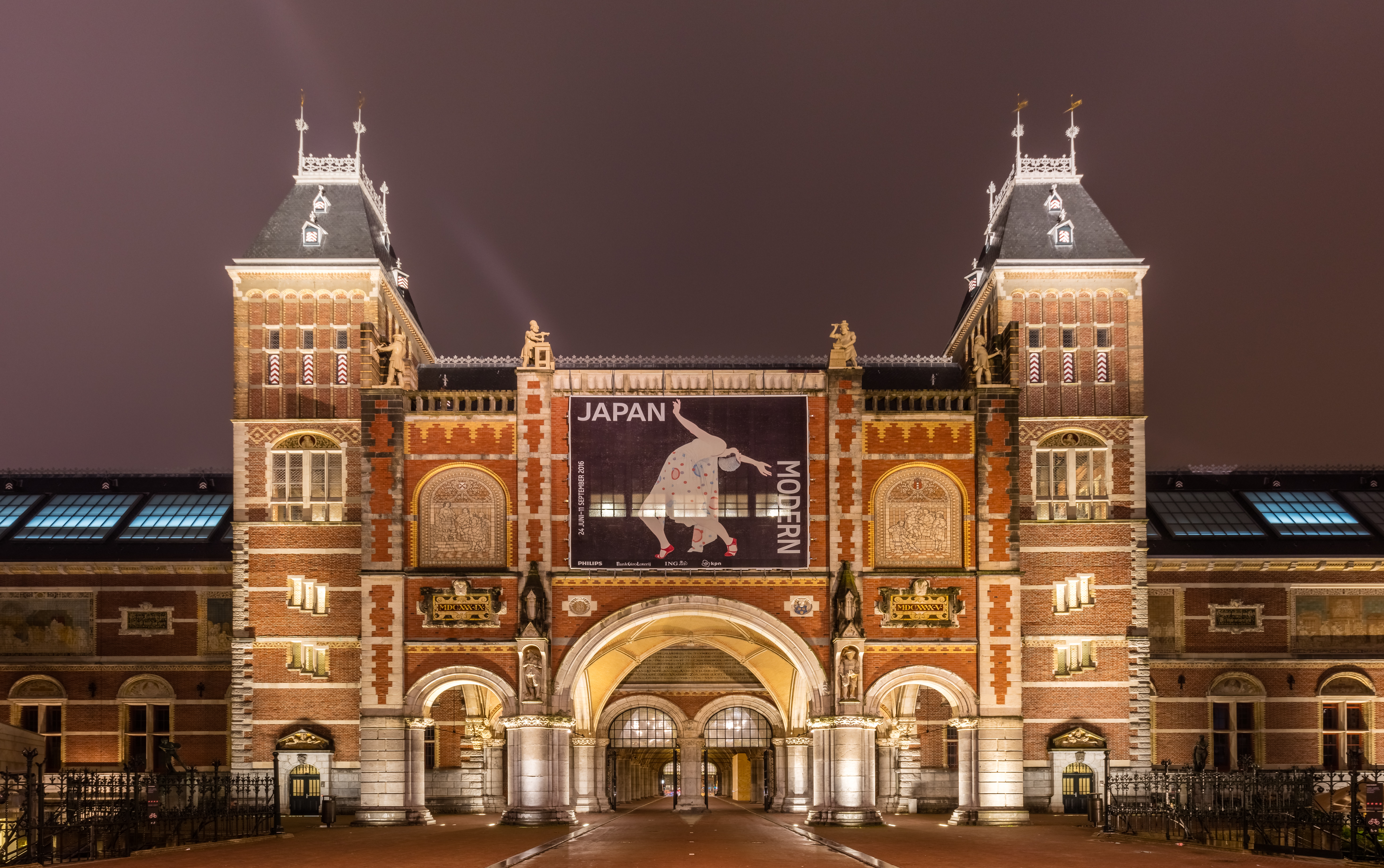
Rijksmuseum
The first design contest for a new Rijksmuseum was held in 1863. Pierre Cuypers entered and came in second. The jury didn't think any of the submissions was good enough, so they declined to choose a winner. Thirteen years later they ran the contest again. This time Cuypers won, and on 1 October 1876 construction began on the brick palace that now anchors Museumplein in Amsterdam. The building combines Gothic and Renaissance vocabulary in a way that looks at first glance like neither and on second glance like both. It opened on 13 July 1885 and has been the keeper of Dutch art and history ever since.
Cuypers Plays the Long Game
Cuypers did not just design the structure. He directed the program of decoration that covers it inside and out, a program so elaborate it required its own design contest. The sculptures went to B. van Hove and his collaborators. The tile panels and paintings went to other winners. The stained glass went to W.F. Dixon. Every surface of the building refers to Dutch art history. The result was a building that did not just house the national collection - it argued, in brick and stone and glass, that the Dutch tradition deserved this kind of cathedral. The Rijksmuseum had moved into the Trippenhuis in 1817 and stayed there for sixty-eight years. The Cuypers building made it impossible to forget what the institution was meant to do.
Ten Years in the Dark
In December 2003 the main building closed for what was supposed to be a five-year renovation. It took almost ten. The Spanish architects Antonio Cruz and Antonio Ortiz of Cruz y Ortiz drew the redesign, which restored Cuypers' interiors that had been painted over during the 20th century and removed the floors that had been inserted into the courtyards. The renovation cost 375 million euros. During the long closure, about 400 works - including Rembrandt's The Night Watch and other 17th-century masterpieces - went on display in the Philips Wing so visitors could still see something. Project architect Muriel Huisman described the design philosophy as "silent architecture," a deliberate refusal to dramatize the seams between old and new. The building reopened on 13 April 2013.
The Night Watch Room
At the end of the Gallery of Honour, framed by the long perspective of the upper floor, hangs the painting that everyone comes to see. Rembrandt finished The Night Watch in 1642 and never got more money for a painting in his life. The civic guardsmen who commissioned it were not all delighted - the canvas treats the parade as a swirling, half-organized event rather than the orderly portrait they had paid for. Captain Frans Banninck Cocq steps forward with his lieutenant. A girl in gold materializes from the shadows. A dog barks. The painting is enormous - originally even larger before the canvas was trimmed in 1715 to fit a doorway. In 2019, before its scheduled restoration, the museum showed every Rembrandt it owns - 22 paintings, 60 drawings, over 300 prints - together for the first time.
A Reckoning
In 2021 the Rijksmuseum mounted an exhibition called Slavery. The show told the history of Dutch colonial slavery through ten people - not as statistics but as named lives: Joao, Wally, Oopjen, Paulus, van Bengalen, Surapati, Sapali, Tula, Dirk, Lohkay. More than 1.6 million people were enslaved by Dutch traders across the 17th to 19th centuries, in Suriname, Brazil, the Caribbean, South Africa and the East Indies. As part of the exhibition the museum added labels to 77 works in the permanent collection, marking the previously unmentioned links between Dutch Golden Age wealth and the slave trade that helped fund it. The Vermeer exhibition followed two years later: 28 of the 37 known Vermeers in one place, what curator Pieter Roelofs called a once-in-a-lifetime event. All time slots sold out almost immediately.
One Million Objects
The collection holds about one million objects, of which roughly 8,000 are on display at any time. Through the Rijksstudio webplatform, the museum has put 700,000 high-resolution images online under a Creative Commons license that makes them essentially copyright-free. You can download a Vermeer and print it on a tote bag. The director Taco Dibbits, in charge since 2016, treats the open-access policy as essential to the museum's mission. In January 2026 the Rijksmuseum announced a new sculpture garden with works by Henry Moore, Alberto Giacometti and Louise Bourgeois, planned to open in autumn 2026. The building Cuypers designed in 1876 still sets the terms of how the Dutch see their own history - more carefully now than when it opened, and with more of the past on the wall.
From the Air
The Rijksmuseum stands at 52.36 N, 4.89 E on Museumplein in Amsterdam-Zuid, with the Van Gogh Museum and Stedelijk Museum a few hundred meters west. From altitude it is recognizable as a large symmetrical brick building with twin towers flanking a central passage that runs straight through at ground level - the only museum in the world with a public bicycle tunnel through it. Schiphol (EHAM) is 11 km southwest. The Vondelpark is the green rectangle just to the west of the museum complex.