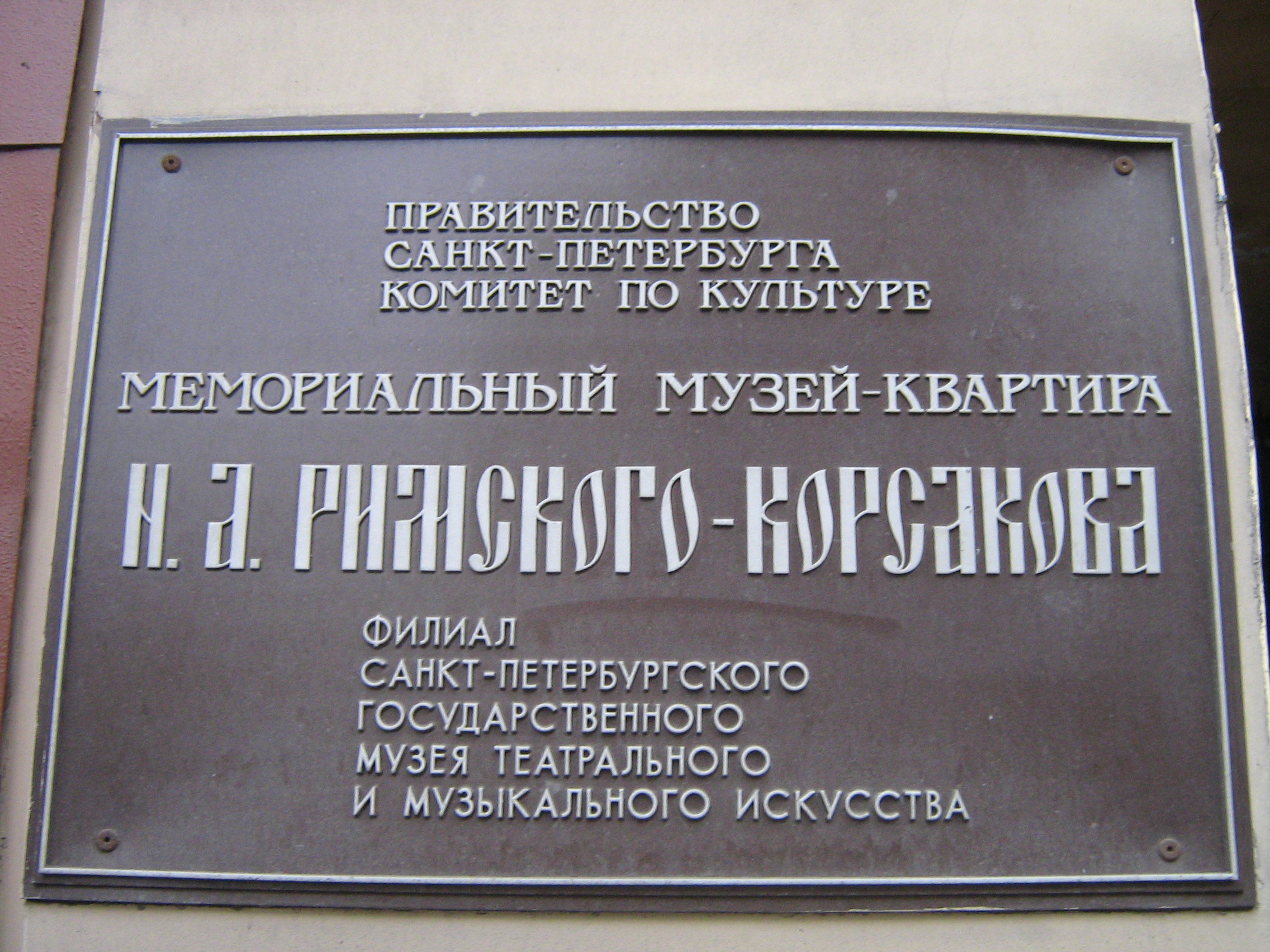
Rimsky-Korsakov Memorial Museum-Apartment
There is no piano in Rimsky-Korsakov's study. The composer worked at a writing desk, hearing the orchestra in his head and trusting it - so the room where Sadko and The Golden Cockerel were written is silent in a way that surprises visitors who expect a music museum to look like a concert hall. Apartment 39, third floor, 28 Zagorodny Prospect, set back in a courtyard off one of Petersburg's busy avenues. He lived here for the last fifteen years of his life. He died here in 1908. And on Wednesday evenings, before he died, half of Russian music walked up these stairs to play him their new pieces.
The Korsakov Gatherings
By 1905 they were a fixture: every Wednesday, composers and singers crowding into the drawing room of apartment 39, no formal program, just whoever showed up playing whatever they had been working on. Glazunov premiered pieces here. So did Lyadov, Taneyev, Scriabin, Rachmaninoff. The young Stravinsky - then in his early twenties, still a year or two from The Firebird - played his early experiments under the eye of his teacher. The bass Feodor Chaliapin sang. Nadezhda Zabela-Vrubel, wife of the painter Mikhail Vrubel, accompanied him. The Becker piano Rimsky-Korsakov bought in 1902 still stands in the same corner of the same room. The gatherings, miraculously, still happen - the museum hosts chamber concerts on the original instrument, in the original room, for audiences who sit roughly where Stravinsky once sat being terrified.
The Apartment That Almost Wasn't
After the 1917 revolution, Rimsky-Korsakov's widow Nadezhda was forced out. She had time, before she went, to do one extraordinary thing: she catalogued everything. Her husband's manuscripts, the music library, the posters, the family photographs, the Becker piano, the writing desks, the corner stoves, the wallpaper - all of it documented, much of it removed for safekeeping. The apartment then became a kommunalka, a Soviet communal apartment, where ten families and twenty-some people lived among Rimsky-Korsakov's furniture for half a century. Three generations of his descendants lobbied for the apartment to be made a museum. The decision finally came in 1967. They peeled back layers of paint to find the original wallpaper underneath. Over 250 of Nadezhda's catalogued items came home, returned to the rooms where they had stood when her husband worked.
The Mighty Handful's Last Voice
Rimsky-Korsakov was the youngest of the Mighty Handful - the Moguchaya Kuchka, the five composers (with Mussorgsky, Borodin, Cui, and Balakirev) who set out in the 1860s to build a uniquely Russian classical tradition free of German influence. By the time he moved into Zagorodny Prospect in 1893, he was the last one still composing seriously. Mussorgsky was fifteen years dead, Borodin twelve. Rimsky-Korsakov spent his last fifteen years here finishing what the others had left undone - editing Mussorgsky's Boris Godunov into the version the world would hear, finishing Borodin's Prince Igor with Glazunov, and writing his own late masterworks. Eleven of his fifteen operas were composed in this apartment. The Tale of Tsar Saltan, Sadko, The Legend of the Invisible City of Kitezh, the political satire of The Golden Cockerel that nearly got him in trouble with the censors - all of them began at the desk in the silent study, with Nadezhda at her own desk nearby making the piano arrangements as he wrote.
The Golden Pen
Among the museum's most precious objects is a fountain pen given to the composer in 1880 to mark the premiere of his opera May Night. He used it for the next twenty-eight years - to write every score, every letter, every entry of the autobiography he called My Musical Life. The pen sits in a glass case in the apartment now, alongside portraits of his ancestors. The Rimsky-Korsakovs were noble but not particularly grand: the family descended from a Lithuanian named Ventseslav Korsak who came to Russia in the 1400s. Tsar Fyodor III added the prefix Rimsky in 1677, on the basis that the family's distant ancestors had supposedly been Roman subjects. Nikolai Andreyevich was the fourteenth Korsakov in Russia. The Roman connection had grown thin by then. The music had not.
Visiting Now
The museum sits in a courtyard that surprises you - you walk in off Zagorodny Prospect, past the modern shop fronts, and suddenly the city noise drops and you are in a quiet inner space ringed by greenery and old facades. The five-storey building is unremarkable, the staircase is plain, and then you are in apartment 39 standing in the dining room, looking at portraits of Rimsky-Korsakovs from the 18th century. The original tiled corner stoves are still here. The marble fireplace. The folding doors with their bronze handles. The writing desk where The Tsar's Bride was composed. Most music museums show you instruments their subjects never touched. This one shows you the room they actually worked in, almost exactly as they left it.
From the Air
The museum sits at 59.92 degrees north, 30.34 east, in central Saint Petersburg just south of the Fontanka river, near the Vladimirskaya metro. From the air the building disappears into the dense block fabric of historic Petersburg - look instead for nearby landmarks, the green spire of the Vladimir Cathedral one block north and the Five Corners intersection a few hundred meters east. Pulkovo airport (ULLI) lies 17 km south. Best approached at low altitude under the long northern summer light, when the courtyards of central Petersburg show their full character; in winter the city's white roofs blur the geometry.