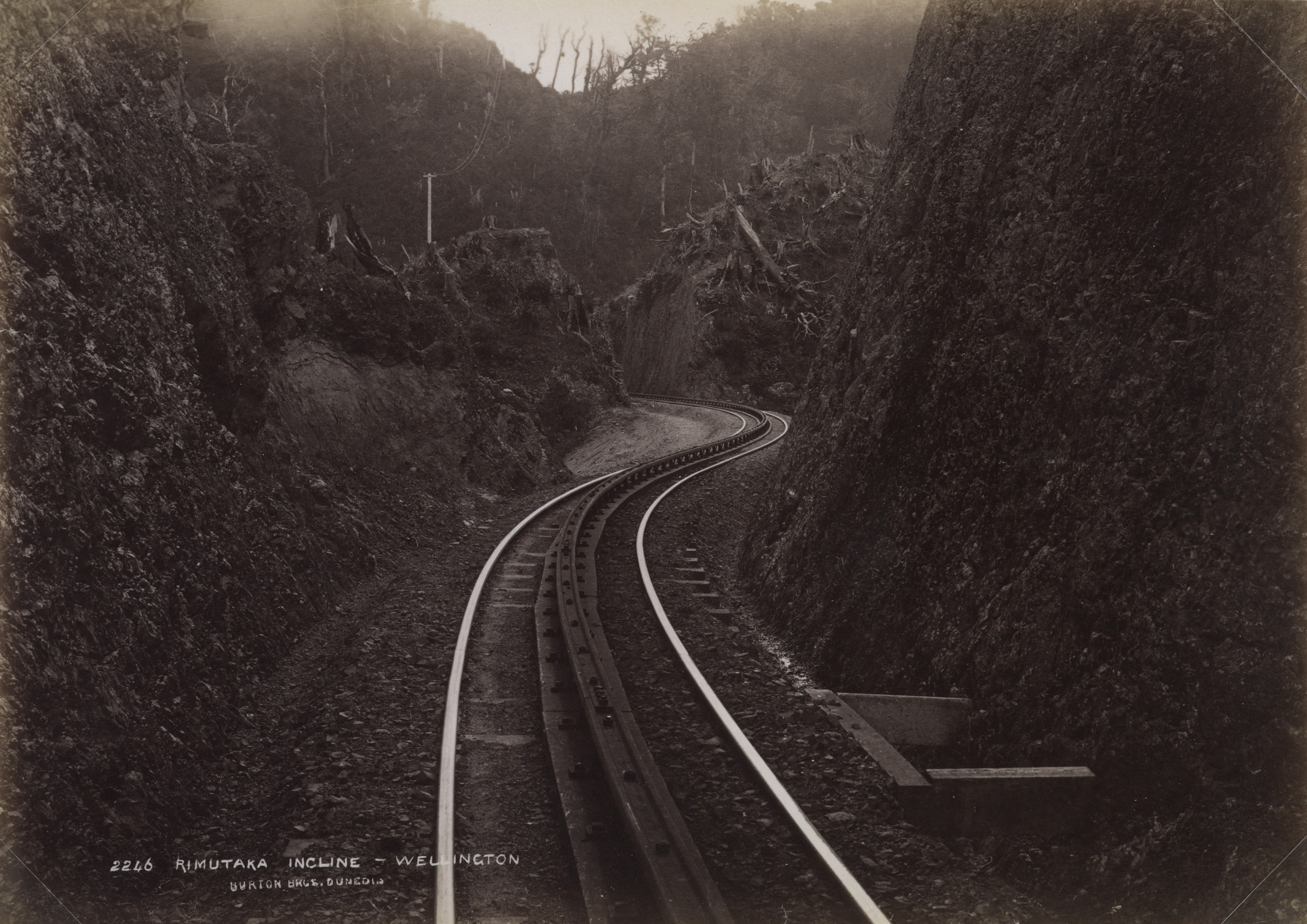
Rimutaka Incline
Five locomotives to climb a hill. That was what it took on the Rimutaka Incline, where trains gripped a raised centre rail with horizontal wheels and hauled themselves up a grade of 1-in-15 through some of the most unforgiving terrain in New Zealand's lower North Island. For 77 years, from 1878 to 1955, this three-mile stretch of railway between Summit and Cross Creek stations was the bottleneck, the adventure, and the engineering marvel of the Wairarapa Line. Passengers braced against the lurch of Fell engines biting into steel. Railwaymen lived in isolation at stations perched on the mountainside. And the whole contraption worked, day after day, because the alternative was no railway at all.
A Problem of Gradient
The trouble started in 1871, when the New Zealand government authorised a railway from Wellington to Masterton. The Remutaka Range stood in the way. Survey parties investigated four routes, and every one of them ran into the same problem: the terrain between the Hutt Valley and the Wairarapa dropped and climbed too steeply for conventional adhesion railways. Charles O'Neill, the Provincial Engineer, surveyed a tunnel route requiring 2.6 km of boring through rock, but the colonial treasury could not contemplate the expense. What they could afford was something radical. The Fell mountain railway system, patented by John Barraclough Fell and already proven on the Mont Cenis Pass between France and Italy, used a horizontal centre rail gripped by additional wheels on the locomotive. It allowed trains to climb grades that would spin conventional wheels to a standstill. New Zealand adopted it, and the Rimutaka Incline became one of only a handful of Fell railways ever built.
Life on the Incline
Operating the incline was a daily feat of logistics and nerve. Trains ascending from Cross Creek required up to five H-class Fell locomotives, their horizontal wheels pressing against the centre rail at pressures that could strip the grease clean off the mechanism. Top speed was 8 km/h going up. Coming down was no faster, because the Fell brake vans had to hold the train against gravity every metre of the descent. At Summit station, the highest point on the line, railway families lived in a handful of houses at an elevation exposed to Remutaka's notorious gales. Cross Creek, at the foot of the incline, was scarcely more hospitable. The community there depended entirely on the railway for its existence, and when the incline closed, Cross Creek emptied. In 1936, seven lightweight railcars named after historic Maori canoes were introduced for the route. Built at the Hutt Workshops with oversized rear wheels to clear the centre rail, they were expected to manage 15 to 17 mph on the climb but actually achieved only 10 to 12. Passengers loved them anyway.
The Long Wait for a Tunnel
Almost from the day the incline opened, people wanted a replacement. The expense, the delays, the danger of operating in alpine weather on grades that terrified engineers and occasionally killed them made the incline a constant subject of criticism. In 1898, J.H. Dobson surveyed alternatives. A 5-mile tunnel between Mangaroa and Cross Creek came tantalizingly close to approval before the cost killed it. The 1920s brought another round of campaigning, another feasibility study, and another postponement. In 1936, the new Labour government announced it would proceed with a tunnel. Detailed surveys were completed by 1939. Then World War II intervened. It was not until 1948 that construction finally began on what would become the 8.93 km Remutaka Tunnel, bored through the range between Maymorn and the eastern foothills. A consortium of Morrison-Knudsen and Downer completed the work. On 20 April 1954, the tunnel headings met with a surveying error of just 44.5 millimetres. The tunnel opened on 3 November 1955, five days after the last train climbed the incline.
Afterlife on the Mountainside
Demolition was swift. Track between Cross Creek and Pigeon Bush was pulled up by March 1956, with H 199 hauling the work trains that dismantled the very line the locomotive had served. Five of the six H-class Fell engines were towed to the Hutt Workshops and scrapped. H 199 alone survived, donated to Featherston and displayed in a park before finding a permanent home in the Fell Locomotive Museum, which opened in 1984. The formation itself refused to disappear. In 1976, a book about the incline reignited public interest. By the mid-1980s, runners were using the old railway bed as a backcountry trail. The official Remutaka Rail Trail opened in 1987, following the original formation from Cross Creek to Kaitoke through native bush, across old bridges, and through the Pakuratahi Tunnel. Today it is one of the most popular walking and cycling routes in the Wellington region. Where five locomotives once struggled at walking pace, cyclists now freewheel through forest that has reclaimed the cuttings.
From the Air
Located at 41.15S, 175.20E in the Remutaka Range between the Hutt Valley and Wairarapa. The old incline formation is visible as a scar across the mountainside. The Remutaka Rail Trail follows the route. Nearest airports: NZWN (Wellington, 50 km southwest), Masterton (NZMS, 50 km northeast). Approach with caution due to mountain turbulence and rapidly changing weather over the range. Best viewed from 3,000-5,000 ft AGL.