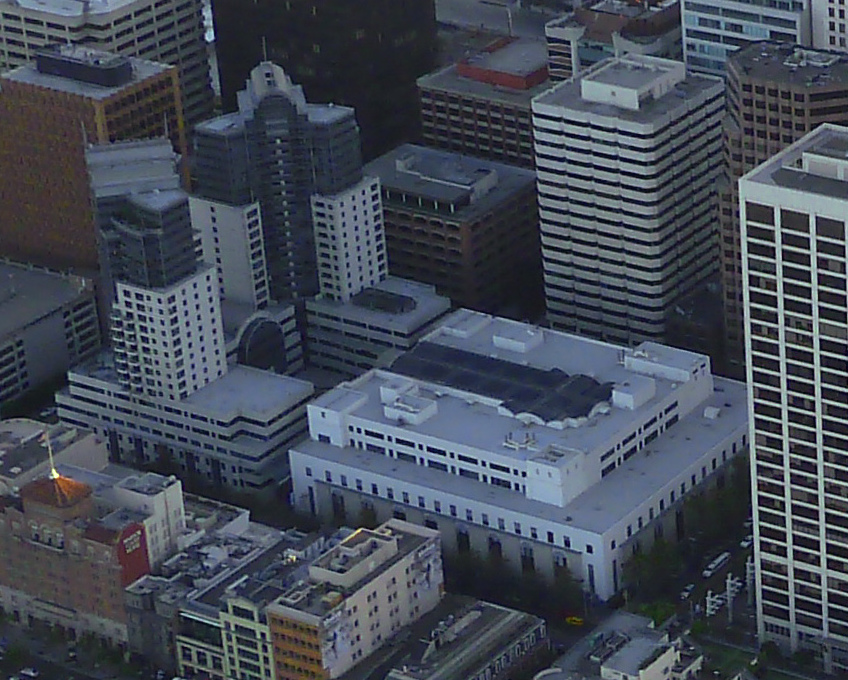
Rincon Center
The murals in the lobby of Rincon Center are not polite. Painted by Anton Refregier between 1941 and 1948 as a WPA art project, the twenty-seven panels depict California history with unflinching honesty: Native American displacement, labor strikes, the exploitation of immigrant workers, the internment of Japanese Americans. During the McCarthy era, congressional committees tried to have the murals destroyed. They survived. The building that houses them, the former Rincon Annex Post Office, was converted in the 1980s into a mixed-use center with shops, restaurants, offices, and apartments. The murals stayed on the walls.
Refregier's Panels
Anton Refregier's History of San Francisco murals were commissioned as part of the New Deal's Federal Art Project. Refregier worked on them for seven years, from 1941 to 1948, creating twenty-seven panels that trace California's story from pre-contact Native American life through the Gold Rush, the building of the railroads, the 1906 earthquake, the general strike of 1934, and World War II. The murals are explicitly pro-labor and unflinching about racial injustice. These qualities made them targets during the Red Scare of the 1950s, when Congress considered removing or painting over them. Public outcry and artistic advocacy saved them.
From Post Office to Mixed Use
The Rincon Annex Post Office was built in 1939 in the Streamline Moderne style. After the postal service moved to newer facilities, the building was converted in the late 1980s into Rincon Center, a complex that includes two buildings: the original post office and a new addition. The development includes restaurants, shops, offices, and 320 apartments, anchored by a dramatic 85-foot-tall atrium with a rain column sculpture. The conversion preserved the murals and the original post office lobby, making them accessible to the public as part of the building's ground-floor commercial space.
Art That Refuses to Be Comfortable
Refregier's murals are remarkable because they treat public art as a form of truth-telling rather than decoration. The panel depicting the internment of Japanese Americans was painted while the camps were still operating. The labor scenes celebrate workers rather than owners. The treatment of Native Americans acknowledges genocide rather than discovery. Walking through the lobby of Rincon Center, past the coffee shops and the lunch crowd, you encounter a version of California history that most civic art avoids. The murals have been designated a National Historic Landmark, ensuring that they will continue to be uncomfortable, and that the building will continue to be worth visiting because of it.
From the Air
Located at 37.79°N, 122.39°W at 101 Spear Street in San Francisco's South of Market district, near the Embarcadero. Nearest airports: SFO (KSFO, 10 nm south), Oakland (KOAK, 9 nm east).