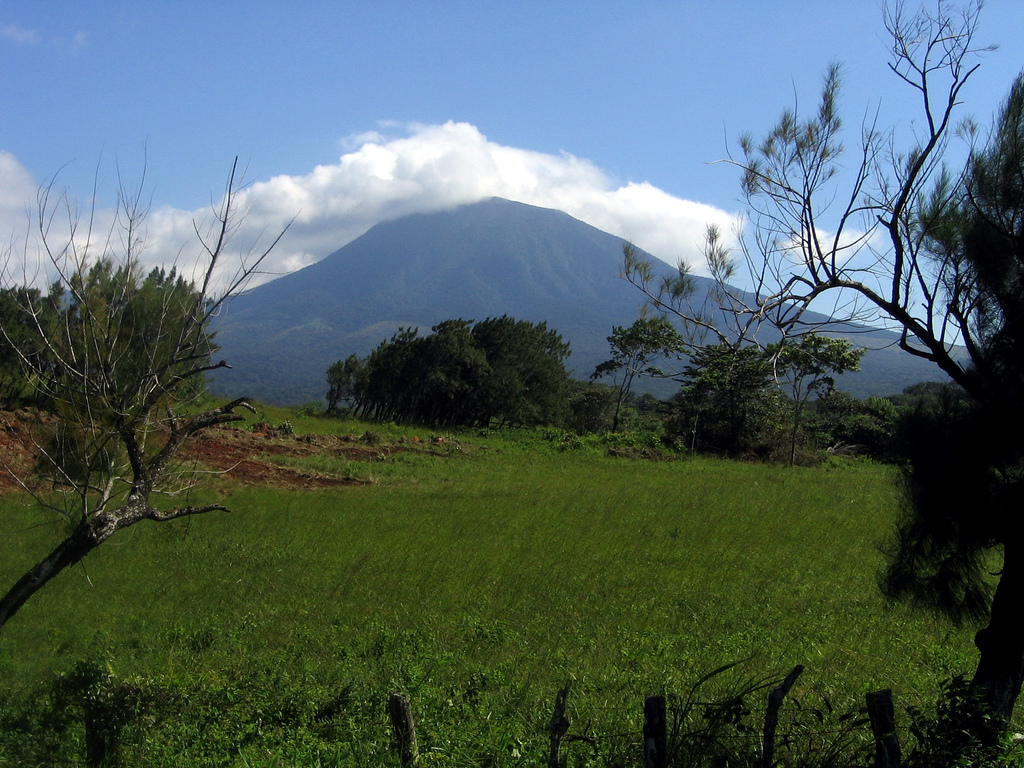
Rincon de la Vieja Volcano
The legend goes like this: Princess Curabanda fell in love with Mixcoac, a chief from an enemy tribe. When her father Curabande discovered the affair, he threw Mixcoac into the volcano's crater. Curabanda, grief-stricken, threw their infant son in after him -- to reunite father and child -- and then retreated to the mountain's slopes, where she lived alone for the rest of her life, becoming a recluse healer whom locals called the old woman. They named the volcano after her: Rincon de la Vieja, the Old Woman's Corner. The mountain has been erupting, rumbling, and steaming ever since, as if the story's anguish never quite settled.
A Volcano That Never Sleeps
Rincon de la Vieja is an active andesitic complex volcano standing 1,916 meters above sea level, roughly 23 kilometers from the city of Liberia in Guanacaste province. It is one of a handful of active volcanoes in Costa Rica -- alongside Poas, Turrialba, Arenal, Irazu, and Miravalles -- though in recent years only Rincon de la Vieja, Turrialba, and Poas have shown sustained activity. The volcano's recent eruption history reads like a drumbeat: lahars flowing through nearby rivers in May and June 2017, hydrothermal blasts in April 2020, a 1.5-kilometer ash column later that month, a 2-kilometer column in June 2021, and a 7.5-kilometer volcanic cloud in April 2023 that sent material from the crater lagoon cascading down the northern cone and into surrounding rivers. Trails within the national park are frequently closed, and hikers report hearing rumblings that sound like distant thunder -- the volcano's way of reminding visitors that the ground beneath their feet is not entirely solid.
The Heat Below
Fumaroles hiss from the slopes. Hot pools bubble in clearings. Mud pots gurgle and spit in two distinct thermal areas on the volcano's flanks. These surface expressions hint at the energy underground: geologists estimate Rincon de la Vieja has a generating potential of 140 megawatts. For decades, the national park designation limited exploitation to test wells, but in 2013 the Las Pailas Geothermal Power Plant was expanded to 55 megawatts with financing from the European Investment Bank. The plant, operated by the Instituto Costarricense de Electricidad (ICE), sits just outside the park boundary and represents Costa Rica's second geothermal installation -- the first is at neighboring Miravalles Volcano. Together they feed renewable energy into a national grid that already runs largely on hydroelectric and geothermal power, making Costa Rica one of the greenest electricity producers in the Americas.
Cloud Forest and Crater Lake
Rincon de la Vieja National Park covers 12,759 hectares and protects two distinct forest types that stack vertically up the volcano's slopes. Lower elevations hold montane forest where sloths hang in cecropia trees and spider monkeys swing through the canopy. Higher up, the vegetation transitions to dwarf cloud forest -- stunted, moss-draped trees that filter moisture from persistent mist. Trails from the Santa Maria ranger station wind through both zones, passing hot springs and waterfalls along the way. The park shelters tapirs, kinkajous, pumas, jaguars, and both howler and spider monkeys. Before 2011, hikers could climb to the summit crater, where a turquoise lagoon sat inside the caldera. That access ended on September 22, 2011, after an eruption on September 16 sent volcanic ash and mud rising over 36 meters above the lagoon surface, making the route too dangerous to maintain.
The Backbone of Central America
Rincon de la Vieja sits on the volcanic spine that runs the length of Central America, part of the same tectonic system that built the entire isthmus. The Cocos Plate dives beneath the Caribbean Plate along this coast, and the friction generates the magma that feeds the chain of volcanoes stretching from Guatemala to Panama. This particular volcano is a complex structure -- not a single cone but a cluster of vents and craters built up over multiple eruptive episodes. The result is a broad, rugged massif rather than the classic pointed peak. From the air, it looks less like a volcano and more like a rumpled green plateau with steam leaking from its seams. Lodges and resorts in the surrounding area offer canopy tours, horseback riding, river rafting, and ATV trails -- activities that depend on the volcano's slopes for their scenery and on its geothermal heat for their hot spring pools.
From the Air
Rincon de la Vieja Volcano is located at 10.83N, 85.32W in Guanacaste province, northwestern Costa Rica. The summit rises to 1,916 meters (6,286 feet) MSL, the highest point in the surrounding national park. From cruise altitude, the broad complex volcano is identifiable by steam venting from the summit area. Daniel Oduber Quiros International Airport (MRLB) in Liberia is approximately 23 km to the southwest. Caution: the volcano is active with recent eruptions producing ash columns up to 7.5 km. Volcanic ash advisories may be in effect. Mountain weather with orographic cloud buildup is common, especially in the wet season (May-November).