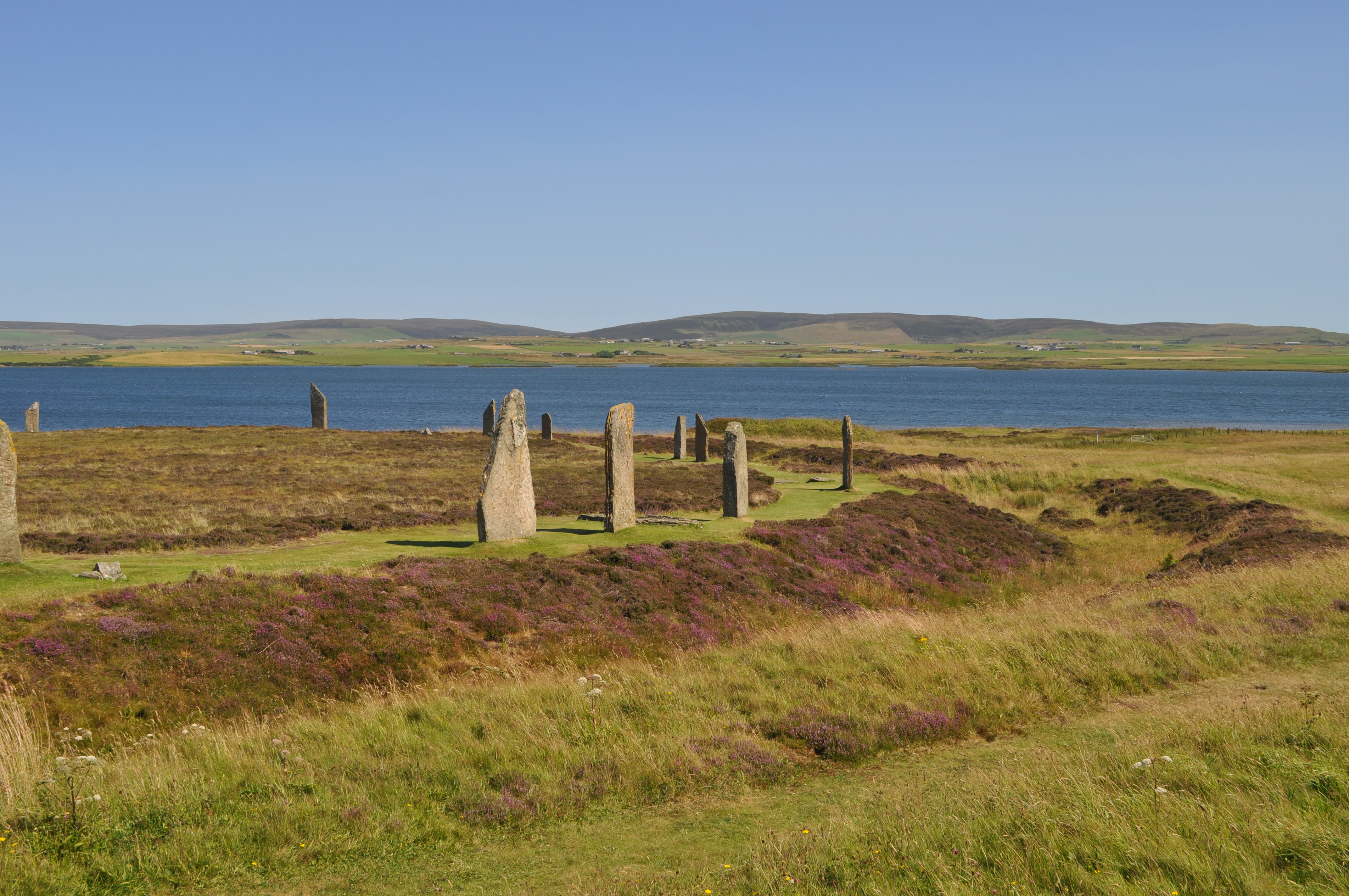
Ring of Brodgar
Twenty-seven stones still stand. There were once sixty, arranged in a circle so precise that it remains the only major henge and stone circle in Britain to form an almost perfect ring. The Ring of Brodgar occupies a narrow isthmus between the Lochs of Stenness and Harray on Orkney's Mainland, and on a grey Orcadian day, with wind driving across the water and the stones silhouetted against low cloud, it is easy to understand why later Norse settlers called this place the Temple of the Sun.
The Circle and Its Mysteries
The stone circle is 104 metres in diameter, the third largest in the British Isles, ranking alongside Avebury and Stanton Drew among the greatest ceremonial monuments of prehistoric Britain. It was likely erected between 2500 and 2000 BC, making it the last of the great Neolithic monuments built on the Ness -- younger than the nearby Standing Stones of Stenness, younger than Maeshowe. A surrounding ditch, carved into bedrock, appears to have been created in sections, possibly by work gangs from different parts of Orkney, suggesting the Ring was a communal project that drew labor from across the archipelago. The stones themselves may have been added later, perhaps erected over a long period. Technically, the absence of an encircling bank means Brodgar is not a true henge, though archaeologists continue to use the term. Its interior has never been excavated, leaving open the tantalizing possibility that wooden structures or other features lie beneath the turf.
The Ness Between Two Worlds
Brodgar sits at the center of a ritual landscape that UNESCO designated a World Heritage Site in 1999 under the name "Heart of Neolithic Orkney." To the southeast lies Maeshowe, the passage grave aligned with the winter solstice. To the south stand the Standing Stones of Stenness. Between them, ongoing excavations at the Ness of Brodgar have uncovered buildings both ritual and domestic, along with pottery, bone tools, and a polished stone mace head. Perhaps the most remarkable find is a massive stone wall, possibly 100 metres long and 6 metres wide, that may have spanned the entire peninsula -- a symbolic barrier between the sacred landscape of the Ring and the everyday world beyond. Historic Environment Scotland's Statement of Significance notes that these monuments were roughly contemporary with the mastabas of archaic Egypt, the brick temples of Sumeria, and the first cities of the Harappa culture in India.
Runes, Odin, and the Broken Stone
When Norse settlers reached Orkney by the 9th century, they encountered monuments already ancient beyond reckoning and wove them into their own mythology. According to local legend, the Ring of Brodgar became the Temple of the Sun, while the Standing Stones of Stenness served as the Temple of the Moon. Young people supposedly made vows and prayed to Woden at these sites and at the "Odin Stone" that stood between the two circles -- until a farmer destroyed it in 1814, provoking outrage that echoed for generations. Several stones at Brodgar bear runic carvings left by Norse hands: the name "Bjorn," a small cross, an anvil. These markings layer one civilization's meaning onto another's, a palimpsest in stone that spans four thousand years.
Charting the Ancient Sky
The Ring of Brodgar has attracted bold theories about Neolithic astronomy. Alexander Thom proposed that Brodgar's diameter of 125 "megalithic yards" -- identical to the inner banks at Avebury and Newgrange -- proved that ancient builders across the British Isles shared a common unit of measurement. Others have argued that the surrounding burial mounds were positioned as backsights for lunar observations. Archaeologist Euan MacKie even suggested that the residents of nearby Skara Brae might have been a priestly class conducting ceremonies at Brodgar and Stenness. These claims remain contested -- Graham Ritchie pointed out that the burial mounds have not been reliably dated, and there is no archaeological proof for a theocratic elite. But the theories speak to something real about Brodgar: standing inside the circle, surrounded by standing stones and the distant shapes of cairns against the Orkney sky, the astronomical dimension feels intuitive, even if the evidence resists certainty.
From the Air
Located at 59.00N, 3.23W on the isthmus between Loch of Stenness and Loch of Harray, Mainland Orkney. The stone circle is clearly visible from the air as a ring of standing stones on a narrow land bridge between two bodies of water. Maeshowe is approximately 1 nm to the southeast. Nearest airport: Kirkwall (EGPA), approximately 8 nm east. Best viewed at 1,500-2,500 ft AGL.