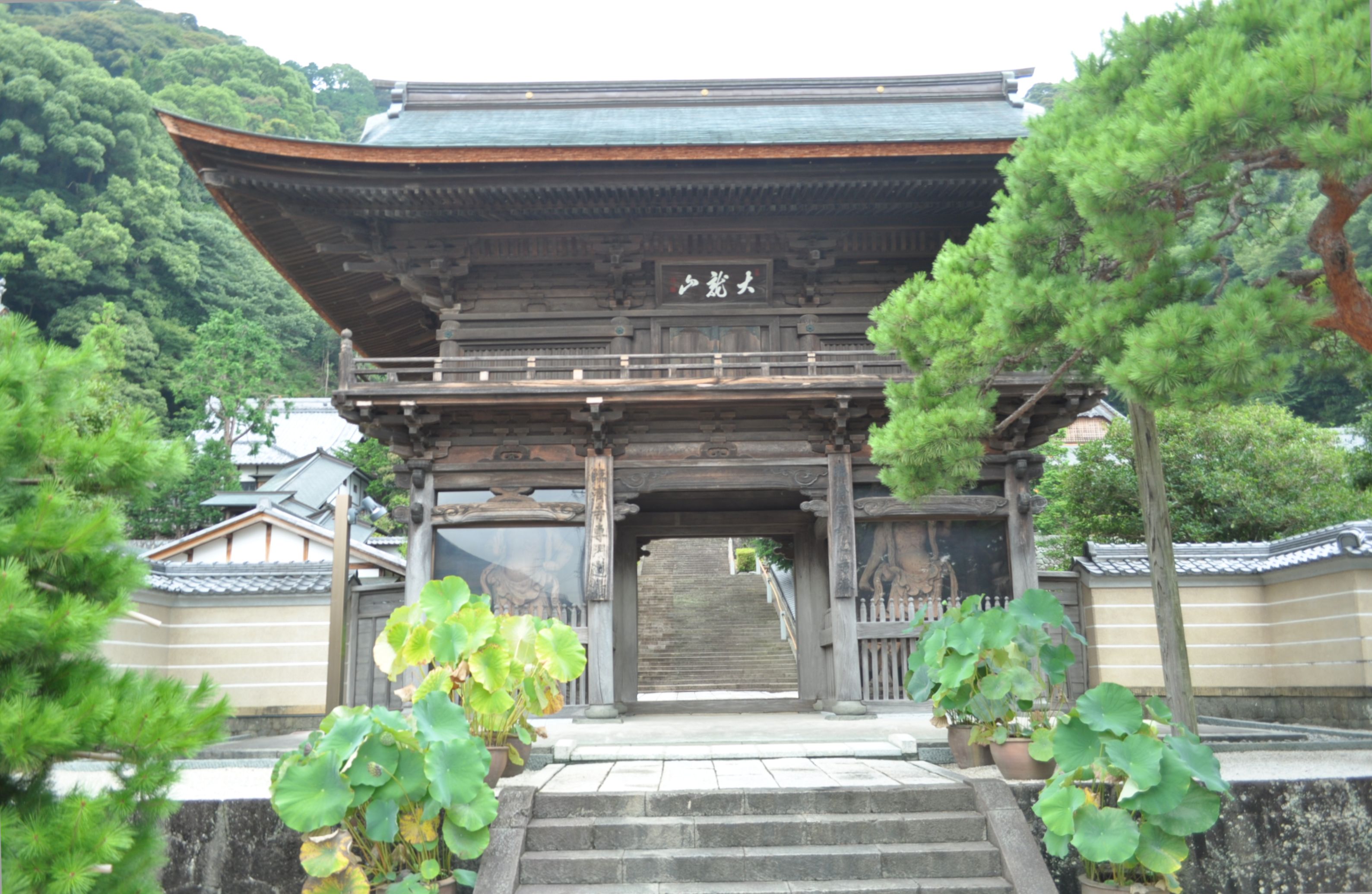
Rinzai-ji
Two days. That is all the public gets each autumn to step inside Rinzai-ji and see one of Japan's nationally designated Places of Scenic Beauty. For the remaining 363 days, the garden behind these walls remains invisible to everyone but the monks who tend it. This restriction is not mere exclusivity -- it is continuity. Rinzai-ji has operated as a working Zen temple since 1536, and the silence it maintains is the same silence that shaped the education of Tokugawa Ieyasu, the man who would unify Japan and establish a dynasty that ruled for over 250 years. Before he was a shogun, he was a boy hostage, sent to this temple to study under the warrior-monk Sessai Choro. The lessons he absorbed here -- discipline, patience, strategy -- became the foundation of everything that followed.
A Temple Born from Succession and Bloodshed
Rinzai-ji was not built for quiet contemplation alone. In 1536, the powerful daimyo Imagawa Ujichika founded the temple on the grounds of a villa owned by his mother, at the base of Shizuhata Castle. It was intended for his third son, Imagawa Yoshimoto, who had been sent into the priesthood because no one expected him to inherit leadership of the clan. His uncle, the formidable warrior-monk Sessai Choro, became the temple's founding priest and Yoshimoto's tutor. But fate rewrote the plan. Both of Yoshimoto's elder brothers died, and the third son emerged from the temple to claim the chieftainship of the Imagawa clan -- though not without a bloody succession dispute that left bodies in its wake. Rinzai-ji continued to serve as the bodaiji, the ancestral mortuary temple, of the Imagawa clan through the turbulent Sengoku period.
The Education of a Future Shogun
The most consequential student to walk through Rinzai-ji's gates was not an Imagawa at all. The young Tokugawa Ieyasu -- then known by his childhood name, Takechiyo -- was held hostage in Sunpu by the Imagawa clan as a guarantee of his father's loyalty. The Imagawa sent him to Rinzai-ji to be tutored by Sessai Choro, the same warrior-monk who had shaped Imagawa Yoshimoto. Sessai was no ordinary cleric. He was a military strategist and political advisor whose counsel guided the Imagawa through decades of conflict. Under his instruction, the young hostage absorbed lessons in Zen Buddhism, classical Chinese literature, military strategy, and the art of governance. Historians have long noted that Ieyasu's legendary patience -- the quality that ultimately won him control of Japan after decades of waiting and maneuvering -- bears the unmistakable imprint of Zen discipline. The temple where he learned it still stands.
Burned and Rebuilt
In 1568, the Takeda clan of Kai Province invaded Suruga Province, and Rinzai-ji was burned to the ground. The Imagawa clan's power collapsed, and their ancestral temple went up in flames along with their domain. The destruction might have been the end of the story, but Tokugawa Ieyasu -- by then a rising warlord in his own right -- remembered the temple where he had been educated. In 1582, he ordered Rinzai-ji rebuilt. The reconstruction produced buildings that still stand today, including the Main Hall, or Hondo, an elegant irimoya-style structure with a frontage of 22.7 meters and a depth of 16.8 meters. The Hondo was designated an Important Cultural Property of Japan in 1983. The Sanmon gate also dates from the Edo period, giving the temple compound an architectural coherence that spans more than four centuries.
The Garden Behind Closed Doors
The Japanese garden at Rinzai-ji has been a nationally designated Place of Scenic Beauty since 1936, but seeing it requires either monastic vows or precise timing. The temple opens to the public for only two days each autumn, creating an annual pilgrimage for garden enthusiasts who queue for a glimpse of what is otherwise a completely private space. This extreme exclusivity is unusual even by the standards of Japanese temple gardens, many of which limit access but not to this degree. The garden's design reflects the aesthetic principles of Rinzai Zen -- the temple belongs to the Myoshin-ji branch of the Rinzai school, one of the major lineages of Japanese Zen Buddhism. Its main devotional image is a statue of Amida Nyorai. For the rare visitor who passes through the gates on one of those two autumn days, the garden offers a compressed experience of everything the temple represents: carefully cultivated beauty maintained by centuries of discipline, revealed only in brief, deliberate moments.
From the Air
Located at 34.993N, 138.376E in the Aoi Ward of Shizuoka City, Japan, at the base of the hills north of the city center near the former site of Shizuhata Castle. The temple compound is set among trees at the foot of the mountainous terrain that rises north of Shizuoka's urban plain. From the air, look for the green temple grounds contrasting with the surrounding urban development, near the base of the forested hillsides. Nearest airport: Mt. Fuji Shizuoka Airport (RJNS) approximately 22 nm southwest. Shizuoka Heliport is closer to the city center. The area sits between Suruga Bay to the south and mountainous terrain to the north -- maintain terrain awareness when flying at lower altitudes near the northern hills.