Rio de Janeiro
The Portuguese explorers who entered Guanabara Bay in January 1502 mistook it for a river mouth and named the place Rio de Janeiro - River of January. The error persisted; the city that grew around the bay kept the name even after geography corrected the misconception. The natural harbor, surrounded by granite peaks and forested hills, became the colonial capital in 1763, replacing Salvador, and remained Brazil's seat of power until 1960, when Brasilia was carved from the interior. By then Rio had accumulated the institutions and infrastructure of a capital - the National Library, the Municipal Theater, the Copacabana Palace - along with the contradictions that define it still. The city of 6.7 million holds some of Brazil's greatest wealth in beachfront apartments and some of its deepest poverty in the favelas that climb the hills behind them. The view from Christ the Redeemer encompasses both: the curved beaches of Copacabana and Ipanema, the forested peaks of Tijuca, and the informal settlements where a quarter of the population lives. Rio is beautiful and brutal in equal measure, a city that has never resolved the tensions that its geography makes visible.
Christ Above the City
Christ the Redeemer stands 30 meters tall atop Corcovado mountain, arms outstretched 28 meters, visible from nearly everywhere in Rio. The statue was conceived in 1920, designed by Brazilian engineer Heitor da Silva Costa and sculpted by French artist Paul Landowski, constructed between 1922 and 1931 from reinforced concrete and soapstone. The pieces were carried up the mountain by the same cog railway that now brings tourists - over two million annually.
The statue became Rio's symbol and one of the New Seven Wonders of the World. The pose - arms open in blessing or embrace - defines the city's self-image: welcoming, inclusive, arms wide to receive the world. The reality is more complex. The view from the base shows favelas as clearly as beaches, inequality as starkly as beauty. Christ watches over a city that has not resolved the contradictions his gesture seems to transcend. Lightning strikes the statue frequently; workers repair the damage and reopen the site. The arms remain open, the blessing continues, the problems persist below.
The Beaches
Copacabana and Ipanema defined beach culture for the twentieth century. The four-kilometer crescent of Copacabana, lined with hotels and apartment towers, was where the bossa nova was born in the late 1950s - the 'Girl from Ipanema' walked past the bar where Jobim and de Moraes wrote her song. The beaches democratized in ways the rest of Rio did not: vendors from favelas sell agua de coco alongside tourists from five-star hotels, pick-up football games mix classes that otherwise never meet.
The beachfront promenade, designed by Roberto Burle Marx in his signature wave pattern of black and white Portuguese stone, stretches from Leme through Copacabana to Ipanema and Leblon. The neighborhoods behind it progress from slightly seedy to extremely wealthy; Leblon consistently ranks among the most expensive real estate in South America. But the beach itself belongs to everyone - by law and by custom, Brazilian beaches are public. The scene on summer weekends - hundreds of thousands of people on a few kilometers of sand - is Rio at its most characteristic: crowded, chaotic, somehow functioning despite conditions that should produce disaster.
The Favelas
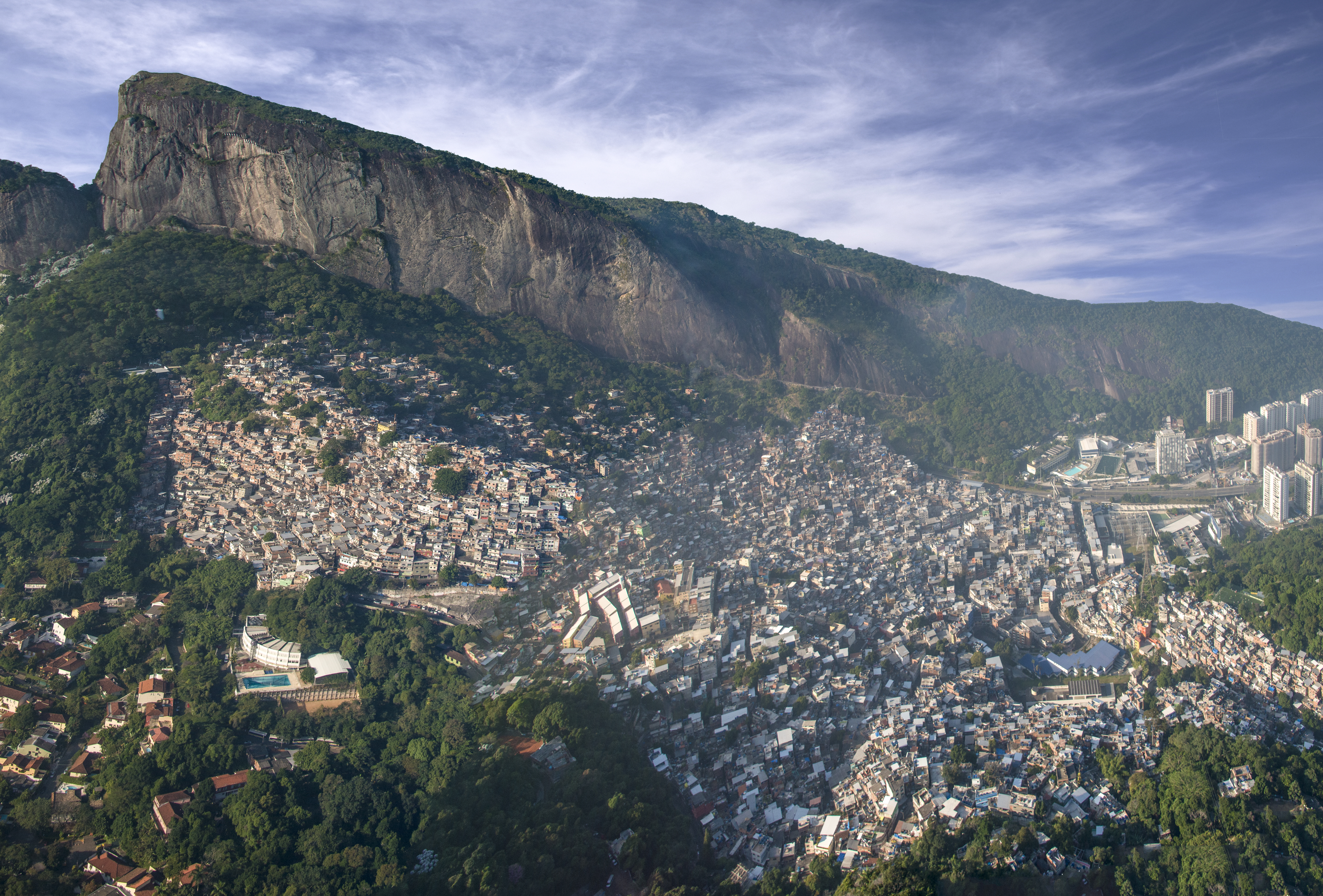
The favelas began in 1897 when soldiers returning from the Canudos War occupied a hill in Rio's center, naming it Morro da Favela after a plant common in Bahia. The settlement grew as rural migrants flooded the city faster than formal housing could accommodate them. By 2020, an estimated 1.5 million people - roughly 22% of Rio's population - lived in favelas, some clinging to hillsides so steep that access requires climbing hundreds of stairs.
Rocinha, the largest favela, holds over 100,000 residents in a space smaller than one square kilometer. The density is extraordinary; the infrastructure improvisational. Electricity is often pirated; water arrives by hose or truck; the construction is concrete and brick, built incrementally over decades. For years the state's primary interaction with favelas was through police operations that resembled military invasions. The 'pacification' program launched in 2008 installed permanent police posts but achieved mixed results; violence has resurged in many communities. The favelas are not separate from Rio - they are integral to it, providing the labor that runs the formal city, contributing the cultural energy that defines Brazilian music and dance, occupying the hillsides that postcards crop out of frame.
Carnival
Carnival takes over Rio for four days before Lent, though the preparation consumes the entire year. The samba schools - neighborhood-based organizations that are actually competitive performance groups - spend months designing costumes, composing songs, choreographing the elaborate parades that unfold in the purpose-built Sambadrome. Each school gets roughly 80 minutes to pass through, 3,000 to 4,000 performers presenting a unified theme judged by criteria including rhythm, costume, float design, and overall impact.
The Sambadrome parades are organized spectacle; the street parties - blocos - are organized chaos. Hundreds of blocos parade through neighborhoods throughout the Carnival period, some with hundreds of thousands of followers dancing behind sound trucks. The city essentially shuts down for business while opening for pleasure on a scale unmatched anywhere. Carnival generates over $1 billion in economic activity and something harder to measure in collective release - the one moment when Rio's divisions seem temporarily suspended, when everyone dances in the streets together. The suspension is temporary; the problems return with Ash Wednesday. But for four days, the city becomes what it imagines itself to be.
The Olympic Legacy
Rio hosted the 2016 Summer Olympics, the first South American games, at a cost of approximately $12 billion. The promise was transformation: new metro lines, rehabilitated port areas, sports facilities that would benefit residents long after the athletes departed. The reality was more complicated. The metro extension opened; the port area was redeveloped; but many venues now stand underused or abandoned. The velodrome hosts occasional events; the Olympic golf course struggles to attract players; the aquatics center closed for lack of funding.
The games coincided with Brazil's deepest recession and a political crisis that would lead to the impeachment of President Dilma Rousseff. The costs became symbols of misplaced priorities - billions spent on stadiums while hospitals lacked supplies, police went months without pay, and the state declared a financial emergency. Rio in 2026 bears the Olympic infrastructure like scar tissue: useful in places, neglected in others, a reminder of ambitions that exceeded capacity. The statue still watches from Corcovado; the beaches still draw crowds; the problems that existed before the games persist after them.
From the Air
Rio de Janeiro (22.91°S, 43.17°W) occupies a dramatic setting between granite peaks and Guanabara Bay on Brazil's southeastern coast. Two airports serve the city: Galeao/Antonio Carlos Jobim International (SBGL/GIG) on Governador Island in Guanabara Bay has two runways (10/28 at 4,000m and 15/33 at 3,180m); Santos Dumont (SBRJ/SDU) downtown handles shuttle flights to Sao Paulo with a single runway (02R/20L, 1,323m) on reclaimed land. Sugarloaf Mountain (395m) and Corcovado with Christ the Redeemer (710m) are unmistakable landmarks. The curved beaches of Copacabana and Ipanema are visible along the southern coast. Favelas appear on hillsides throughout the urban area. The Maracana Stadium and Olympic Park are in the northern zone. Weather is tropical with hot humid summers (Dec-Mar) and mild winters. Sea breezes moderate coastal temperatures. Afternoon thunderstorms are common in summer. Morning fog can affect Santos Dumont operations. The approach to SDU requires crossing the city center with strict altitude restrictions.