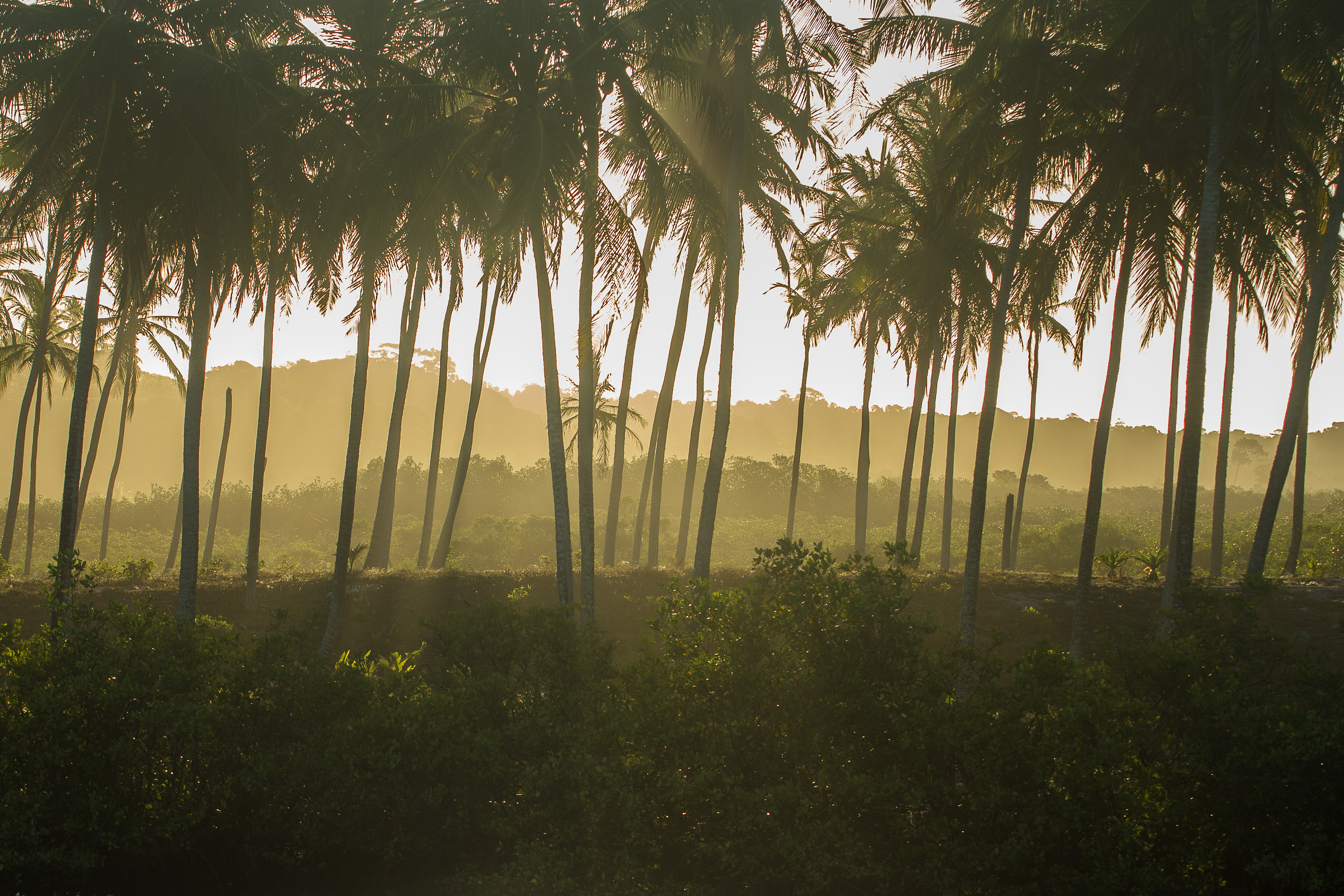
Rio dos Frades Wildlife Refuge
There is a lizard found nowhere else on Earth called Cnemidophorus nativo. The species name means 'native' in both Portuguese and English, a quiet acknowledgment from the biologists who described it that it belongs, specifically and entirely, to this particular stretch of the southern Bahian coast. Rio dos Frades Wildlife Refuge was created in 2007 to protect the sandy plain where the lizard lives, along with the mangroves, bromeliads, and orchids that share its small world near the mouth of the Frades River. The refuge is 894 hectares, barely larger than Central Park. Most of it is in private hands. Whether it survives the tourism boom now sweeping this coast is an open question.
A Thin Strip of Sand
The refuge sits in the municipality of Porto Seguro, on a narrow coastal plain bounded inland by a low cliff that rises toward the Atlantic Forest interior. North of the reserve lies Pau Brasil National Park. South lies Monte Pascoal National Park and the Corumbau Marine Extractive Reserve. Rio dos Frades is one small piece of a larger conservation mosaic, all of it part of the Caraíva-Trancoso State Environmental Protection Area created in November 2000. The Frades River drains a 436-square-kilometer basin that includes forested hills and farmland before reaching the sea through the reserve. Average rainfall runs about 1,400 millimeters per year - enough to keep the restinga salt marsh green and the mangroves rooted in brackish mud, not enough to support the dense Atlantic Forest that once covered the hills above.
What Lives Here
Restinga is the Brazilian word for the scrubby, salt-tolerant vegetation that grows on sandy coastal plains - tough grasses, low shrubs, and thickets of flowering trees shaped by wind and salt. Epiphytic bromeliads cluster in the branches. Orchids bloom in the humidity. Along the river mouth a small fringe of mangroves holds the bank together, providing nurseries for fish and crustaceans that feed both the river and the sea. Cnemidophorus nativo - sometimes called the native whiptail lizard - is the refuge's headline species, a slender sand-colored reptile adapted to restinga and nowhere else. The river mouth itself is small and picturesque, a narrow channel of clear water crossing the white beach to meet the waves. Local residents from the village of Itaporanga use the beach and the river mouth for fishing and for simple weekend leisure, as they have for generations.
The Long Road to Protection
The path to designation was slow. IBAMA, the Brazilian environmental agency, opened public consultations on the refuge and several other proposed conservation units on May 15, 2006, and the federal decree creating Rio dos Frades followed on December 21, 2007. Classification is IUCN Category III - natural monument or feature - and management falls to the Chico Mendes Institute for Biodiversity Conservation, which administers most of Brazil's federal reserves. The refuge was folded into the Central Atlantic Forest Ecological Corridor, a larger initiative created in 2002 to link fragmented forest patches across this part of Bahia and Espírito Santo. A consultative council was formed on July 21, 2011. Reports note that landowner representatives, though invited, attended without enthusiasm. As of 2014 the refuge still had no management plan and remained closed to visitors.
Pressure and Promise
Most of the refuge lies on private property. That ownership structure creates the central problem: construction on those parcels threatens the very habitat the federal decree was meant to save. Water buffalo, introduced elsewhere in Brazil for farming and escaped into wetlands, trample sensitive restinga vegetation when they wander through. And the tourism wave washing down the southern Bahian coast from Porto Seguro toward Trancoso and Caraíva brings both pressure and opportunity - pressure in the form of buyers who want beachfront land, opportunity in the form of income for local residents who could benefit from ecotourism if the reserve were managed for visits. Every small protected area in Brazil faces some version of this conflict. Rio dos Frades, with its endemic lizard and its narrow beach, is one of the quieter places where it plays out.
From the Air
Rio dos Frades Wildlife Refuge is located at approximately 16.67°S, 39.11°W on the southern Bahian coast, within the municipality of Porto Seguro. The nearest airport is Porto Seguro International Airport (ICAO: SBPS, IATA: BPS), about 25 km north. From 4,000-6,000 feet the coastline reads as a narrow band of beach and restinga backed by a low cliff and a patchwork of farmland and surviving Atlantic Forest fragments. The Frades River mouth appears as a small, clear channel crossing the sand. Trade winds blow steadily from the east; rainfall averages 1,400 mm per year with the wet season running October through March.