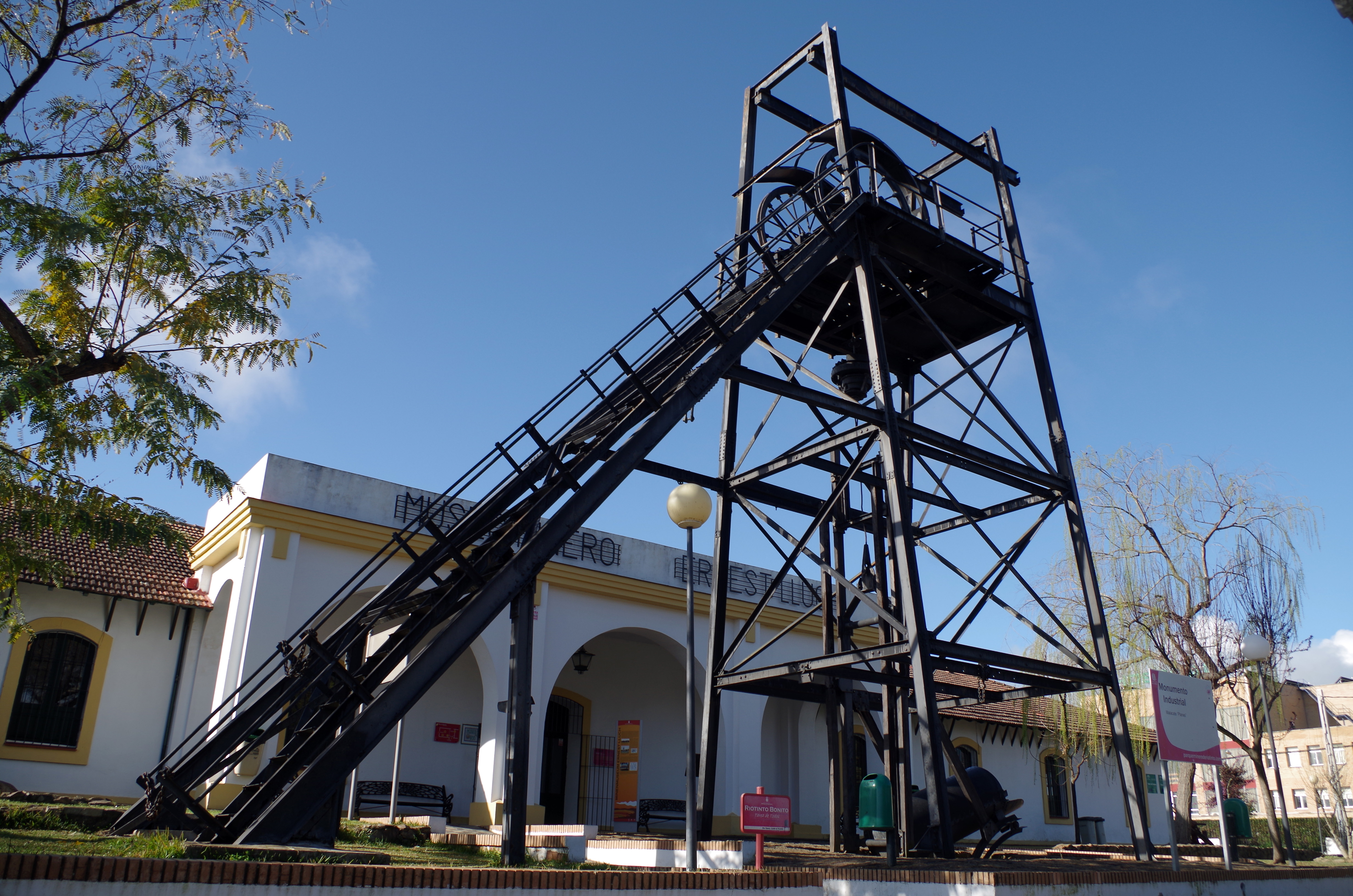
Riotinto Mining Museum
The river runs red here. The Rio Tinto -- literally, the Painted River -- takes its color from the acidic, iron-rich water that drains from five millennia of mining in this corner of Huelva province. The landscape around Minas de Riotinto is scarred and otherworldly, so extreme that NASA has used it as a Mars analog for astrobiology research. At the center of this industrial moonscape, inside a building that once served as the hospital for the Rio Tinto Company Limited's British employees, the Riotinto Mining Museum tells the story of one of the oldest and most continuously exploited mining sites on Earth.
From Hospital Wards to Exhibition Halls
The building that houses the museum was designed in 1921 as a hospital for the staff of the Rio Tinto Company Limited, the British firm that had purchased the mines from the Spanish government in 1873. The hospital operated from 1927 until 1983, treating the injuries and ailments of workers in one of the world's most productive copper and pyrite operations. In 1970, the south pavilion was converted for social security services. After the Rio Tinto Foundation was established in 1987 with the goal of preserving the region's mining heritage, the corporation ceded the hospital building for the planned museum. Restoration began in 1990, and the doors opened to the public in 1992 as part of the broader Riotinto Mining Park, an initiative to transform the spent industrial landscape into a cultural destination.
Five Thousand Years Underground
The museum's sixteen thematic rooms trace an arc from prehistory to the late 20th century, when the Riotinto mines finally ceased operations. Roman-era mining instruments share space with Victorian industrial machinery, illustrating how the same deposit was worked by radically different civilizations using radically different methods. In the basement, a reproduction of a Roman subway mine allows visitors to experience the cramped tunnels where enslaved laborers once extracted copper ore by hand. The collection includes minerals from the Iberian Pyrite Belt -- the massive sulfide deposit that stretches across southern Spain and Portugal, one of the largest concentrations of pyrite on the planet. The museum also houses archaeological remains and a room dedicated to the historic Riotinto Railway, complete with steam locomotives that once hauled ore from the mines to the port at Huelva.
The British Colony That Time Forgot
When the Rio Tinto Company Limited arrived in 1873, they brought not just mining technology but an entire way of life. The British built a parallel community complete with a Presbyterian church, a cricket ground, a hospital, and Victorian-style houses that still stand in the village of Bella Vista. For over a century, British managers and engineers lived in something approaching a colonial enclave in rural Andalusia, separated from the Spanish workers by language, religion, and the invisible walls of class. The hospital-turned-museum is itself an artifact of this peculiar transplantation -- a piece of British institutional architecture sitting in the Spanish countryside, now repurposed to tell a story that stretches back long before any Briton set foot in the Iberian Pyrite Belt.
Mars on Earth
The landscape surrounding the museum is as much a part of the story as anything inside it. Millennia of mining have created a terrain of open pits, slag heaps, and acid-red waterways that bears an unsettling resemblance to images from the surface of Mars. The Rio Tinto itself supports extremophile microorganisms that thrive in conditions lethal to most life -- a discovery that has made the area a subject of serious astrobiological study. From the air, the mining basin reads as a vivid palette of reds, oranges, and yellows carved into the green Andalusian hills, a wound in the earth that tells the story of human ambition across fifty centuries.
From the Air
Located at 37.693N, 6.597W in Minas de Riotinto, Province of Huelva, Andalusia, Spain. The open-pit mines and red-colored Rio Tinto are dramatic visual features from altitude. The landscape's distinctive red and orange coloring makes it unmistakable. Nearest airport: LEHC (Huelva, ~65 km south). The mining basin and rail line to Huelva are visible features.