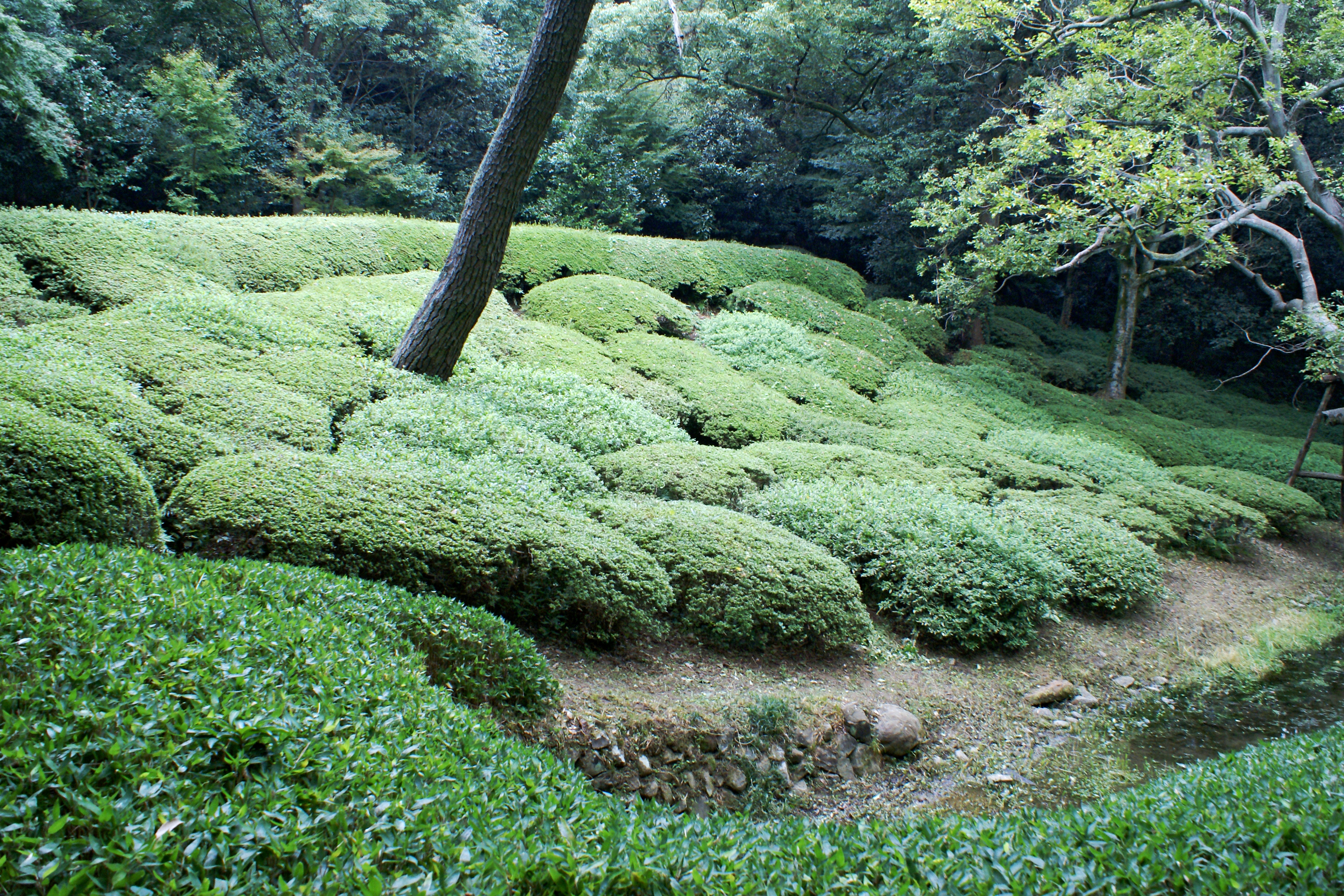
Ritsurin Garden
It took a hundred years to finish. Starting in 1625, when feudal lord Ikoma Takatoshi began shaping a garden around the South Pond, and ending in 1745 under the Fifth Lord Yoritaka, Ritsurin Garden grew through the ambitions of five successive lords of Takamatsu. Each inherited his predecessor's vision and expanded it, sculpting ponds, planting pines, and borrowing the forested slopes of Mt. Shiun -- "Purple Cloud Mountain" -- as a living backdrop that no gardener could have built. The result is one of the largest and most celebrated strolling gardens in Japan, a landscape designed to be experienced in motion, where every few steps reframe the view.
A Century of Shaping
The garden's origins trace to 1625 in the old province of Sanuki, when Ikoma Takatoshi chose the east side of Mt. Shiun as his site. The mountain's greenery would serve as borrowed scenery -- a technique in Japanese garden design where the surrounding landscape becomes part of the composition without being altered. After the Matsudaira clan took control of the province, successive lords continued the work, adding ponds, artificial hills, and teahouses over the next century. The Kikugetsu-tei, or Moon Scooping Pavilion, dates to around 1640 and remains one of the garden's most treasured structures. Its name evokes the act of cupping moonlight reflected in the water below -- a gesture that captures the garden's philosophy of framing fleeting natural beauty.
Two Gardens in One
Ritsurin is really two gardens divided by history. The southern portion preserves the traditional Japanese style of the Edo period: meticulously shaped black pine trees with branches trimmed into geometric forms, stone arrangements, and ponds stocked with koi. The northern portion tells a different story. After the Meiji government requisitioned the garden in 1868 and opened it to the public on March 16, 1875, the northern section was redesigned in Western style. A large museum building -- now the Commerce and Industry Promotion Hall -- and folk craft galleries were added. For a time, the garden even housed a zoo and a swimming pool, both since removed. The contrast between the two halves traces the cultural shifts that reshaped Japan in the late nineteenth century, from feudal seclusion to eager modernization.
The Art of the Pine
What distinguishes Ritsurin from other great Japanese gardens is the sheer density of its cultivated trees. The hakomatsu -- carefully maintained black pines -- are the garden's signature. Their branches, twigs, and needles are trimmed into elaborate geometric shapes that look almost sculptural, the product of generations of patient pruning. Some of these trees are centuries old, shaped continuously since the Edo period. Beyond the pines, the garden contains numerous ponds and streams, two artificial mountains called Hiraiho and Fuyo-ho, and a Wild Duck Hunting Moat that recalls the feudal lords' pastimes. Visitors toss food to koi that crowd the waterways, their orange and white forms flashing beneath weeping willows.
The Mountain Behind the Garden
Mt. Shiun does not belong to the garden, but the garden would not exist without it. The mountain's forested slopes -- dense with broadleaf evergreens and conifers -- rise behind the southern ponds, giving the landscape a depth and wildness that no arrangement of stones or pruned branches could achieve alone. On clear days, the mountain's reflection doubles in the still water of the South Pond, and the boundary between designed and natural dissolves entirely. The name Shiun means "Purple Cloud," a reference to the haze that sometimes settles on the slopes in certain light, lending the mountain an otherworldly quality that the garden's designers were wise enough to frame rather than compete with.
From the Air
Located at 34.33N, 134.04E in Takamatsu, Kagawa Prefecture, on the northeast coast of Shikoku. Nearest major airport is Takamatsu Airport (RJOT), approximately 15 km to the south. The garden sits on the eastern edge of the city near the Kotoku rail line. From altitude, look for the large green space against the base of Mt. Shiun on Takamatsu's east side. The Seto Inland Sea coastline is visible to the north. Recommended viewing altitude: 3,000-5,000 feet.