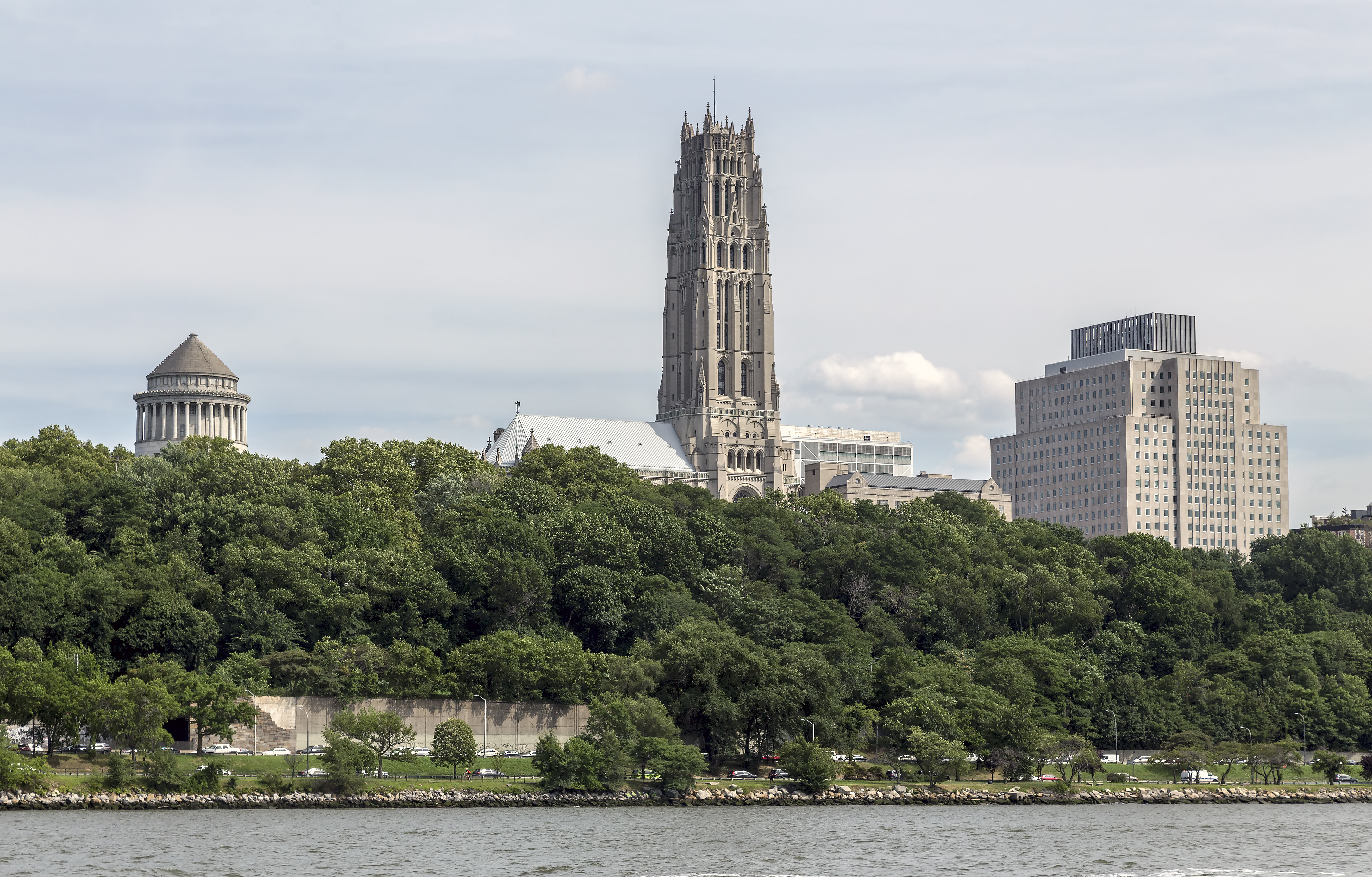
Riverside Church
The bells weigh a combined 100 short tons. That single fact captures something essential about Riverside Church: everything here operates at a scale that seems designed to make the sacred feel physical. The carillon in the 392-foot tower, though no longer the one with the most bells in the world, remains the heaviest by aggregate weight, its 74 bells and mechanisms totaling some 500,000 pounds. When they ring over Morningside Heights, the sound rolls down the Hudson and across Harlem, a vibration you feel in your chest before you identify it as music. John D. Rockefeller Jr. bankrolled this place, and he built it to last for generations.
A Rockefeller Cathedral in All but Name
Riverside Church grew from the ambitions of Harry Emerson Fosdick, a liberal Baptist minister who accepted the pastorate in 1925 on the condition that the congregation abandon its insistence on baptism by immersion and open its doors to all Christians. Rockefeller, already the congregation's most prominent member, purchased land near Grant's Tomb on the Hudson and commissioned architects Henry Pelton and Charles Collens to design a church modeled on the Gothic cathedral of Chartres. Construction began in 1926 and was completed in 1930. The building cost roughly four million dollars, an extraordinary sum at the time, and Rockefeller funded most of it personally. The result was a soaring nave supported by steel beams heavy enough to hold the massive carillon, a cloister passageway with Corinthian colonettes and grisaille windows, and a tower that dominated the Morningside Heights skyline. When it was finished, The New Yorker's architecture critic took notice. Statues of the architects and the general contractor, Robert Eidlitz, were carved above the cloister doorway, an unusual honor that speaks to the pride the builders took in their work.
The Pulpit That Shook the Nation
On April 4, 1967, exactly one year before his assassination, Martin Luther King Jr. stood at the pulpit of Riverside Church and delivered a speech that cost him allies and earned him enemies. "Beyond Vietnam: A Time to Break Silence" was King's most forceful public condemnation of the Vietnam War, linking the struggle for civil rights at home to the violence the United States was waging abroad. The speech fractured his relationship with the Johnson administration and drew sharp criticism from other civil rights leaders who feared it would distract from domestic goals. King chose Riverside deliberately. The church had positioned itself as a forum for moral argument on the largest questions of the day, and its pulpit carried weight. Jesse Jackson eulogized Jackie Robinson here in 1972. Nelson Mandela spoke from this same spot after his release from prison in 1991. Kofi Annan addressed the congregation after September 11, 2001. Fidel Castro, the Dalai Lama, and King Abdullah II of Jordan have all stood where Fosdick once preached. The New York Times has called Riverside "the Vatican for America's mainstream Protestants," and the comparison, while imperfect, captures the institution's outsized influence.
More Than a Sanctuary
Riverside Church was conceived from the outset as a social-services center disguised as a house of worship. Behind the Gothic facade are meeting rooms, classrooms, a daycare center, a kindergarten, a library, an auditorium, and a full gymnasium. The church runs a food bank, distributes clothing, offers confidential HIV testing and counseling, and operates barber-training programs. Its Coming Home ministry, founded in 1985, assists formerly incarcerated people after release, an extension of prison reform work that began in 1971. During the 1980s, Riverside joined the Sanctuary movement, sheltering undocumented immigrants. In 2011, the church donated tents to Occupy Wall Street protesters and took them in during cold weather after the evacuation of Zuccotti Park. The building's Martin Luther King Jr. Wing, renamed in 1985, houses much of this programmatic work across its seven floors. It is a church that has always understood ministry as action rather than abstraction.
Bells, Organs, and a Radio Station
The mechanical ambitions of Riverside Church extend well beyond the carillon. The tower contains four elevators, two reaching the tenth floor and two rising to the twentieth, where a mechanical power room and the clavier cabin sit above the bells. The heaviest steel beams in the entire structure were concentrated in the tower to support the carillon's weight, and the north facade of the nave hangs from a single cross truss weighing sixty short tons. Multiple organs have been installed and rebuilt over the decades, including instruments by Aeolian-Skinner and M. P. Moller. The church also operated its own radio station, WRVR on 106.7 FM, which broadcast sermons and cultural programming from 1960 until the church sold it in 1976 after years of annual losses. A trace of that era persists: a recorded Riverside sermon still airs on the station, now WLTW, early on Sunday mornings. From November 1976 to June 1987, the church hosted the Riverside Dance Festival, offering thirty-four weeks of programming from over sixty dance companies before a funding shortfall ended it.
A Tower on the Hudson
Approaching from the river, Riverside Church rises above Morningside Heights like a medieval fortress transplanted to Manhattan's Upper West Side. The tower's verticality draws the eye upward past Grant's Tomb and the trees of Riverside Park, a deliberate effect that Pelton and Collens achieved by borrowing from the proportions of Chartres. The interior surprises with its pink-painted walls and mirrored surfaces, details that soften the Gothic severity. Einstein's likeness appears on the facade among figures of scientists, a choice that sparked controversy during construction because he was both alive and Jewish at a time when the other depicted figures were deceased Christians. The committee had not originally included him, but someone decided that the greatest physicist of the age deserved his place on the wall. That willingness to provoke, to expand the definition of who belongs, has defined Riverside Church from its founding. It remains interdenominational, affiliated with both the American Baptist Churches USA and the United Church of Christ, a congregation that has never been content to stay inside the lines.
From the Air
Located at 40.8118N, 73.9631W on Morningside Heights in Upper Manhattan, overlooking the Hudson River. Best viewed from 2,000-3,000 feet AGL approaching from over the Hudson. The 392-foot Gothic tower is one of the tallest church structures in the United States and is easily identifiable. Grant's Tomb is immediately to the south. Columbia University campus lies to the east. Nearby airports: KLGA (LaGuardia) 6nm east, KTEB (Teterboro) 8nm northwest.