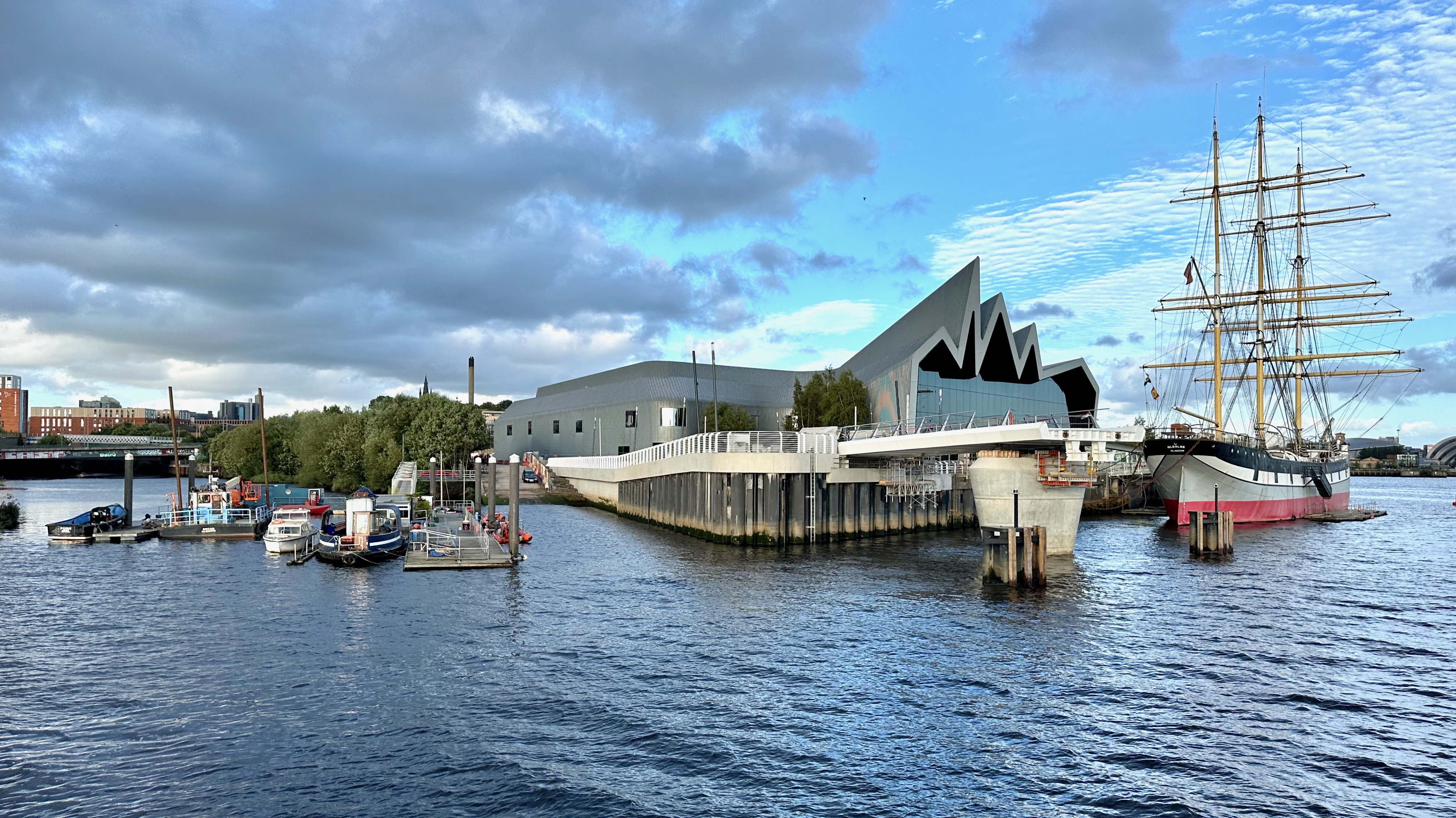
Riverside Museum
The PS Waverley, the last seagoing paddle steamer in the world, was built at Pointhouse Quay on the River Clyde by the shipyard of A. and J. Inglis. Today, on that same quay where more than five hundred ships were launched, the tall ship Glenlee rides at permanent berth beside a building that looks like nothing the Clyde has ever seen before. The Riverside Museum, designed by Zaha Hadid and opened in 2011, is Glasgow's museum of transport -- a seventy-four-million-pound structure whose zigzag roofline suggests the pleated surface of a wave frozen in zinc. Inside, the story of a city that once moved the world is told through locomotives, tramcars, ship models, and the oldest surviving pedal bicycle.
Three Homes in Fifty Years
Glasgow's transport collections have been nomadic. The museum was born in 1962, created in the wake of the closure of Glasgow's tram system, and initially housed in the former Coplawhill tram depot on Albert Drive in Pollokshields. That building was later converted into the Tramway arts center. In 1988, the collections moved to the Kelvin Hall, opposite Kelvingrove Art Gallery and Museum, where they occupied a cavernous exhibition space originally built in 1927. By the early 2000s, it was clear the Kelvin Hall could not do justice to the scope of the collection. The search for a third and permanent home led to Pointhouse Quay, where the confluence of the River Kelvin and the Clyde offered both a waterfront setting and a direct connection to Glasgow's shipbuilding heritage.
Hadid's Wave on the Clyde
Zaha Hadid won the architectural competition in October 2004. Her design was unveiled the following year: a long, narrow building whose roof rises and falls in dramatic pleats, its walls of glass opening onto both the city and the river. Engineers Buro Happold translated Hadid's vision into a structure that could sit on the unstable ground of a former shipyard. The Lord Provost of Glasgow cut the first turf in November 2007. Construction took nearly four years, with BAM Construct UK as the main contractor. Glasgow City Council and the National Lottery Heritage Fund committed sixty-nine million pounds; a charitable trust raised the remaining five million from corporate and individual donors. The building was completed on 20 June 2011 and opened to the public the following day.
The Clyde Room and the Ships That Made Glasgow
The Clyde Room contains some 250 ship models representing the contribution of the River Clyde to global maritime trade and the Royal Navy. Here are models of the Comet of 1812, the first commercially successful steamship in Europe; the mighty Hood; the Queen Mary and Queen Elizabeth; and the QE2. Locomotive manufacture was equally central to Glasgow's industrial identity. The museum displays engines from the Caledonian Railway, the Highland Railway, the North British Railway, and a South African Railways 15F locomotive built by the Glasgow-based North British Locomotive Company at its Polmadie Works in 1945. The locomotive was brought home from South Africa in 2006 and displayed in George Square before taking its place in the new museum.
Kelvin Street and the Lost City
One of the museum's most evocative exhibits is the reconstruction of 'Kelvin Street,' a full-scale replica of 1930s Glasgow. Visitors walk through a recreated streetscape that includes a pre-1977 Glasgow Subway station -- built using salvaged fittings from the former Merkland Street station -- and a replica of the Regal Cinema, which screens Scottish transport documentaries including the Oscar-winning Seawards the Great Ships. Seven Glasgow Corporation tramcars from different eras trace the evolution of the city's public transport, alongside trolleybuses, horse-drawn vehicles, fire engines, motorcycles, and the world's leading collection of Scottish-built cars from manufacturers like Argyll, Arrol-Johnston, and Albion Motors.
The Tall Ship at the Door
Berthed alongside the museum, the Glenlee is one of only five Clyde-built sailing ships still afloat. Launched in 1896 from the Bay Yard of A. Rodger and Company in Port Glasgow, she sailed around Cape Horn fifteen times carrying bulk cargo. The Clyde Maritime Trust saved her from the scrapyard, and she now serves as a floating exhibit, her masts and rigging visible from the museum's river-facing glass walls. Together, the Glenlee and the Riverside Museum sit on ground where ships were built for over a century, at the point where a small river meets the great one that gave Glasgow its purpose. The museum tells the story of how things moved -- by sea, by rail, by road, by tram -- and in doing so tells the story of the city itself.
From the Air
The Riverside Museum sits at 55.865°N, 4.306°W at Pointhouse Quay in Partick, Glasgow, where the River Kelvin meets the River Clyde. The distinctive zigzag zinc roofline designed by Zaha Hadid is visible from the air, with the tall ship Glenlee berthed alongside on the Clyde. Nearest airport: Glasgow International (EGPF, 5 nm west). The museum is approximately 1 nm west of Glasgow city center, on the north bank of the Clyde. The Clyde Arc bridge and SEC Armadillo are visible to the east.