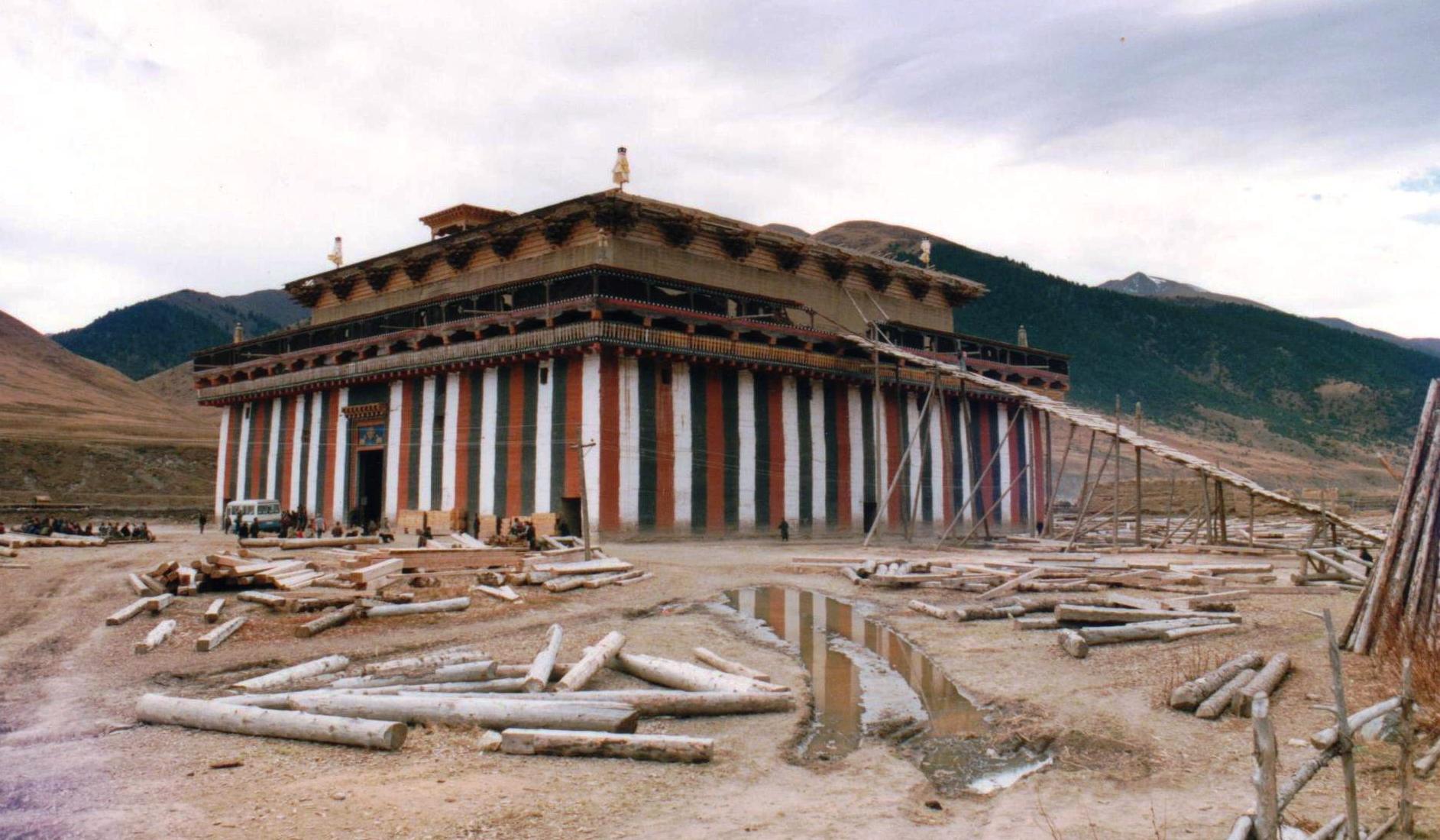
Riwoche Monastery
The columns are the first thing you notice. Massive tree trunks, stripped but uncarved, painted in vertical stripes of red, black, and white -- the signature colors of the Taklung Kagyu lineage. They hold up a three-story temple in a fertile valley of eastern Tibet, 134 kilometers west of Chamdo, where the Dzi River runs toward the Mekong. Riwoche Monastery was founded in 1276 CE, making it one of the oldest and largest monastic institutions in Kham. According to the Blue Annals, the 15th-century history of Tibetan Buddhism compiled by Go Lotsawa, Riwoche once held the greatest reputation among all Khampa monasteries. At its peak, 2,000 monks lived and studied here. Today 305 remain, carrying forward a tradition of philosophy and logic that has survived seven and a half centuries of upheaval.
A Lineage Divided
Riwoche owes its existence to a student named Sangye On. His teacher, Sangye Yarjon, was the third lineage-holder of the Taklung branch of the Kagyu school -- one of the four major schools of Tibetan Buddhism. From its founding, the Taklung lineage split into "upper" and "lower" branches. Riwoche became the seat of the lower branch, and its influence radiated across eastern Tibet. The Kagyu school emphasizes the direct transmission of teachings from master to student, which gives individual monasteries outsized importance as repositories of specific lineages. Riwoche's role as the Taklung Kagyu headquarters in Kham meant that its abbots wielded both spiritual and political authority. Sangye On's disciple Choku Orgyan Gonpo, who lived from 1293 to 1366, became the second abbot and consolidated the monastery's position. The surrounding community grew to include practitioners from both the Kagyu and Nyingma schools, some of them married -- an unusual arrangement that reflected Kham's frontier pragmatism.
Tree Trunks and Painted Stripes
The main temple's architecture makes the monastery's lineage visible from a distance. The three-story structure rises from huge tree trunks -- columns that are essentially whole trees, their bark removed but their form preserved. These are painted in the alternating red, black, and white vertical stripes distinctive of the Taklung Kagyu tradition. The effect is both imposing and startlingly organic, as if the building grew from the forest floor rather than being constructed upon it. Inside, the monastery housed a notable 14th-century cloth painting called the Jnanatapa, depicting the Onpo Lama Rinpoche and the spiritual lineage of Riwoche -- a kind of visual genealogy of the transmission of Buddhist teachings through the centuries. The painting was unearthed in recent years, having survived the period of destruction that nearly erased the monastery entirely.
Destruction and Restoration
Riwoche did not survive the 20th century intact. During the upheavals that swept Tibet under Chinese Communist rule, the monastery was destroyed -- its buildings dismantled, its treasures scattered or lost. The destruction was part of a broader campaign against Tibetan religious institutions that targeted thousands of monasteries across the plateau. Riwoche's history of philosophical rigor and its standing as the most respected monastery in Kham made it a symbolic as well as material target. Restoration began in 1985, a painstaking process of rebuilding what could be rebuilt and mourning what could not. The three-story temple was reconstructed with its distinctive painted columns. Monks returned. By the early 21st century, 305 monks were again in residence -- a fraction of the historical peak of 2,000, but enough to sustain the teaching lineages in philosophy and logic that had made Riwoche famous across the Tibetan Buddhist world.
Valley of the Dzi River
The monastery sits at approximately 3,400 meters in a valley that the Dzi River, a tributary of the Mekong, has carved into the eastern Tibetan highlands. The setting is characteristic of Kham: a fertile valley floor surrounded by mountains, isolated enough to develop its own character, connected enough by river and trail to participate in the broader Tibetan world. Ratsaka, the nearest town (also known as Riwoche Town), lies 29 kilometers to the south. Chamdo, the largest city in eastern Tibet, is 134 kilometers to the east. The remoteness is relative -- Kham has always been remote by lowland standards -- but it helped preserve what the destruction could not erase: the oral traditions, the philosophical debates, the teacher-student relationships that constitute the Taklung Kagyu lineage. A monastery can be demolished. The knowledge its monks carry in their memories is harder to destroy.
From the Air
Located at 31.37N, 96.50E in the Chamdo region of eastern Tibet Autonomous Region. The monastery sits at approximately 3,400 meters elevation in the Dzi River valley, a tributary of the Mekong. Terrain is mountainous -- the eastern Tibetan Plateau with peaks exceeding 5,000 meters surrounding valley systems. Chamdo Bangda Airport (ZUBD) is the nearest airport, approximately 134 km to the east and one of the world's highest commercial airports at 4,334 meters. The Dzi River valley is identifiable from altitude as a green corridor running through brown and gray highland terrain. Expect challenging mountain weather, strong winds, and limited visual references in cloud.