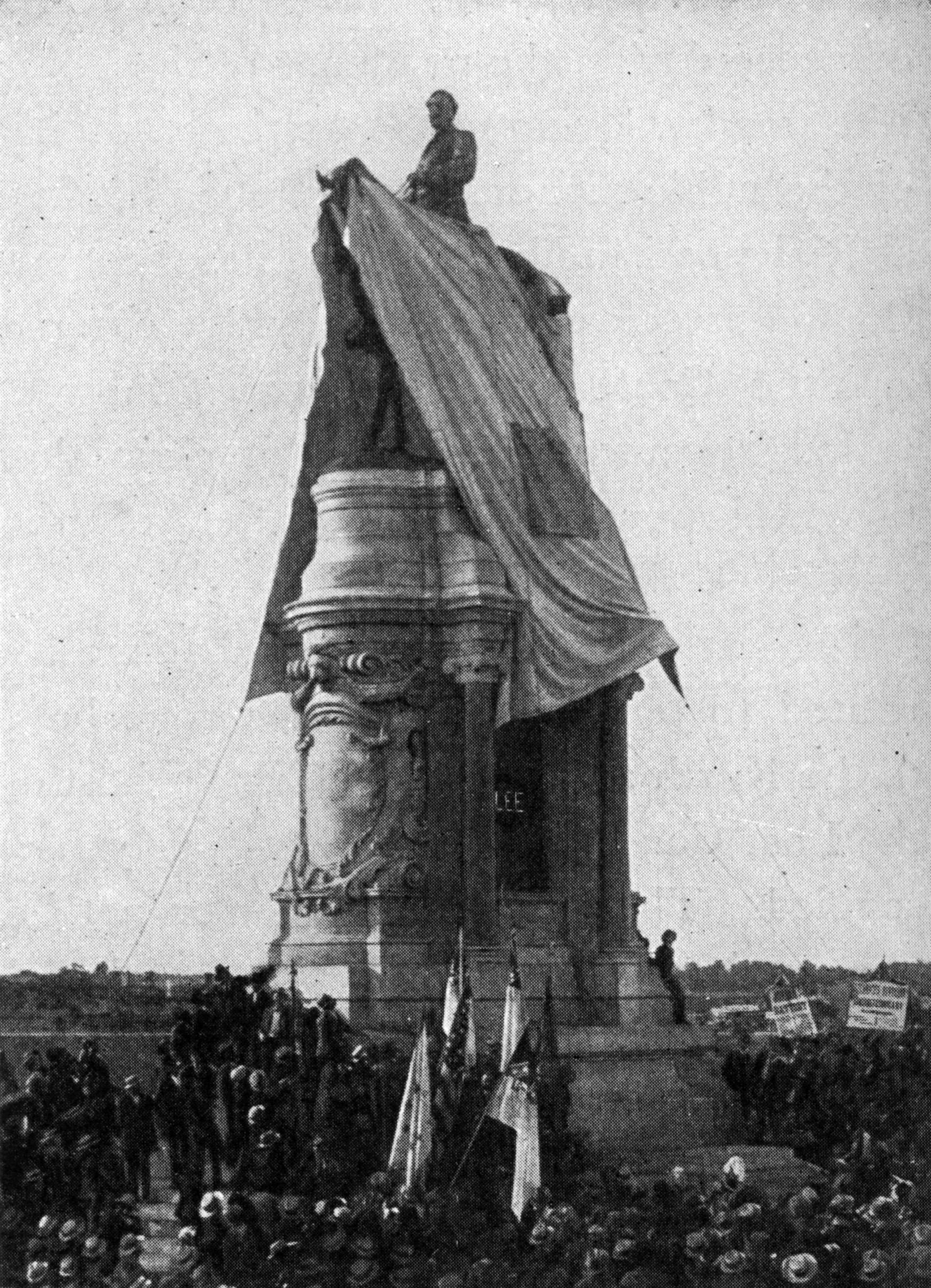
Robert E. Lee Monument (Richmond, Virginia)
For 131 years, a bronze Confederate general on horseback presided over the center of Richmond from a traffic circle that online maps once treated as the city's geographic heart. The Robert E. Lee Monument arrived on Monument Avenue in 1890. It left on September 8, 2021, hoisted away by crane while thousands watched and cheered. Between those two dates stretches a story not just about a statue, but about what a city chooses to honor, who gets to decide, and how long it takes a democracy to change its mind.
Sculpted in Paris, Hauled by Thousands
The monument began as an act of collective Confederate mourning. After Robert E. Lee died in 1870, survivors of his Army of Northern Virginia, the Lee Monument Association led by General Jubal Early, and the Ladies' Lee Monument Association all pursued separate efforts to memorialize their commander. These groups merged into the Lee Monument Commission in 1886, led by Lee's nephew and Virginia governor Fitzhugh Lee, pooling $52,000 in funds. French sculptor Antonin Mercié, chosen for his international reputation, threw himself into research, acquiring period saddles, stirrups, coats, and boots to ensure accuracy. Journalist Lida McCabe, who observed the final transaction in France, noted the striking contrast between Mercié's artistic devotion and the American representative's indifference to the sculpture itself. The cornerstone was laid on October 27, 1887. When the completed statue arrived by rail on May 4, 1890, newspaper accounts describe 10,000 people turning out to haul the four wagons bearing its pieces to the site. The monument was unveiled on May 29, 1890, though not without protest: a group of U.S. army veterans in Illinois passed a resolution entitled 'treason must be made odious,' denouncing the display of Confederate flags at the dedication.
Alone in a Tobacco Field
The monument's early years were surprisingly unglamorous. Developer Otway Allen had donated the land for the statue, and Richmond annexed it in 1892, but economic difficulties stalled neighborhood development. For several years the towering bronze general stood alone in the middle of a tobacco field on the city's outskirts. Monument Avenue would not take shape until the early 1900s, when the surrounding land was developed into the grand residential boulevard that eventually gave the monument its context. Over the next century, the Lee Monument became a focal point of Richmond's identity, listed on the Virginia Landmarks Register in 2006 and the National Register of Historic Places in 2007. A time capsule embedded in the base pedestal during construction became the subject of decades of curiosity, its contents the source of competing legends.
Summer of Reckoning
The monument's transformation began in the summer of 2020. Following the murder of George Floyd, Virginia Governor Ralph Northam ordered the statue's removal on June 4. Legal challenges came immediately. A lawsuit citing an 1887 deed in which the Commonwealth promised to 'faithfully guard' and 'affectionately protect' the statue led to injunctions, hearings, and a trial that stretched through the fall. Meanwhile, the traffic circle became something else entirely. Protesters rechristened it Marcus-David Peters Circle, memorializing a Black Richmond man shot and killed by police in 2018 while unarmed. Graffiti transformed the monument's stone pedestal into a canvas of protest art. Ballerinas danced at the base. Video projections of George Floyd, Malcolm X, and Angela Davis flickered across the bronze surface at night. By October 2020, the New York Times named the graffiti-covered monument among the most influential American protest artworks since World War II.
The Last Confederate Statue Falls
On September 2, 2021, the Supreme Court of Virginia ruled unanimously that the restrictive covenants from 1887 and 1890 were no longer enforceable. Six days later, the bronze sculpture was lifted from its plinth. Governor Northam marked the occasion: 'After 133 years, the statue of Robert E. Lee has finally come down, the last Confederate statue on Monument Avenue, and the largest in the South.' Two weeks later, the Emancipation and Freedom Monument was installed at nearby Brown's Island. The Lee statue was transferred to the Black History Museum and Cultural Center of Virginia, approved unanimously by Richmond City Council. When crews dismantled the pedestal in February 2022, they recovered two time capsules: a lead box containing mementos from the monument's 1889 planning commission and a copper box from the original 1887 cornerstone. A new time capsule replaced them, containing 39 items including artifacts from the COVID-19 vaccination campaign, items from the Mattaponi and Pamunkey nations, and a railroad spike found near the Shockoe Bottom African Burial Ground. The traffic circle is now a bare patch of grass.
From the Air
Located at 37.554°N, 77.460°W in Richmond, Virginia. The former monument site is a traffic circle at the intersection of Monument Avenue and Allen Avenue. From the air, Monument Avenue is visible as a wide, tree-lined boulevard running northwest-southeast. The circle is now an open grassy area. Nearest airports: Richmond International (KRIC) approximately 7 nm southeast; Chesterfield County (KFCI) approximately 10 nm southwest. Best viewed at 2,000-3,000 ft AGL.