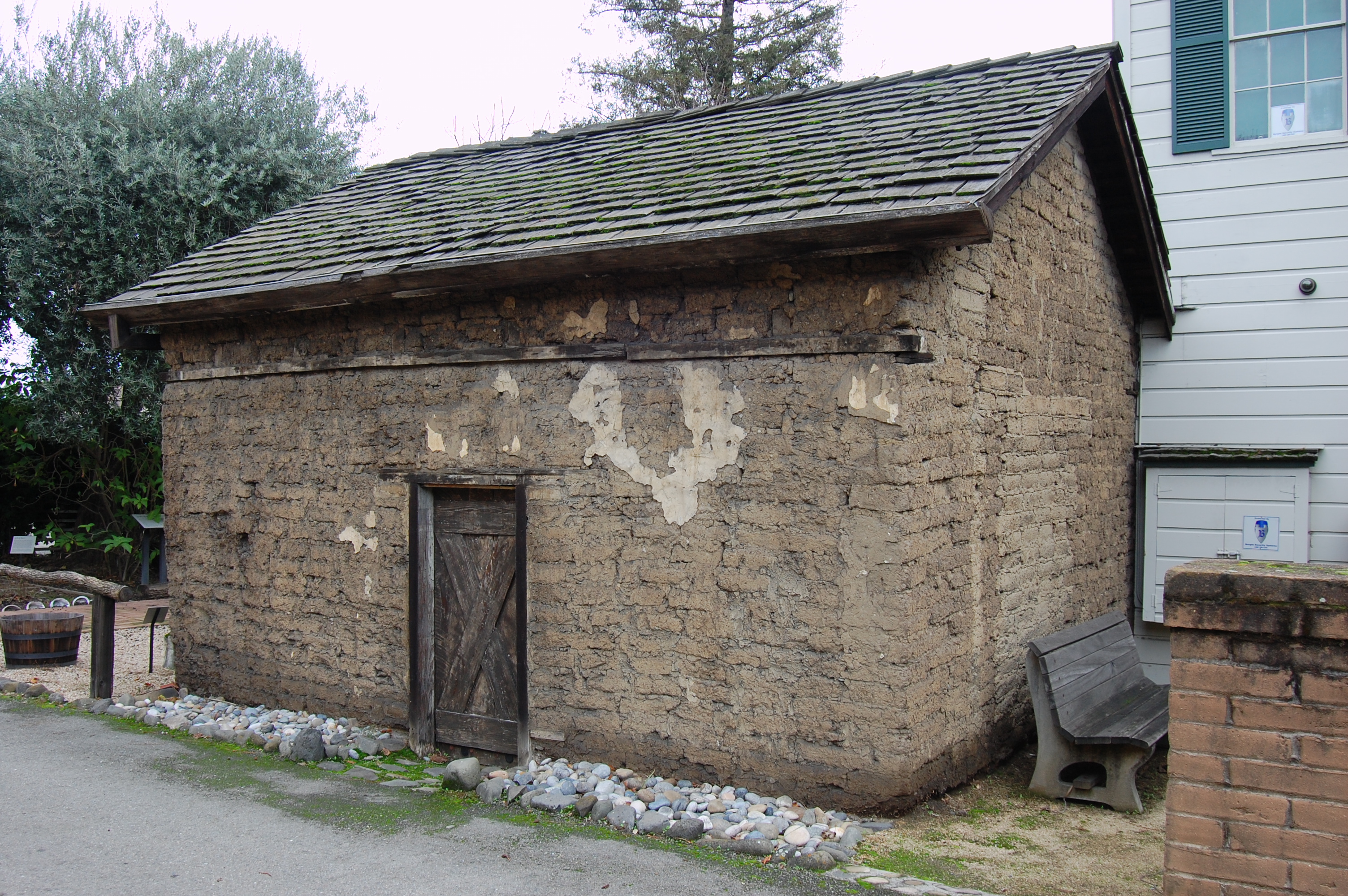
Roberto-Sunol Adobe
The name on the land grant reads Roberto Balermino, and the land was called Rancho Los Coches -- the Ranch of the Pigs. It was 1836, a full fourteen years before California joined the United States, and Balermino, a Tamien man of the Ohlone people, was building a one-story adobe house on 2,219 acres of what is now Midtown San Jose and Willow Glen. He was one of a small number of indigenous Californians to hold a Mexican land grant in his own name, a distinction that says as much about the exceptions to colonial dispossession as about the rule. Governor Manuel Micheltorena formally confirmed the grant in 1844, but by then Balermino had already been living in his adobe for eight years.
A Debt Paid in Land
In 1847, the rancho changed hands -- not through conquest or sale, but through debt. Spanish-born businessman Don Antonio Sunol, who had lived in California since the 1820s, obtained Rancho Los Coches from Balermino in payment of what Balermino owed him. Sunol built an adjoining house of brick, making it the first brick structure completed in Alta California. Where Balermino's adobe was earth and straw shaped by hand, Sunol's house announced a different era -- one of fired bricks and mercantile ambition. The two structures stood side by side, separated by eleven years and by the distance between indigenous landholder and colonial entrepreneur. Both buildings were placed on the National Register of Historic Places on March 17, 1977, and California Historical Landmark marker number 898 was erected in front of the Sunol House that same year.
The Sea Captain's Balcony
In 1853, the property passed to Captain Stefano Splivalo, a Dalmatian sea captain who had apparently decided that a ranch in the Santa Clara Valley suited him better than the Adriatic. Splivalo transformed the Sunol House, adding a second story, a balcony, and wooden siding over the original brick walls. During the 1870s he expanded further, adding three rooms on the eastern side. The Splivalo family lived there for four decades, long enough that the house became known as "Laura Ville." After the captain died in 1891, the property drifted through several owners. In 1906, Julio Bassoni, an Italian immigrant, bought the houses and a surrounding four-acre parcel. His family maintained a traditional Willow Glen orchard on the land until 1966, growing fruit on the same ground where Balermino had once raised pigs.
Lifting the Second Story
By the 1970s, the adobe and its brick companion were deteriorating. John Bruzzone Sr., whose family had settled on Willow Street in 1934, owned the land behind the home site and stumbled upon the structures in 1973. He recognized what he had found. Bruzzone hired adobe-architecture specialist Gilbert Sanchez, an architect, and a contractor to undertake a restoration that bordered on engineering spectacle: they lifted the entire second story off the Sunol House, reinforced the first floor with concrete and steel, then set the upper story back down. The restored buildings reopened to the public in 1977, the same year they received their National Register listing. Laura Ville was leased as law offices for the next thirty-five years, an afterlife as improbable as its construction.
From Rancho to Museum
In August 2016, the California Pioneers of Santa Clara County opened the Roberto Adobe and Sunol House Museum, a free public museum inside the restored structures. The nonprofit's mission is to preserve the layered history the buildings represent -- Ohlone, Mexican, Spanish, Dalmatian, Italian, and finally the postwar suburbanization of Willow Glen. Walking through the rooms, visitors move from Balermino's adobe walls, built of the earth itself, to Splivalo's Victorian modifications, to the Bruzzone-era concrete reinforcement. Each layer is visible, deliberate, and honest about the compromises preservation requires. The museum stands in a neighborhood of mid-century houses and tree-lined streets, a quiet block where one of San Jose's oldest surviving structures sits between homes built more than a century after it.
From the Air
Located at 37.32N, 121.91W in the Willow Glen neighborhood of San Jose, the Roberto-Sunol Adobe is not individually visible from altitude but sits within the residential grid south of downtown San Jose, identifiable by the tree-canopy pattern of Willow Glen. Nearest airports: San Jose International (KSJC, 4nm N), Reid-Hillview (KRHV, 5nm E). Best viewed at 2,000-3,000 feet AGL as part of the Willow Glen neighborhood overview.