Robins Air Force Base
Before he became the father of Air Force logistics, Augustine Warner Robins traveled through China disguised as a millionaire tourist, collecting intelligence for the Army. He chased Pancho Villa across the Mexican border under General Pershing. He earned his pilot wings in June 1918, only to have the armistice rob him of combat. And in 1921, a near-fatal plane crash shattered his jaw and arm. When Robins died of a heart attack on Father's Day 1940 at Randolph Field, Texas, the system he built for cataloging military supplies and materials had already transformed how America prepared for war. A year later, Colonel Charles Thomas landed at Herbert Smart Airport near Macon, Georgia, scouting a site for an Army Air Corps depot. He chose the sleepy whistle-stop town of Wellston, 18 miles south of Macon, and he chose the name Robins for the field, honoring his mentor.
From Dairy Farms to Arsenal
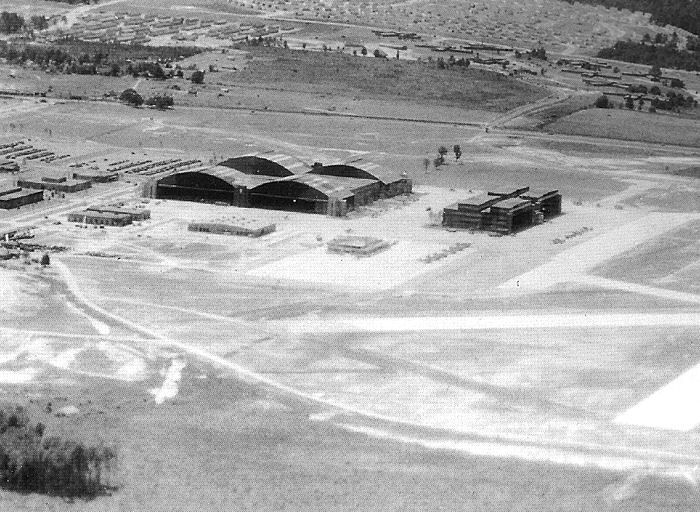
The War Department's selection of middle Georgia dairy-farm country seemed improbable. Wellston barely registered on a map. But Macon civic leaders, backed by Congressman Carl Vinson, had lobbied hard, and by August 1942 construction on the depot was complete. During World War II, the workforce swelled to over 23,000 employees repairing nearly every type of Army Air Force aircraft in the inventory: B-17 Flying Fortresses, C-47 Skytrains, B-29 Superfortresses, B-24 Liberators, P-38 Lightnings, P-47 Thunderbolts, and P-51 Mustangs. The base became a logistics engine, and the once-anonymous town reinvented itself as Warner Robins, eventually growing into the sixth-largest city in Georgia.
Wars Fought from the Shop Floor
Robins never fired a shot in anger, but its reach extended into every American conflict of the Cold War era. During Vietnam, maintenance teams flew to Southeast Asia to repair battle-damaged aircraft while the base modified C-130 Hercules transports into AC-130 gunships and converted AC-119s for close air support. The same C-141 Starlifters maintained at Robins resupplied Israel during the 1973 Yom Kippur War. In October 1983, Robins C-130s supported the invasion of Grenada. During the 1990-91 Persian Gulf War, the base delivered record numbers of parts, repairs, and personnel to coalition forces, with Robins-maintained F-15 Eagles and E-8 Joint STARS aircraft playing key roles. Between 1977 and 1981, the base also served as President Jimmy Carter's air terminal for visits to his hometown of Plains, Georgia.
The Machine That Keeps the Fleet Flying
Today the Warner Robins Air Logistics Complex is one of only three such facilities in the entire Air Force, alongside Oklahoma City at Tinker AFB and Ogden at Hill AFB in Utah. The complex employs over 25,000 civilian, contractor, and military personnel, making it the single largest industrial complex in the state of Georgia with an annual payroll exceeding one billion dollars. Its hangars and workshops have worldwide responsibility for the repair, modification, and overhaul of F-15 Eagles, C-5 Galaxy and C-5M Super Galaxy transports, C-130 Hercules, C-17 Globemaster IIIs, AC-130 gunships, U-2 Dragon Lady reconnaissance planes, RQ-4 Global Hawks, and every helicopter in the Air Force inventory. The base also hosts the headquarters of Air Force Reserve Command and operates the E-8C Joint STARS airborne battlefield surveillance platform.
Wings on Display
Adjacent to the base, the Museum of Aviation sprawls across 51 acres with more than 85 historic aircraft and missiles on display, making it the second-largest museum in the U.S. Air Force system. Founded in 1981, its collection includes a B-1 Lancer, a B-52 Stratofortress, an SR-71 Blackbird, a Marietta-built B-29, and a C-123 Provider modified for Operation Ranch Hand, the controversial herbicide-spraying missions over Vietnam. The museum also houses the Georgia Aviation Hall of Fame. More than 500,000 visitors walk through its four major exhibition buildings each year, making it one of the most visited aviation museums in the American South.
Tornado Alley on the Flight Line
Central Georgia's weather has tested the base repeatedly. On April 30, 1953, an F4 tornado with winds exceeding 200 mph tore through the installation, killing 18 people nearby and injuring 300. Just ten months later, another tornado struck. At least seven tornadoes have hit the base and surrounding area over the decades, including an EF-1 that ripped hangar roofs off on April 1, 2016. The base's resilience to these storms mirrors its broader character: a place built to absorb punishment, repair what's broken, and send it back into service.
From the Air
Robins AFB sits at 32.64°N, 83.59°W in Houston County, Georgia, approximately 100 miles south-southeast of Atlanta. The airfield identifier is KWRB. The base and its massive hangar complexes are clearly visible from altitude, bordered by the city of Warner Robins to the west and the Ocmulgee River to the east. The Museum of Aviation campus is visible on the southwest side of the base. Nearby civilian airports include Middle Georgia Regional (KMCN) in Macon, roughly 18 miles to the north.