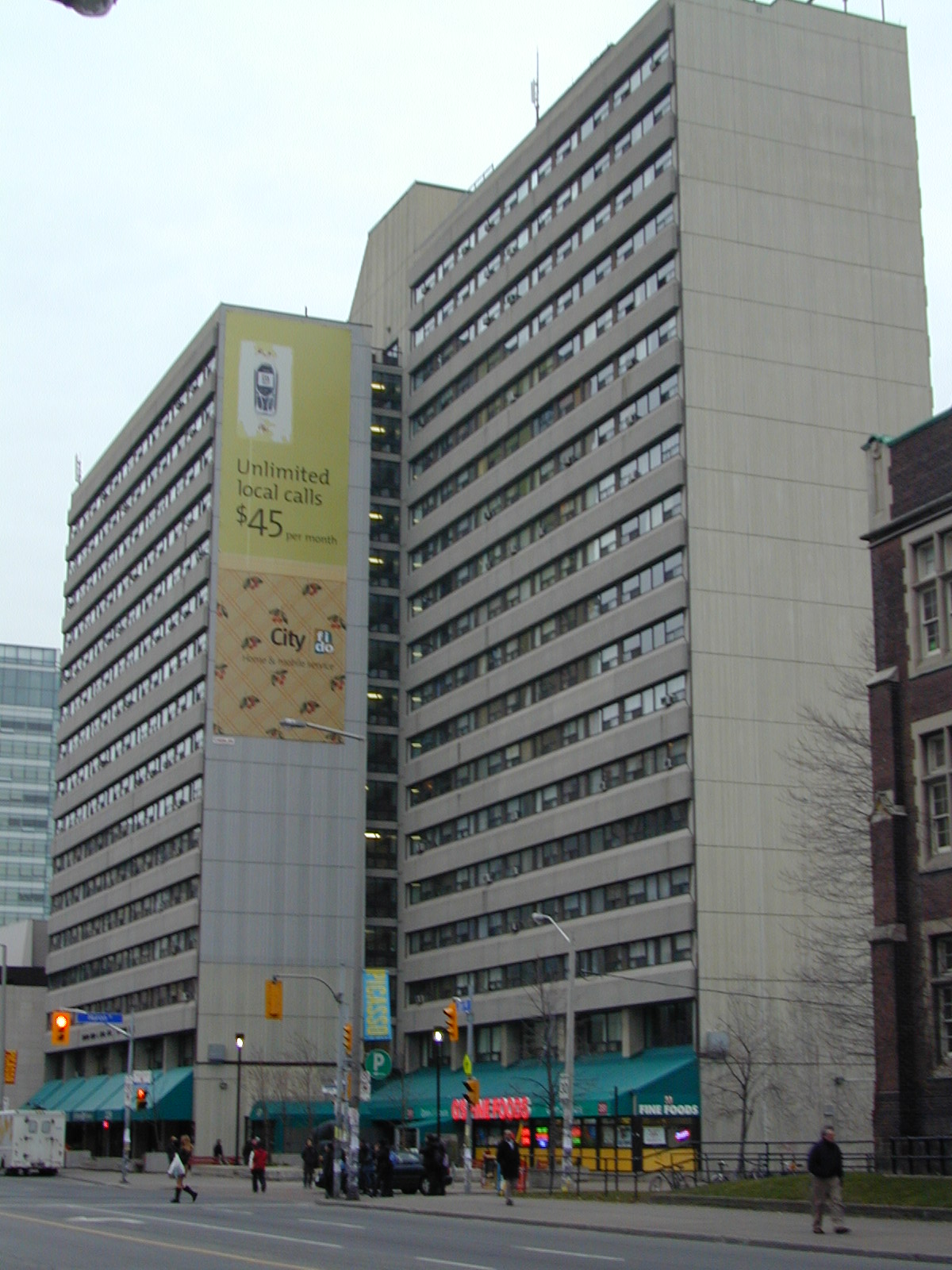
Rochdale College: The 18-Storey Experiment That Swallowed Itself
A Bachelor's degree cost twenty-five dollars and required answering one simple question. A Master's cost fifty, with the applicant choosing the question. A PhD ran one hundred dollars - no questions asked. That pricing structure tells you most of what you need to know about Rochdale College, the 18-storey concrete tower at 341 Bloor Street that housed North America's largest co-operative residence from 1968 to 1975. What began as a solution to student housing demand at the University of Toronto became a free university, a commune, a pirate radio station, a health clinic, a self-contained society - and eventually, in the words of the CBC, 'North America's largest drug distribution warehouse.' On May 30, 1975, police carried the last residents from the building. The doors were welded shut behind them.
An Accidental Skyscraper
Rochdale began in 1958 when nineteen-year-old philosophy student Howard Adelman was hired by the Campus Co-operative to address housing demand at the University of Toronto. Campus Co-op formed a non-profit offshoot, secured federal mortgages at below-market rates, and incorporated Rochdale College in 1964. The building was never supposed to be so tall. Campus Co-op wanted a structure at two times lot coverage - modest and manageable. But Rochdale's location on a busy arterial road meant zoning allowed seven times coverage, inflating capacity to 840 residents. The founders greeted this with enthusiasm. The intellectual leader Dennis Lee pushed for education to be central; Adelman noted that running an education program for $75,000 would save $175,000 in property tax. The free university was, in part, a tax dodge. The building opened floor by floor through the fall of 1968, and screened applicants - mostly U of T students - could not wait. A practical decision was made to admit 'people who walked in right off the street.'
A Separate Society Inside a Building
The architecture was designed for communal living. Some floors were divided into 'ashrams' - units of about a dozen bedrooms sharing a collective kitchen, dining room, and washroom. Other areas had conventional apartments. The first two floors held common spaces for socializing, education, and commerce. The roof was accessible from the 18th floor; clothing there was optional. Between 1970 and 1973, residents built what amounted to a parallel city within the concrete tower. They founded a health clinic where babies were born, a library, food services, a child care centre, an in-house radio and TV station, and a newspaper. The pirate radio station was called CRUD. The CRTC tried to shut it down repeatedly; the staff kept it on the air. There was a health-food store, a rooftop laundromat, a free school called Superschool where children designed their own curriculum, and a medical clinic staffed by a registered nurse. Some inhabitants reportedly did not go outside for weeks at a stretch.
The Cultural Engine
Rochdale's influence on Toronto's cultural institutions was substantial. Participants were involved with Coach House Press, Theatre Passe Muraille, the Toronto Free Dance Theatre, and House of Anansi Press. This Magazine - originally called This Magazine is About Schools - had connections to Rochdale. The Spaced-out Library, founded by science fiction writer Judith Merril, later became the Merril Collection at the Toronto Public Library. Rochdale's co-op daycare, Acorn, was relocated to the basement of nearby St. Thomas Church and still operates today as Huron Playschool Cooperative. Students had complete freedom to develop their own learning process. The college included theatres for drama and film and a ceramics studio. Students decided school policy and made their own evaluations. No accredited degrees were awarded - only the joke degrees, and their equally witty 'non-degrees,' which required saying something (BA), something logical (MA), or something useful (PhD).
When the Bikers Moved In
Rochdale's commitment to consensus decision-making was also its undoing. Granting a vote to everyone who lived - or claimed to live - in the building, the governing body could not reach agreement to expel those who failed to pay rent or live up to its ideals. As nearby Yorkville gentrified in the late 1960s, Toronto's counterculture migrated into Rochdale. Homeless squatters arrived. Then bikers dealing hard drugs. Undercover RCMP officers followed. Until late 1971, an unwritten code had kept hard drugs out. Then the governing council hired biker gang members as security, and an alliance with the Vagabonds outlaw motorcycle club took hold. By 1971, the CBC reported that hash, pot, and LSD were in large supply. Rochdale's educational mission evaporated as the drug business expanded. Unable to pay its mortgage to the Canadian government, the college drifted toward insolvency. Political pressure forced financial foreclosure, and Rochdale closed in 1975.
What Remains at 341 Bloor
The 18-storey tower still stands at 341 Bloor Street, now called the Senator David A. Croll Apartments. Its sister building, the Tartu student residence, sits a short distance west on Bloor. Both were designed by architects Elmar Tampold and John Wells. In front of the building stands a sculpture called the Unknown Student. In Rochdale's final days, the college published its own epitaph: 'Drug dealing is now the domain of the professionals, i.e. lawyers, doctors, etc. Let's hope they never get to live in the same building.' Chronicler David Sharpe wrote that 'the accomplishment of Rochdale cannot be separated from its eventual destruction, and an institution that was not allowed to be self-destructive about such sweeping questions would have tested nothing at all.' In 2022, Canadian playwright David Yee staged a play about Rochdale at the Summerworks theatre festival. The experiment ended. The questions it asked did not.
From the Air
Located at 43.667N, 79.401W on Bloor Street at Huron Street in downtown Toronto, on the northwest edge of the University of Toronto campus. The 18-storey tower at 341 Bloor Street (now the Senator David A. Croll Apartments) is visible among the mid-rise and low-rise buildings of the Annex neighbourhood. Yorkville, the upscale shopping district that was once Toronto's hippie centre, is immediately north. The University of Toronto's main campus spreads south and east. Billy Bishop Toronto City Airport (CYTZ) is 3 km south. From 2,000-3,000 feet, the building is identifiable as a concrete tower among lower structures along Bloor Street's commercial corridor.