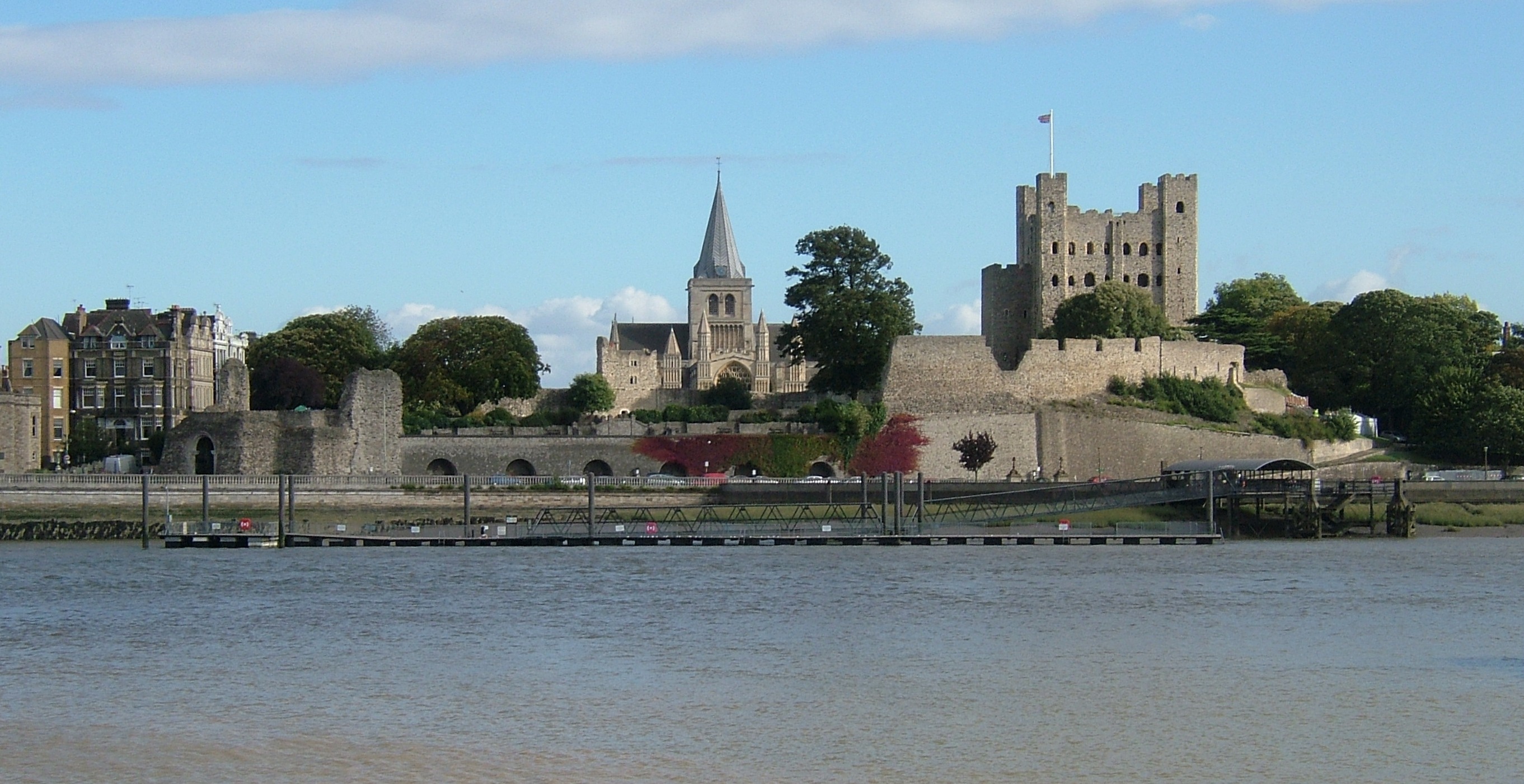
Rochester Castle
In the autumn of 1215, King John sent a message to his justiciar: 'Send to us with all speed by day and night, forty of the fattest pigs of the sort least good for eating, to bring fire beneath the tower.' The order was not a culinary request. John was besieging Rochester Castle, where rebel barons had barricaded themselves inside the tallest Norman keep in England, and every conventional method of assault had failed. The pig fat was rendered into a combustible accelerant, packed into a mine tunnel dug beneath the castle's southeastern corner tower, and ignited. The resulting fire brought the entire tower crashing down. It was an act of brutal ingenuity that summarized the medieval approach to castle warfare, and the siege it ended remains one of the most meticulously documented in English history.
The Keep on the Medway
Rochester Castle stands on the east bank of the River Medway in Kent, commanding both the river crossing and Watling Street, the old Roman road that connected London to the Channel ports. A castle was first built here after the Norman Conquest, given to Bishop Odo of Bayeux, half-brother of William the Conqueror. That first fortification saw action during the Rebellion of 1088 when Odo backed Robert Curthose's claim to the English throne against William Rufus. After the garrison surrendered, the castle was abandoned. Between 1087 and 1089, Gundulf, Bishop of Rochester, built a new stone castle on the king's orders, establishing the extent of the fortifications that survive today. In 1127, Henry I granted the castle to the Archbishop of Canterbury in perpetuity, and Archbishop William de Corbeil built the massive keep that dominates the site. Rising to 113 feet, it was one of the tallest keeps in England at the time of its construction and remains one of the best preserved of its era in either England or France.
The Great Siege of 1215
The crisis came in the wake of Magna Carta. King John had been forced to accept the charter in June 1215, but he had no intention of honoring it. When civil war erupted, a group of rebel barons seized Rochester Castle in October, gambling that the fortress could hold long enough for reinforcements to arrive from London. John arrived with a large army and laid siege. His forces stormed the outer walls quickly, but the keep proved impervious. The garrison retreated inside and held out for weeks. John's miners dug tunnels beneath the southeastern corner tower, shoring them up with timber props. When the tunnel was judged sufficient, the props were removed and replaced with combustible material -- and the forty pigs. The fire collapsed the corner, and John's troops poured through the breach. Even then, the defenders retreated behind a cross-wall that divided the keep's interior and fought on until starvation finally compelled surrender. John reportedly wanted to hang the survivors but was dissuaded by advisors who pointed out that his own men might one day face the same fate.
Rebuilding and Decline
The southeastern corner tower was rebuilt after the siege, but with a telling difference. Where the original keep had square corner turrets in the Norman style, the replacement was built as a round tower -- a design that better resisted undermining because it distributed the forces of a collapse more evenly. The contrast between the three square turrets and one round one remains visible today, a permanent scar from the siege of 1215. The castle was besieged again in 1264 during the Second Barons' War, when Simon de Montfort's forces briefly captured it. Edward III undertook significant repairs in the 14th century, but by the Tudor period Rochester had lost its strategic importance. The castle gradually fell into ruin. In the 1870s, Rochester Corporation purchased the castle grounds and opened them as a public park, and in the early 20th century, the castle was placed in state care.
Stone Memory
Rochester Castle's keep survives as one of the finest examples of Norman military architecture anywhere in Britain. Its walls are up to twelve feet thick at the base, pierced by narrow windows that admit light without compromising defense. The interior originally contained four floors: a basement for storage, a ground floor, and two upper floors that served as the principal living spaces, each with a great hall divided by the cross-wall that proved so crucial during the siege. An attached forebuilding protects the entrance at first-floor level, a defensive feature designed to force attackers through a series of turns and doorways before reaching the interior. The keep stands surrounded by the remains of the curtain wall and the 14th-century outer defenses, all of it overlooking the Medway and the cathedral that sits immediately to the south. For a building whose primary purpose was to withstand destruction, Rochester's keep has succeeded beyond any reasonable expectation, standing for nearly nine hundred years in defiance of undermining, bombardment, neglect, and time.
From the Air
Located at 51.39N, 0.50E on the east bank of the River Medway in Rochester, Kent. The castle keep is one of the tallest structures in the town, prominently visible from the air alongside Rochester Cathedral immediately to the south. The M2 motorway passes to the south of the town. Nearest airport: Rochester (EGTO), approximately 1 nm to the south. Best viewed at 1,500-2,500 ft AGL.