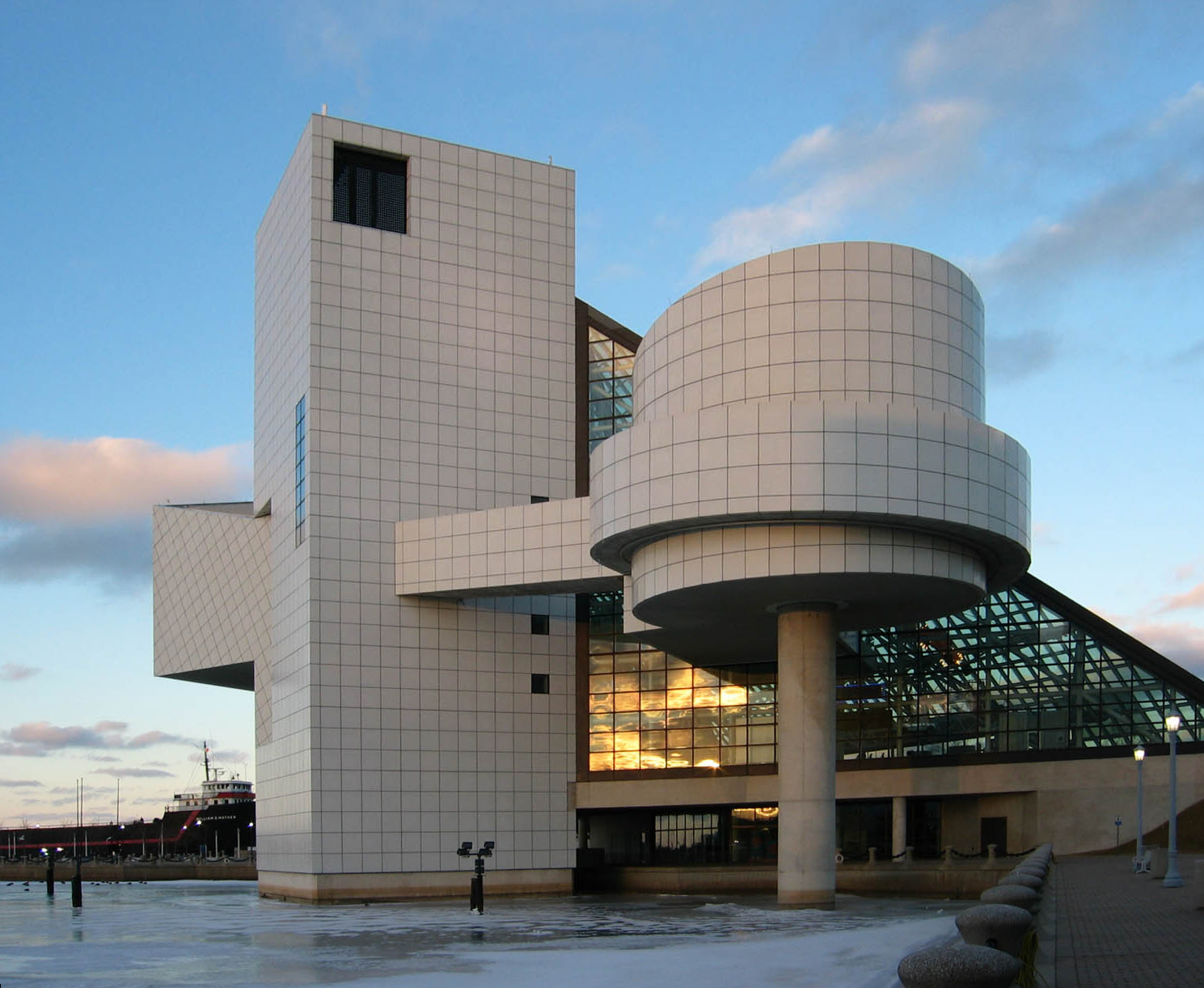
Rock and Roll Hall of Fame: Cleveland's Glass Pyramid of Sound
Cleveland almost didn't get it. Philadelphia had American Bandstand. Memphis had Sun Studios and Stax. Detroit had Motown. New York had everything. But when Ahmet Ertegun, the founder of Atlantic Records, established the Rock and Roll Hall of Fame Foundation in 1983, Cleveland made the argument that won: a local disc jockey named Alan Freed had coined the term 'rock and roll' at radio station WJW, and in 1952 he staged the Moondog Coronation Ball at the Cleveland Arena - widely credited as the first major rock and roll concert. Cleveland's civic leaders pledged $65 million in public money. In 1986, the city was chosen as the Hall's permanent home. I.M. Pei designed a building bold enough to match the music, and on September 1, 1995, Yoko Ono and Little Richard cut the ribbon before a crowd of more than ten thousand.
The Pyramid on the Lake
I.M. Pei's design rises from the shore of Lake Erie as a collision of geometric forms anchored by a 162-foot tower. The tower supports a dual-triangular glass tent that extends across a 65,000-square-foot plaza. Pei originally planned the tower taller, but had to reduce its height because of the building's proximity to Burke Lakefront Airport - rock and roll, it turned out, had to yield to air traffic. Inside are more than 55,000 square feet of exhibition space spread across seven levels. 'It was my intention to echo the energy of rock and roll,' Pei said. 'I have consciously used an architectural vocabulary that is bold and new.' The groundbreaking in 1993 drew Pete Townshend, Chuck Berry, and Billy Joel. The dedication concert the night after the opening featured Chuck Berry, Bob Dylan, Aretha Franklin, Bruce Springsteen, Jerry Lee Lewis, and Iggy Pop performing at Cleveland Stadium.
Inside the Hall
The lower level holds the Ahmet M. Ertegun Exhibition Hall, tracing rock's roots through gospel, blues, rhythm and blues, folk, country, and bluegrass. Exhibits map the cities that shaped the sound: Memphis, Detroit, London, Liverpool, San Francisco, Los Angeles, New York, and Seattle. The second floor features interactive exhibits on one-hit wonders and the 500 Songs That Shaped Rock and Roll, a curated list spanning recordings from the 1920s through the 1990s. The third floor is where inductees are honored, and visitors experience 'The Power of Rock,' one of filmmaker Jonathan Demme's final works. The top two levels host rotating exhibitions that have covered everyone from Elvis Presley and the Grateful Dead to the Clash and the Rolling Stones. The library and archives, housed in a separate building at Cuyahoga Community College, hold handwritten lyrics by Jimi Hendrix, personal letters from Aretha Franklin, and rare concert recordings from CBGB in the 1970s.
The Induction Wars
The Hall inducts new members annually, and nearly every class sparks debate. The first group, in 1986, included Elvis Presley, Chuck Berry, James Brown, Ray Charles, and Buddy Holly. Artists become eligible 25 years after their first record, and roughly 500 experts worldwide vote from a slate chosen by a nominating committee. The process has drawn persistent criticism. The Sex Pistols, inducted in 2006, refused to attend, calling the museum 'a piss stain.' Iron Maiden's Bruce Dickinson called it 'an utter and complete load of bollocks.' Dolly Parton tried to remove herself from the 2022 ballot, saying she hadn't earned it - the Hall kept her on, and she was inducted. Critics have noted that progressive rock, heavy metal, and non-English-language artists have been historically underrepresented, and that female inductees made up just 8.5 percent of the total as of 2014. The arguments are part of the institution's identity. Rock and roll was never supposed to be polite.
Cleveland's Claim
The Rock Hall gives Cleveland something no amount of economic development could manufacture: a cultural identity beyond industrial decline. The museum draws over 500,000 visitors annually, and induction ceremonies held in Cleveland have generated more than $13 million in economic impact per event. Radio station WMMS, which broke David Bowie, Bruce Springsteen, and Rush to American audiences in the 1970s and 1980s, bolsters the city's claim as a place where new music found its first believers. The 25th anniversary concert in 2009 at Madison Square Garden ran almost six hours, closing with Bruce Springsteen and guests including John Fogerty, Billy Joel, and Tom Morello. In 2020, the Hall announced plans to expand its footprint by a third. The glass pyramid on Lake Erie has become what Pei hoped - a dramatic landmark that insists Cleveland matters to the story of rock and roll.
From the Air
Located at 41.51°N, 81.70°W on Cleveland's downtown lakefront, the Rock and Roll Hall of Fame is visible from the air as a distinctive glass pyramid and tower structure on the south shore of Lake Erie. It sits along East Ninth Street, east of where Cleveland Stadium once stood. Burke Lakefront Airport (KBKL) is immediately adjacent - the building's tower height was reduced because of its proximity to the runway. Cleveland Hopkins International Airport (KCLE) is approximately 10 miles to the southwest. The I.M. Pei building is one of the most recognizable structures on the Cleveland waterfront when approaching from over Lake Erie.