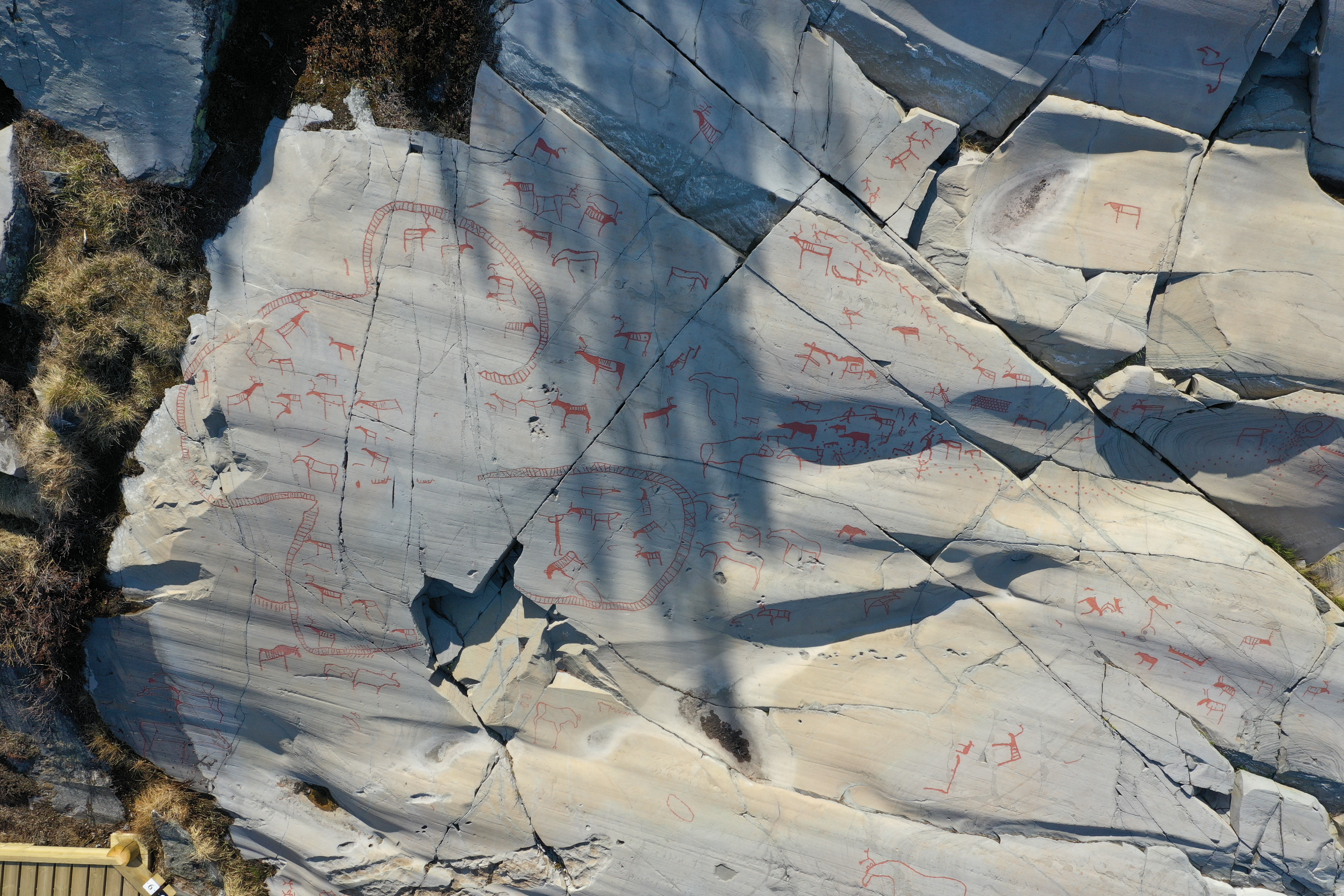
Rock Carvings at Alta
The oldest carvings were made when the rock lay at the water's edge. Five thousand years of post-glacial rebound have carried them dozens of meters inland and several stories above the current shoreline, a geological elevator that also functions as a rough timeline: the higher you climb at Jiepmaluokta, the older the images you find. Discovered by chance in autumn 1973, the rock art of Alta has since yielded more than 6,000 individual carvings scattered across multiple sites in Arctic Norway, the country's only prehistoric World Heritage Site and one of the richest collections of hunter-gatherer rock art in Europe.
Chiseled into Shore Rock
The carvings span from approximately 5200 BC, based on revised dating by researcher Jan Magne Gjerde in 2010 that pushed the oldest phases back by 1,000 years from earlier estimates, to around 500 BC. Professor Knut Helskog of the University of Tromso divided them into five chronological groups using shoreline dating, a method that exploits Scandinavia's continuing post-glacial rebound. When the carvers worked, the rock they chiseled was right on the shore, where waves would have lapped at their feet. The tools were quartzite chisels struck by harder stone hammers. Examples have been found across the area and are displayed at Alta Museum. Remarkably, the carvers continued to use stone chisels even after metal tools entered the region, suggesting that the act of carving itself may have carried ritual significance beyond mere practical mark-making.
Reindeer, Bears, and Boats
Reindeer dominate the imagery across all periods, shown in vast herds being both nurtured and hunted. Depictions of reindeer behind fences reveal large-scale cooperative hunting, the earliest known representation of such a fence dating to roughly 7,000 years ago. Bears occupied a different symbolic space. They appear not merely as prey but in positions suggesting worship, consistent with bear cults known in Sami culture and across northwestern Russia. Vertical tracks emerging from bear dens cross the horizontal paths of other animals, leading researchers to speculate about a connection between bears and the afterlife, as though the bear could move between layers of the world. Around 1700 BC, bear imagery disappears from the carvings, hinting at a shift in spiritual beliefs. Boats tell their own story of technological change: early drawings show small fishing craft, but later panels depict vessels carrying up to 30 people with animal-shaped decorations on bow and stern, prefiguring the longboats of the Viking age.
The Bay of Seals
Jiepmaluokta, a Northern Sami name meaning 'bay of seals,' holds roughly half of all known carvings in the Alta area, more than 3,000 out of about 6,000. A network of wooden walkways stretching three kilometers was built through the site during the 1980s, and in 1991 Alta Museum relocated from the town center to stand beside the carvings themselves. The museum won the European Museum of the Year Award in 1993. Its displays include artifacts thought to relate to the carvers' culture, documentation of the carvings, exhibits on Sami culture, and information on the northern lights. When new carvings are found, the thick growth of moss and lichen is carefully removed and the rock cleaned. Quartz powder is then painted into the grooves so the carvings can be photographed and digitally preserved. In 2014, the museum launched altarockart.no, a digital archive containing thousands of photographs and tracings, part of a broader effort to document art that is slowly weathering away.
Messages Without a Dictionary
Interpreting art made across five millennia by cultures that left no written records is inherently speculative, and the Alta carvings resist easy explanation. Scenes showing dancing, food preparation, or sexual activity might depict mundane life or ritual performance. Figures wearing distinctive headgear occupy prominent positions, possibly priests, shamans, or tribal leaders. Among the most enigmatic images are geometric symbols concentrated in the oldest carvings: circular objects fringed with lines, intricate grid patterns. Some have been tentatively identified as fishing nets or tools, but most remain unexplained. What the carvings make clear, however, is that the people who created them were neither simple nor isolated. The similarity between Alta's earliest panels and contemporaneous carvings in northwestern Russia points to cultural contact or parallel development across a vast swath of the European far north. These were communities with boats, cooperative hunting strategies, and spiritual beliefs complex enough to require carving into stone for posterity.
From the Air
Coordinates: 69.95°N, 23.19°E, near the town of Alta in Finnmark county. The main carving site at Jiepmaluokta is approximately 4-5 km from Alta town center, on the shore of Altafjord. Nearest airport: Alta (ENAT), immediately adjacent to town. From the air, the museum and walkway complex are visible along the rocky shoreline. The site sits at the head of Altafjord, with the dramatic fjord system providing clear visual navigation. UNESCO World Heritage Site since 1985.