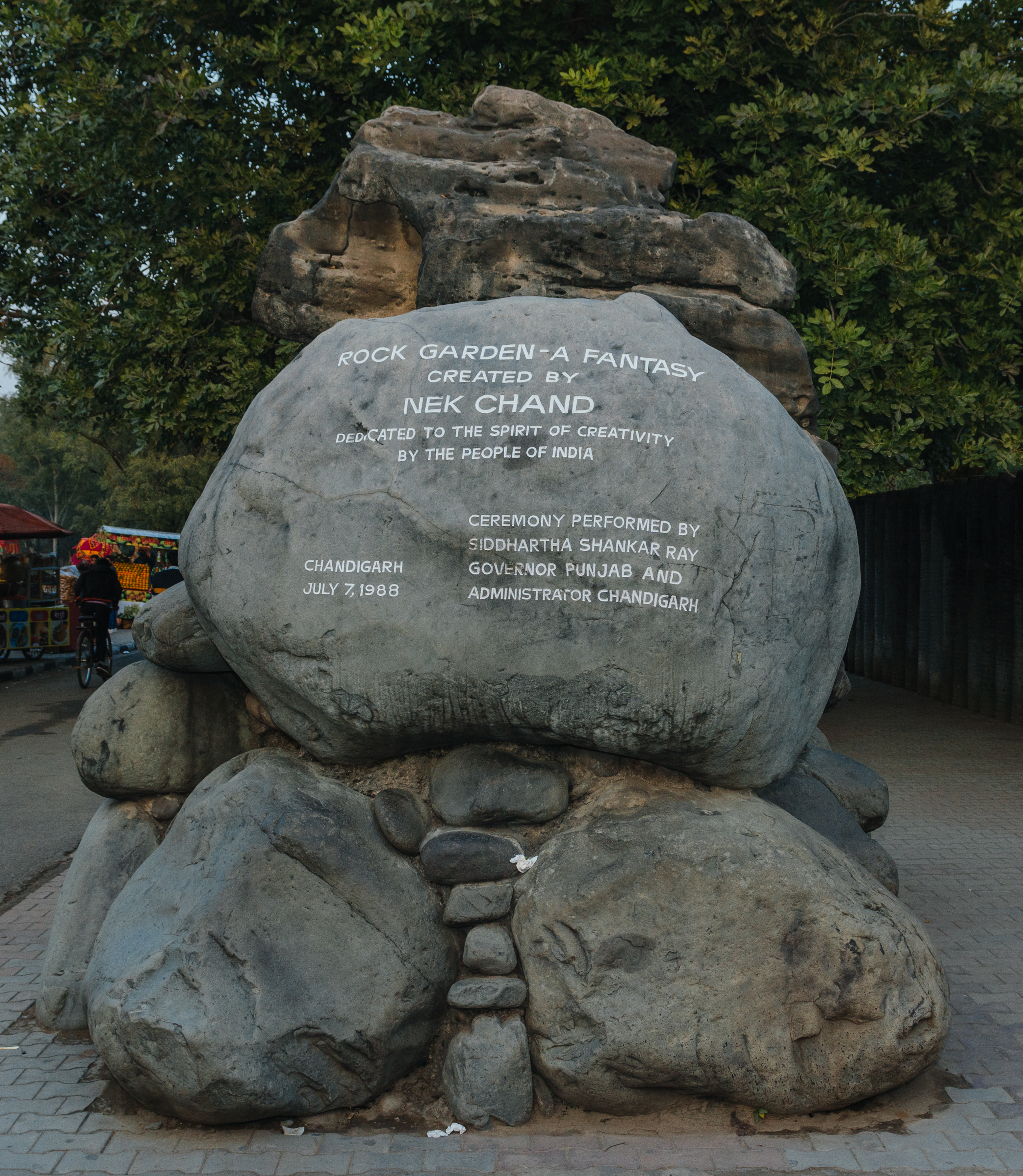
Rock Garden of Chandigarh
For eighteen years, Nek Chand Saini kept a secret. By day he was a public works inspector in Chandigarh, the modernist city Le Corbusier had designed on a grid of rational order. By night and on weekends, he hauled broken ceramics, shattered bangles, discarded tiles, electrical waste, and smashed pipes to a gorge in a forest near Sukhna Lake. The gorge sat inside a land conservancy established in 1902 -- a forest buffer where construction was strictly forbidden. Chand built there anyway, shaping the debris of a rapidly modernizing India into his own vision of a divine kingdom he called Sukrani. When authorities stumbled upon the site in 1976, they found not a junkyard but a 12-acre complex of interlinked courtyards filled with hundreds of pottery-covered concrete sculptures of dancers, musicians, and animals.
One Man's Cathedral of Refuse
Chand began in 1957, working alone in a five-acre patch of forest. Chandigarh was under rapid construction -- Le Corbusier's planned city rising from the Punjab plains -- and demolition sites generated enormous quantities of waste. Chand saw material where others saw garbage. He collected broken bottles, ceramic pots, glass bangles, neon tubes, sink basins, and industrial debris, hauling them to his hidden gorge and transforming them into something the source materials could never have predicted. The sculptures are not rough or primitive. They are deliberate compositions: lines of dancing women with bangles for arms and tile fragments for faces, musicians whose instruments are fashioned from pipe fittings, animals assembled from shards of porcelain. Every surface is covered, textured, alive with color. The courtyards connect through walled pathways, creating a journey through environments that shift in mood and scale. Man-made waterfalls link the spaces with the sound of moving water.
The Illegal Garden and the Authorities
What makes the Rock Garden extraordinary is not just the art but the audacity. Chand worked for nearly two decades on land where nothing was legally permitted to stand. He concealed his project through the sheer remoteness of the gorge and the density of the surrounding forest. By the time officials discovered the site in 1976, the garden had grown too large and too remarkable to simply bulldoze. The Chandigarh administration faced a choice: enforce the conservancy law and destroy a work of singular creative vision, or find a way to preserve it. They chose preservation, providing funding and official support to continue the garden's expansion. It was a rare moment when bureaucracy bent to art. The garden was opened to the public and grew from 12 acres to its current 40 acres, now featuring over 5,000 sculptures alongside open-air theaters, pavilions, and artificial waterfalls.
Vulnerability and Vandals
Recognition brought new risks. In 1990, when Chand traveled abroad for a lecture tour, the Chandigarh city government withdrew its funding. Vandals attacked the garden, damaging sculptures that had taken years to create. The Rock Garden Society stepped in, assuming administration and upkeep of what it recognized as a unique visionary environment. But the threats never fully receded. The recycled materials that give the sculptures their texture -- ceramic, glass, concrete -- deteriorate under Chandigarh's harsh climate, which swings from scorching summers to cold winters with monsoon rains in between. The sheer volume of visitors -- between 3,000 and 4,000 daily -- adds wear that protective measures struggle to address. In 2025, the Chandigarh administration demolished part of the garden's outer wall to make way for a road and parking space, provoking widespread public condemnation and protests.
Art from Nothing, Meaning from Everything
Nek Chand died in 2015, but the garden endures as his monument. Inside the complex, a small Dolls Museum -- inaugurated to mark the second anniversary of his death -- houses 200 rag dolls he made from waste cloth in the 1970s, a quieter expression of the same impulse that produced the sprawling sculpture courts outside. The Rock Garden has become one of the most recognized examples of outsider art in the world, a place where environmental activism, folk creativity, and sheer individual stubbornness converge. It stands as proof that a single person, working alone with discarded materials and an illegal plot of forest, can create something that draws millions and outlasts the institutions that once tried to stop it. The Nek Chand Foundation and local authorities now share responsibility for its maintenance, working to preserve what one road inspector built from the things a modern city threw away.
From the Air
Located at 30.752°N, 76.807°E in Chandigarh, adjacent to Sukhna Lake. The garden occupies 40 acres of forested terrain near the lake's southern shore. Best viewed at 3,000-5,000 ft AGL where the contrast between the planned city grid and the organic garden layout is striking. Nearest airport is Chandigarh International (VICG), approximately 7 nm southeast. Le Corbusier's Capitol Complex is visible to the west.