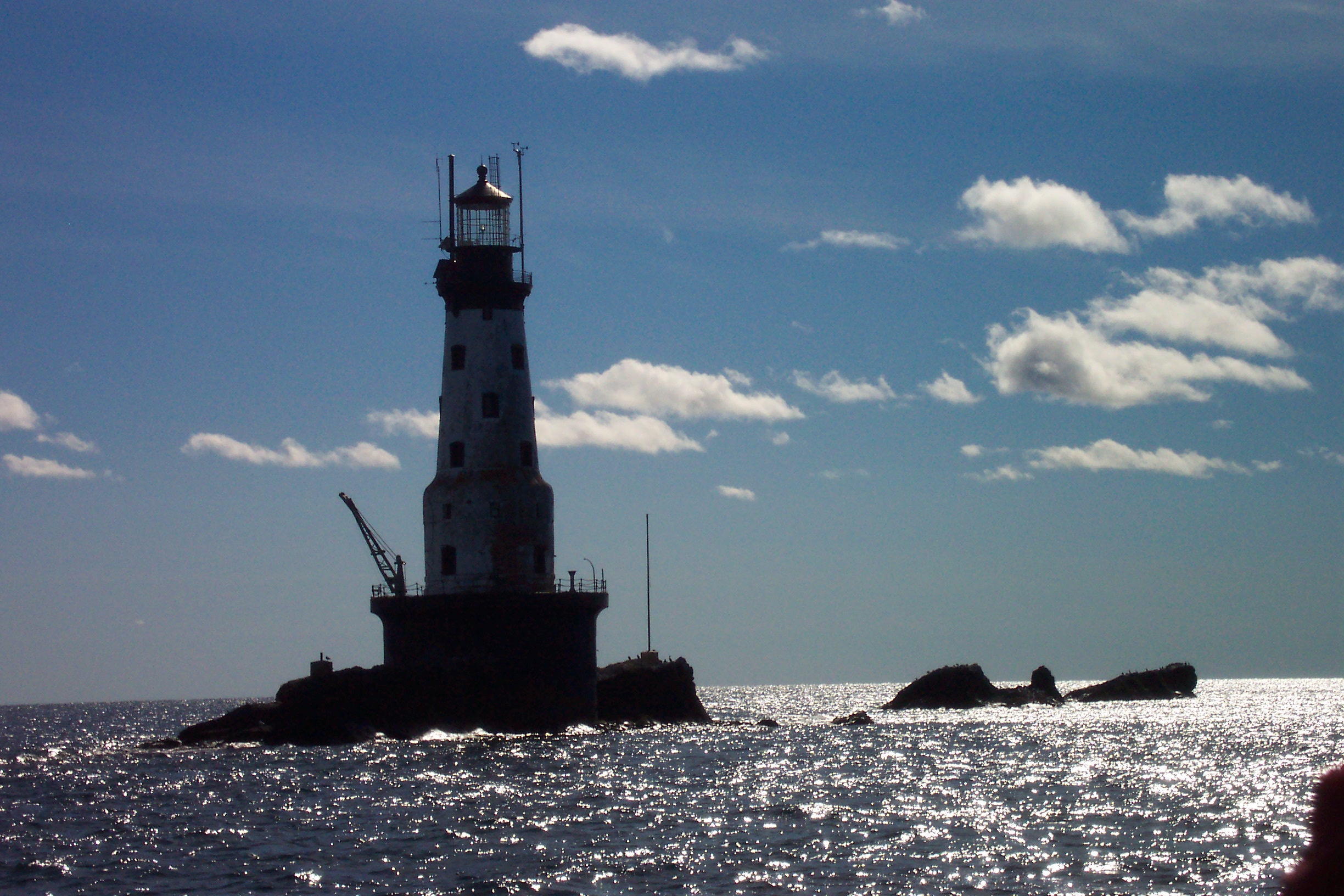
Rock of Ages Light
On May 27, 1933, Captain George Johnson and First Mate Art Kronk could hear the foghorn. They knew exactly where the Rock of Ages Light stood -- off the western tip of Isle Royale, on a reef that had already swallowed two ships. They kept the steamer George M. Cox at full lake speed anyway. The fog was too thick to see through, but the foghorn told them they were close, and Kronk had plotted a course he believed would clear the rocks. It did not. The Cox struck the reef and sat amidships on the shoal, her bow jutting into the air while her stern flooded. Lighthouse keeper John Soldenski raced to the scene in a gasoline-powered boat, towed the life rafts back, and somehow squeezed 127 passengers and crew into the lighthouse and onto the surrounding rocks for the night. The ship that had carried them was unsalvageable. It broke apart in an October storm and sank on top of two other wrecks already resting on the same reef.
A Tower on a Sliver of Rock
The reef off the western end of Isle Royale had been killing ships for decades before anyone built a light there. The Cumberland wrecked in 1877 and was abandoned after efforts to pull her from the rocks failed. She broke in two and sank. Twenty-one years later, the Henry Chisholm, built in Cleveland in 1880, ran onto the same rocks at full steam and broke apart in a late October storm, sinking directly on top of the Cumberland. By then the United States Lighthouse Board had been on a decades-long construction spree across the Great Lakes -- 334 major lights, 67 fog horns, and 563 buoys by the turn of the century. In 1908, construction crews finally arrived at the reef. They established a base at Washington Harbor on Isle Royale and used the lighthouse tender Amaranth to ferry men and materials to the site. The first task was blasting a section of bare rock flat enough to pour a foundation.
Steel Core and Spiral Stairs
The engineering was remarkable for its time and location. Workers erected a steel cylindrical wall on the blasted rock and filled it with concrete, creating a pier 25 feet in diameter. From the bedrock up, a central steel core runs through the entire structure, serving as its main structural support -- a design that was unique among American lighthouses, though it bears some resemblance to the 1893 Chicago Harbor Light. The skeleton of the tower was built from steel, with inner and outer walls of brick and concrete floors supported on radial steel beams. The spiral stairs were cast iron. The caisson forming the first level is 25 feet high and contains a two-story cellar. When the tower was enclosed, the crew built a bunkhouse, mess hall, and galley on a timber platform attached to the rock itself. The light was first lit in 1908 with a temporary lamp. In 1910, a second-order Fresnel lens made by Barbier, Benard and Turenne was installed, throwing a beam visible for miles across the open water of Lake Superior.
One Can of Tomatoes
Keeper duty at Rock of Ages was among the most isolated postings on the Great Lakes. A crew was landed on the station each spring at the beginning of the shipping season, stayed through the entire season, and was evacuated in the fall. Between those dates, they lived on the rock. The remoteness made provisioning dangerous and unreliable. Supply runs depended on weather and the availability of the lighthouse tender, and Lake Superior's weather was notoriously uncooperative. At the end of one particularly difficult season, the crew's provisions dwindled to almost nothing. When the evacuation boat finally arrived, the keepers had been surviving on a single can of tomatoes -- the last item of food in the lighthouse. The incident prompted the lighthouse service to take special precautions for future seasons, stockpiling extra supplies to prevent a recurrence. For 68 years, from 1910 to 1978, keepers maintained the light through spring storms, summer fog, and the brutal lake-effect weather of autumn before being pulled off the rock each winter.
The Night 127 People Slept on a Rock
The George M. Cox had an unusual history before she met her end at Rock of Ages. Built in 1901 as the SS Puritan, she served briefly in the U.S. Navy transporting troops home after World War I, then was purchased by George Cox in 1933 and renamed. On her fateful Lake Superior cruise, she carried a contingent of special guests. Navigational rules called for moderate speed in limited visibility, but Captain Johnson and First Mate Kronk maintained full lake speed despite the fog. When the Cox struck the reef, keeper Soldenski acted immediately. He launched his gasoline-powered boat, towed the life rafts back to the lighthouse, and guided the lifeboats in behind them. The 127 survivors spent the night packed into a lighthouse designed to house a handful of keepers, with others huddled on the exposed rocks around the base. Everyone survived. The Cox did not -- she sat on the shoal until an October storm broke her apart and sent her to the bottom, joining the Cumberland and the Chisholm in a graveyard of ships at the foot of the lighthouse meant to prevent exactly such disasters.
Solar Power and Preservation
In 1978, the Coast Guard automated the Rock of Ages Light, ending nearly seven decades of human habitation on the reef. The keepers left, and the lighthouse became a machine tending itself. In 1985, the original Fresnel lens was removed when the light was converted to solar power. That magnificent lens -- a second-order Fresnel, one of the most powerful designs in the lighthouse builder's toolkit -- now sits on display at the Windigo Information Station on the western end of Isle Royale, where National Park Service rangers say it is worth the trip. The lighthouse itself, listed on the National Register of Historic Places, stood empty and weathering for decades until the Rock of Ages Lighthouse Preservation Society began restoration work in 2014. Working in partnership with the National Park Service, the Society aims to open the lighthouse to public visitors upon completion. For now, the tower remains visible from summer excursion boats operating out of Keweenaw and from the Isle Royale ferry routes -- a steel cylinder rising from bare rock, still flashing its warning across one of the most dangerous stretches of water on the Great Lakes.
From the Air
Located at 47.87°N, 89.31°W on a small rock outcropping approximately 3 miles west of Isle Royale's western tip in Lake Superior. The lighthouse is a steel and brick tower rising from a concrete caisson on bare rock, surrounded by open water. Look for the isolated structure standing alone with no land nearby -- it is one of the most exposed lighthouse positions on the Great Lakes. The reef extends underwater around the tower. Washington Harbor on Isle Royale is visible to the east. Isle Royale's Windigo ranger station is at the head of Washington Harbor. Houghton County Memorial Airport (KCMX) is approximately 55 miles to the southeast on the Keweenaw Peninsula. Grand Portage, Minnesota, and its ferry terminal are about 20 miles to the northwest across the lake. Best viewed at 1,000-3,000 feet AGL to see the tower's isolation on the reef and the shipwreck debris field in the surrounding waters. Lake Superior can generate dramatic weather patterns visible from altitude.