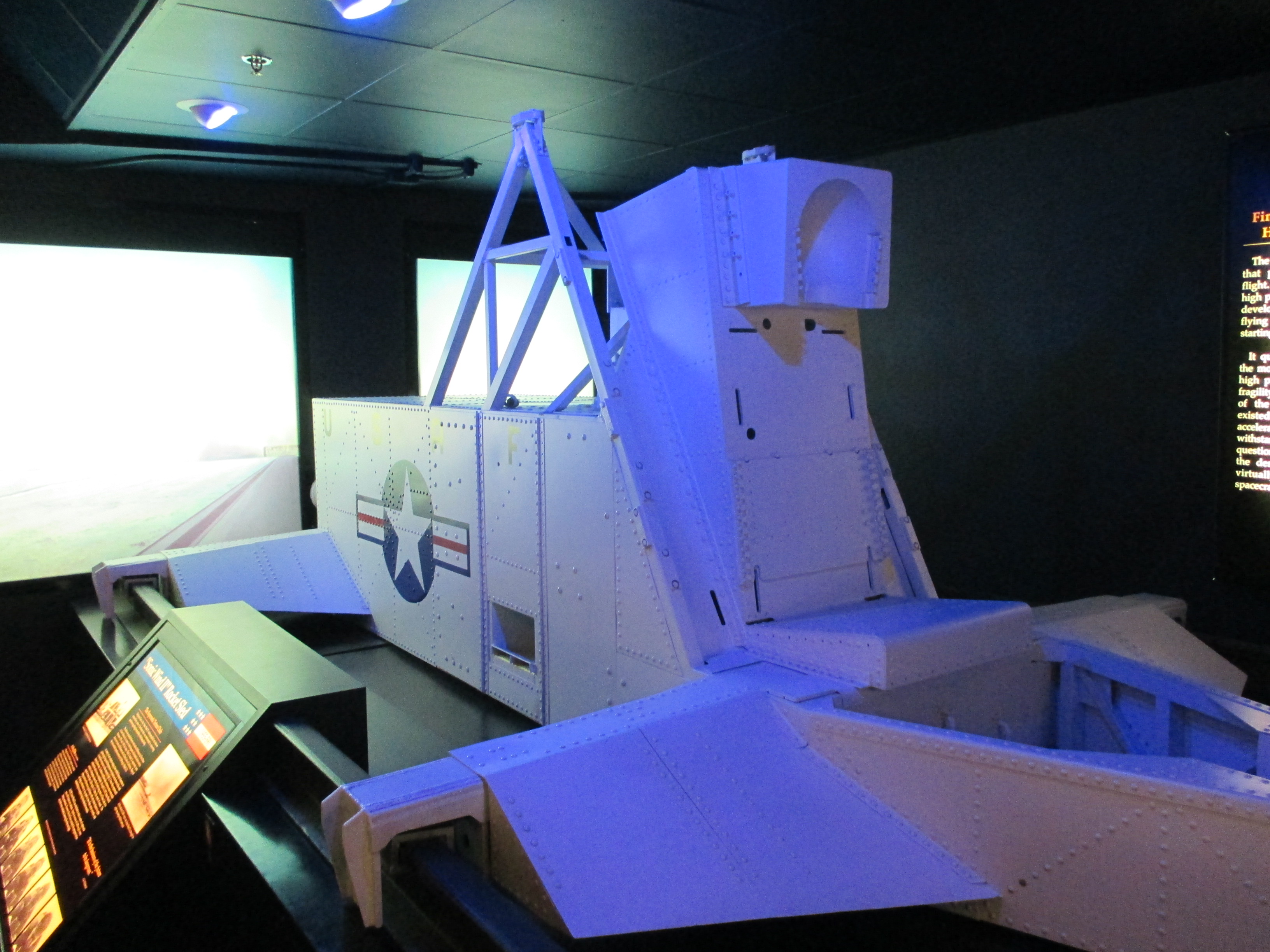
Rocket Sled
In the New Mexico desert, a perfectly straight set of rails stretches nearly ten miles across the basin floor. This is the Holloman High Speed Test Track, where sleds propelled by rockets have reached speeds no wheeled vehicle could survive. The track holds the land speed record for any vehicle: Mach 8.5, or 6,416 miles per hour, achieved in 2003. But the track's most famous experiments involved slower speeds and a volunteer who strapped himself in again and again, determined to learn how much punishment the human body could endure.
Why a Sled, Not a Car
At extreme speeds, wheels become the enemy. The centrifugal forces generated at several hundred miles per hour would tear conventional wheels apart, sending rubber and metal flying in all directions. Rocket sleds solve this problem by eliminating wheels entirely. Instead, they ride on sliding pads called 'slippers' that curve around the head of railroad rails, preventing the sled from lifting off the track while allowing frictionless motion.
Most sled tracks use standard gauge rails - the same 56.5-inch spacing used by commercial railroads - though narrower and wider gauges exist for specialized tests. The rail profile is typically Vignoles rail, the T-shaped cross-section common to railroads worldwide. Some facilities have experimented with air cushions and magnetic levitation as alternatives to slippers, trading friction for reduced vibration. But the basic concept remains unchanged since the 1940s: ignite rockets, accelerate rapidly, gather data, stop before you run out of track.
The Fastest Man on Earth
Colonel John Paul Stapp made himself a human crash test dummy. Between 1947 and 1954, he rode rocket sleds 29 times, subjecting his body to forces that would kill most people. His goal was to determine the limits of human tolerance to acceleration and deceleration - essential data for designing ejection seats that could save pilots' lives at supersonic speeds.
On December 10, 1954, Stapp reached 632 mph on the Sonic Wind No. 1 sled at Holloman Air Force Base. Then the brakes engaged. In 1.4 seconds, he went from 632 mph to zero, experiencing 46.2 G - the force of 46 times his body weight crushing him into the seat. His eyeballs hemorrhaged. His body turned purple with bruises. For a few terrifying minutes, he was blind. But he survived, proving that a pilot could eject from a supersonic aircraft and live. The sled he rode now sits at the New Mexico Museum of Space History, a few miles up the road.
Murphy's Law Was Born Here
The phrase 'If anything can go wrong, it will' entered public consciousness at a 1949 press conference about rocket sled testing. Captain Edward Murphy, an engineer working on experiments to measure the effects of deceleration, became frustrated when a technician wired sensors incorrectly, producing useless data. Murphy complained that if there was any way to do it wrong, that technician would find it.
Project manager John Stapp - the same man who would later ride Sonic Wind to glory - quoted Murphy's observation during subsequent media interviews about the testing program. The phrase caught on, eventually becoming one of the most widely known aphorisms in the English language. Murphy himself was not entirely pleased with his immortality, noting that his original point was about designing systems that couldn't be assembled incorrectly, not about pessimistic fatalism. But the law bearing his name endures, born in the New Mexico desert where things frequently did go wrong.
The World's Fastest Land Vehicle
On April 30, 2003, an unmanned four-stage rocket sled achieved Mach 8.5 on the Holloman track - 6,416 miles per hour, or 10,325 kilometers per hour. It remains the highest speed ever attained by a land vehicle. The test was part of ongoing research into hypersonic flight, testing missile components without the expense of actual missile launches.
The Holloman track itself grew to its current length by absorbing rails from Edwards Air Force Base in California, where early rocket sled testing occurred before operations consolidated in New Mexico. At nearly 10 miles long, it provides enough distance for sleds to accelerate to extreme speeds and still decelerate safely. The track remains active, testing everything from ejection seats to missile guidance systems. Unlike many Cold War facilities that have gone silent, Holloman's rails still thunder with rocket fire, pushing the boundaries of what vehicles can endure.
Tracks Around the World
The Holloman High Speed Test Track is the most famous, but it is not alone. Rocket sled facilities exist or have existed on four continents. The Germans built the first at Peenemuende, where V-1 flying bombs were launched from rails during World War II. France maintains tracks at Istres, Cazaux, and Satory. Britain operates a facility at Pendine in Wales. China, India, and Turkey have all constructed their own high-speed test tracks for military research.
Algeria once hosted a French track at Colomb-Bechar, abandoned after Algerian independence. Sandia National Laboratories operates sled tracks in New Mexico separate from Holloman. The Redstone Technical Test Center at Redstone Arsenal in Alabama, New Mexico Tech, and the Martin Baker facility at Langford Lodge in Northern Ireland all use rail-mounted sleds for ejection seat testing. Wherever nations develop advanced aircraft and missiles, they eventually need a place to test components at speeds that would destroy conventional vehicles. The rocket sled provides that capability, screaming down rails at velocities once thought impossible.
From the Air
The Holloman High Speed Test Track is located within Holloman Air Force Base at approximately 32.89N, 106.15W in the Tularosa Basin of New Mexico. The track runs nearly 10 miles in a straight line across the basin floor, oriented roughly northwest to southeast. From altitude, the track is visible as a thin dark line against the desert, often with support facilities at either end. Holloman AFB (KHMN) is immediately adjacent to the track. This is active restricted airspace (R-5107); expect military operations and potential TFRs. White Sands Missile Range occupies the basin to the west, and White Sands National Park lies approximately 10 nm to the southwest. Alamogordo-White Sands Regional Airport (KALM) is the nearest civilian field, approximately 10 nm to the east. Elevation is approximately 4,100 feet MSL. The Sacramento Mountains rise to over 9,000 feet to the east, while the San Andres Mountains form the western boundary of the basin.