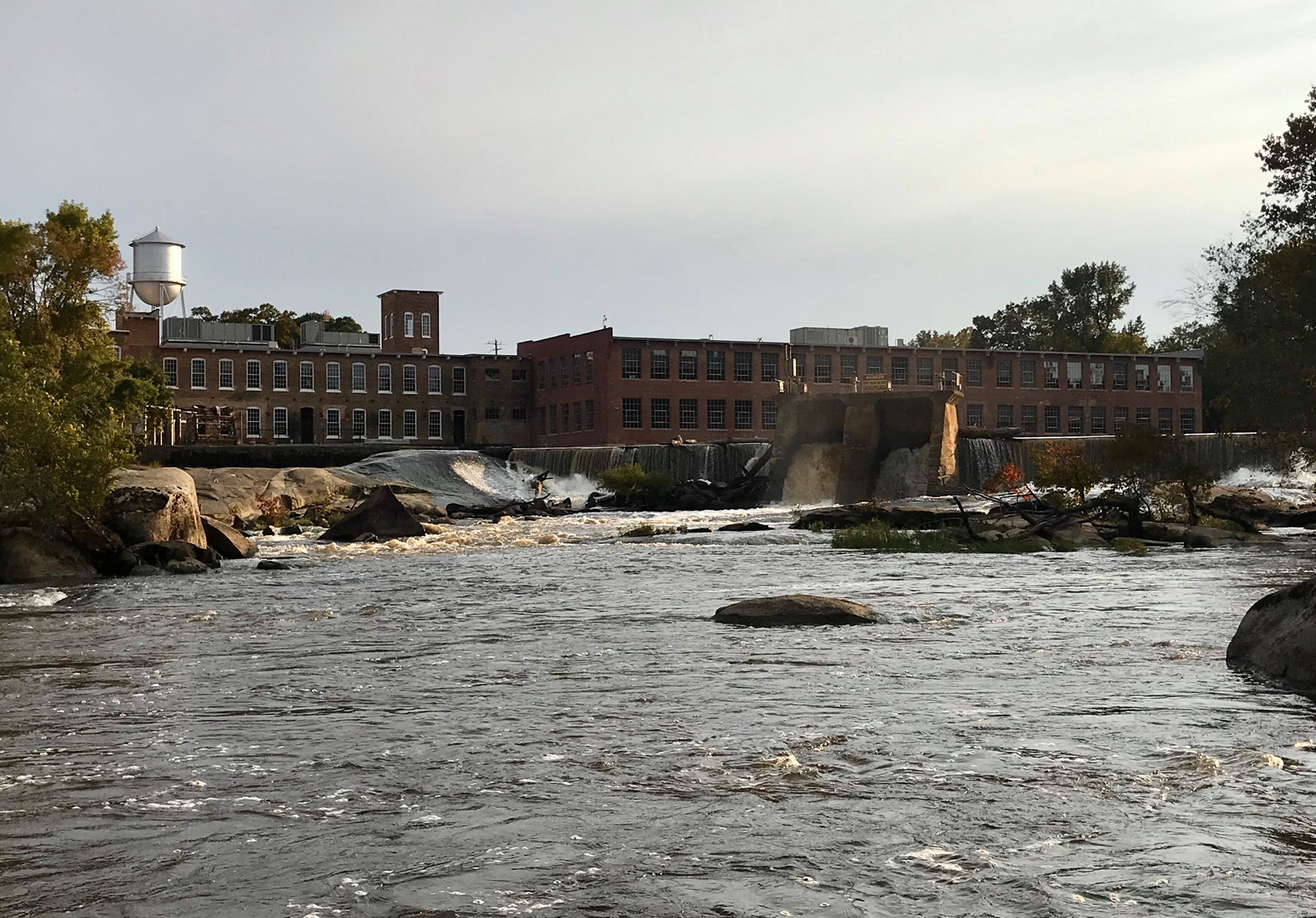
Rocky Mount Mills
The spindles turned for 180 years. When Colonel Joel Battle and Henry A. Donaldson founded Rocky Mount Mills on the Tar River in 1816, it was only the second cotton mill in all of North Carolina. Its workforce was entirely Black -- the majority enslaved, a few free -- making it the first mill in the state to rely on enslaved labor for cotton production. Those two thousand spindles kept turning through the antebellum era, through Union fire, through world wars and economic decline, until the mill finally fell silent in 1996 as the oldest Southern textile company still operating. Today the brick buildings hum again, but with a different kind of energy: craft beer fermenting in copper kettles, restaurant kitchens plating farm-to-table dishes, and young professionals walking to work in converted loft offices along the same riverbank where cotton once moved by rail.
Cotton, Country Women, and Coarse Yarn
Before the Civil War, Rocky Mount Mills occupied a particular niche in the Southern textile economy. Its superintendent recalled that in the 1850s he sold most of the mill's coarse yarn "in five pound bundles for the country trade," woven by rural women on hand looms throughout the middle and western counties of North Carolina. The surplus went north as "coarse filling for the Philadelphia market." Historian Holland Thompson noted that a majority of people in those counties "dressed chiefly in the clothes of domestic or local manufacture." North Carolina was known for its "little spinning mills" producing lower grades of yarn -- first for home looms, later for the weaving mills of New England and the Mid-Atlantic states. Rocky Mount Mills sat at the center of this network, converting raw cotton from the surrounding fields into thread that clothed a largely rural population. In 1825, Donaldson expanded the operation by building a second mill in Fayetteville, staffed entirely by enslaved workers.
Sherman's Fire and the Battle Family Legacy
By the final months of the Civil War, the Confederacy drew its entire supply of textile goods from North Carolina mills. Union commanders understood the strategic value. General William T. Sherman's raiders burned Rocky Mount Mills on the Tar River along with the Great Falls Mill in Rockingham and five of six mills near Fayetteville. In the western counties, General George Stoneman's cavalry destroyed nearly 1,700 bales of cotton stored in High Point and torched mills from Caldwell County to Salisbury. The destruction was systematic and devastating. Yet Rocky Mount Mills rebuilt. The Battle family, which had maintained ownership since 1825, guided the mill through Reconstruction and into the expansion that followed. As the Southern cotton industry boomed in the late 19th century, the company grew rapidly and established a residential village for its workers -- a self-contained community with its own housing, stores, and social life that was eventually incorporated into the city of Rocky Mount in the 1920s.
Wartime Yarn and a Slow Unraveling
Rocky Mount Mills supplied cotton yarn to the United States Army during World War II, continuing a tradition of military provisioning that stretched back to the Confederacy decades earlier. The mills and their surrounding village earned recognition as the Rocky Mount Mills Village Historic District, preserving the physical evidence of nearly two centuries of textile culture on the Tar River. But the forces that reshaped American manufacturing in the second half of the 20th century proved irresistible. Cheaper overseas production, the decline of domestic textile demand, and the general deindustrialization of the American South gradually squeezed the life from the operation. When the mill closed in 1996, it ended a run that had begun when James Monroe was president, making it the longest continuously operating textile company in the Southern states.
Breweries Where the Spindles Stood
Capitol Broadcasting Company purchased the vacant mill complex in 2007, bringing the same vision that had transformed Durham's American Tobacco campus into a vibrant mixed-use district. Redevelopment began in earnest in 2014, and the transformation has been remarkable. The old mill buildings now house craft breweries -- Rocky Mount Mills has positioned itself as an incubator for North Carolina's booming beer scene -- alongside restaurants, loft apartments, offices, and event spaces. Roughly 100 historical homes in the original mill village have been updated and are available as rentals, their porches and clapboard facades carrying the memory of the workers who once lived within earshot of the machinery. In 2019, the River and Twine hotel opened on campus: a collection of 20 boutique tiny house hotels tucked among the historic buildings. The next phase of development centers on Goat Island, a stretch of the Tar River that will offer hiking trails, sandy beaches, and paddling sports. The river that once powered the spindles now draws visitors who come for weekends of beer, barbecue, and kayaking.
From the Air
Located at 35.96°N, 77.80°W on the Tar River in Rocky Mount, North Carolina. The mill complex is visible from 1,500-2,500 feet AGL as a cluster of historic brick buildings along the river's south bank, distinct from surrounding residential areas. Rocky Mount-Wilson Regional Airport (KRWI) is approximately 5 nm to the southwest. The Tar River provides a useful visual reference threading through the city. Best viewed in clear weather on an east-west track along the river corridor.