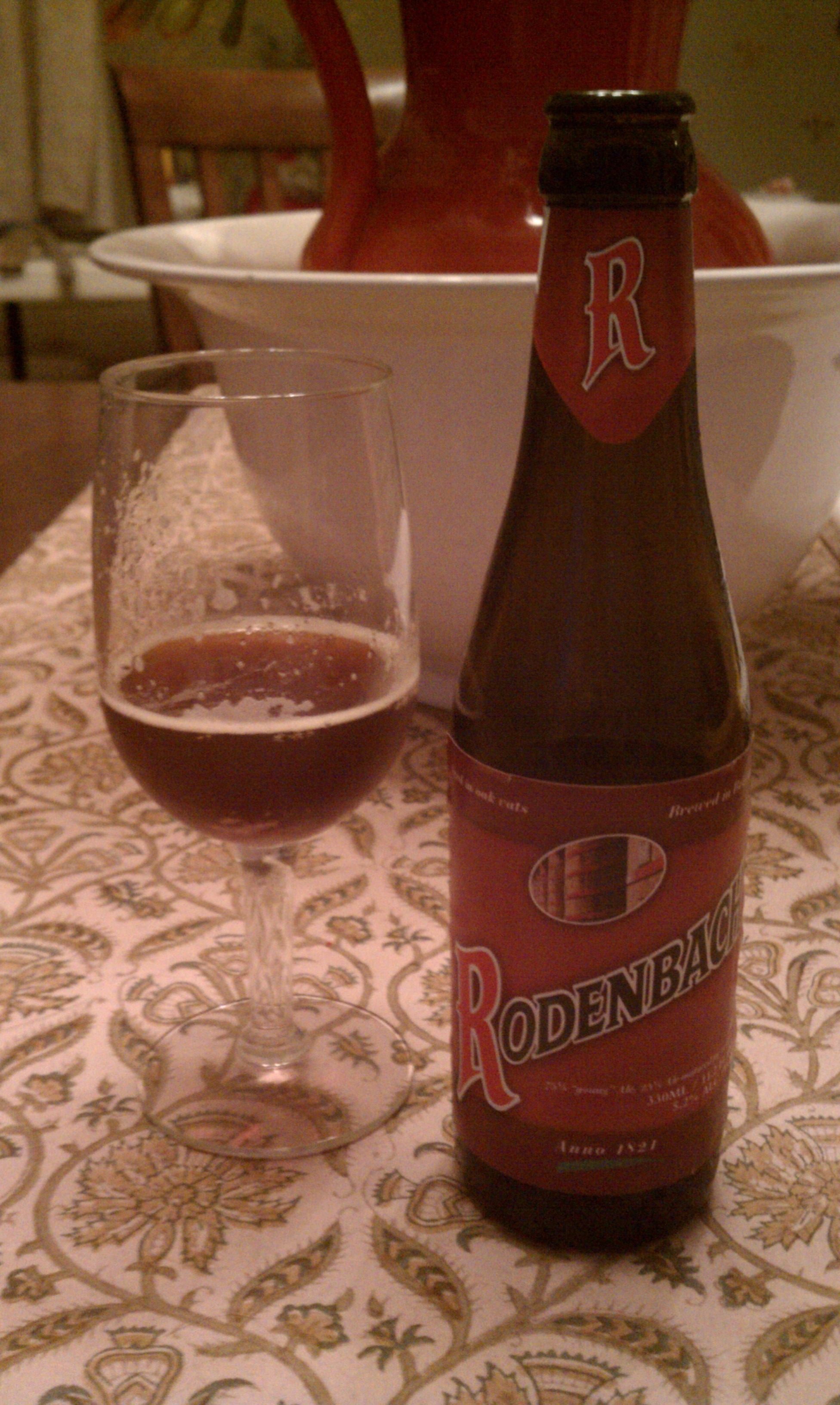
Rodenbach Brewery
Step into the ageing hall at Rodenbach and the first thing you notice is the wood: rows of enormous oak vats, called foeders, standing on end like the columns of a cathedral. Some are over a hundred and fifty years old. Inside them, sour beer is slowly going about its strange chemistry - lactic and acetic bacteria pulling acidity out of a base ale that is otherwise unremarkable, until what comes out two years later is a dark, burgundy-red drink that tastes more like a tart cider crossed with a Loire red than what most of the world calls beer. This is the home of Flemish red.
Four Brothers, One Brewery
The brewery was founded in 1821 by four Rodenbach brothers - Pedro, Alexander, Ferdinand and Constantijn - who pooled money to buy a small operation in the West Flanders city of Roeselare. They agreed on a fifteen-year partnership. When the fifteen years were up, Pedro and his wife Regina Wauters bought the others out, and while Pedro served as a soldier, Regina ran the brewery. Their son Edward took over in 1864, and the business grew steadily through his decades in charge. The family remained majority owners until 1998, when the brewery was sold to Palm Breweries - 177 years and six generations after those four brothers signed their partnership.
Eugene Goes to England
What turned Rodenbach into a brewery the rest of the beer world studies happened in the 1870s, when Edward's son Eugene was sent to England to learn the trade. He came back with two ideas that Britain was then practicing and continental brewers mostly weren't: long maturation in oak barrels, and the blending of old and young beers. Eugene applied both to the local Flemish brown ale tradition, kept the spontaneous Brettanomyces and Lactobacillus that the wood encouraged, and produced something genuinely new. What he created had no exact precedent. The base beer was ordinary; the wood was where the magic happened. Rodenbach has been making it the same way ever since.
The Cathedral of Foeders
Walk through the cooled hall and you'll see them - towering oak fermentation vats called foeders, currently 294 of them according to the brewery, with capacities up to 65,000 liters each. The largest are tall enough that a workman stands on top to clean them through the upper hatch. Beer goes into a foeder, settles in, and stays there for up to two years while wild yeast and bacteria slowly work on it. Sourness builds. Tannins from the oak leach in. The beer turns dark red and acquires the sharp, fruity, vinegary edge that gives Flemish red its character. The wood is irreplaceable: each foeder carries a microbial colony that took decades to establish, and a foeder that fails has to be patched, not replaced. The coopers who maintain them have one of the rarest jobs in the brewing world.
Old, Young, and Blended
Most of what Rodenbach sells is a blend. Rodenbach Original is roughly 75% young, fresh ale and 25% beer aged two years in the foeders - the young portion softens the acidity, the aged portion provides complexity, and at 5.2% alcohol it drinks easily. Grand Cru flips the ratio: about 67% aged and 33% young, which produces a winier, sharper beer at 6%. Vintage is a step further still - unblended beer drawn from a single foeder selected by the tasting panel for its qualities. At the most extreme end sits Vin de Céréale, aged about three years in the wood and pushed to 10% alcohol, sold only in bottles. There is also Caractère Rouge, a matured beer further aged with cherries, raspberries and cranberries - sweet and tart in roughly equal measure.
Burgundy in a Glass
British beer writer Michael Jackson famously called Rodenbach the "Burgundy of beers," and the comparison stuck because it is half right: the color, the tannin, the depth, the way it should be served at cellar temperature rather than cold. The other half - what makes Rodenbach genuinely strange to people raised on lagers - is that it is sour. Properly sour. Lambic drinkers in Brussels recognize the taste profile immediately; everyone else needs a few sips to recalibrate. The brewery's microbiology is so distinctive that for two decades, from 1980 to 2000, Rodenbach supplied its yeast and bacteria culture to De Dolle Brouwers in nearby Esen, and historically also to the Trappists at Westvleteren and to Brouwerij Felix in Oudenaarde. Even today, the museum tour through the wood-filled hall is one of the few places in beer where the rest of the world still comes to study how it's done.
From the Air
Rodenbach sits at 50.946°N, 3.138°E on the eastern edge of Roeselare, West Flanders. The nearest commercial airfield is EBKT (Wevelgem-Kortrijk) about 18 km south; EBOS (Ostend-Bruges) is around 40 km northwest. From the air the brewery complex shows as a cluster of long red-roofed industrial buildings and a tall malting tower just east of the city center, with the Roeselare-Lys canal slipping past to the south.