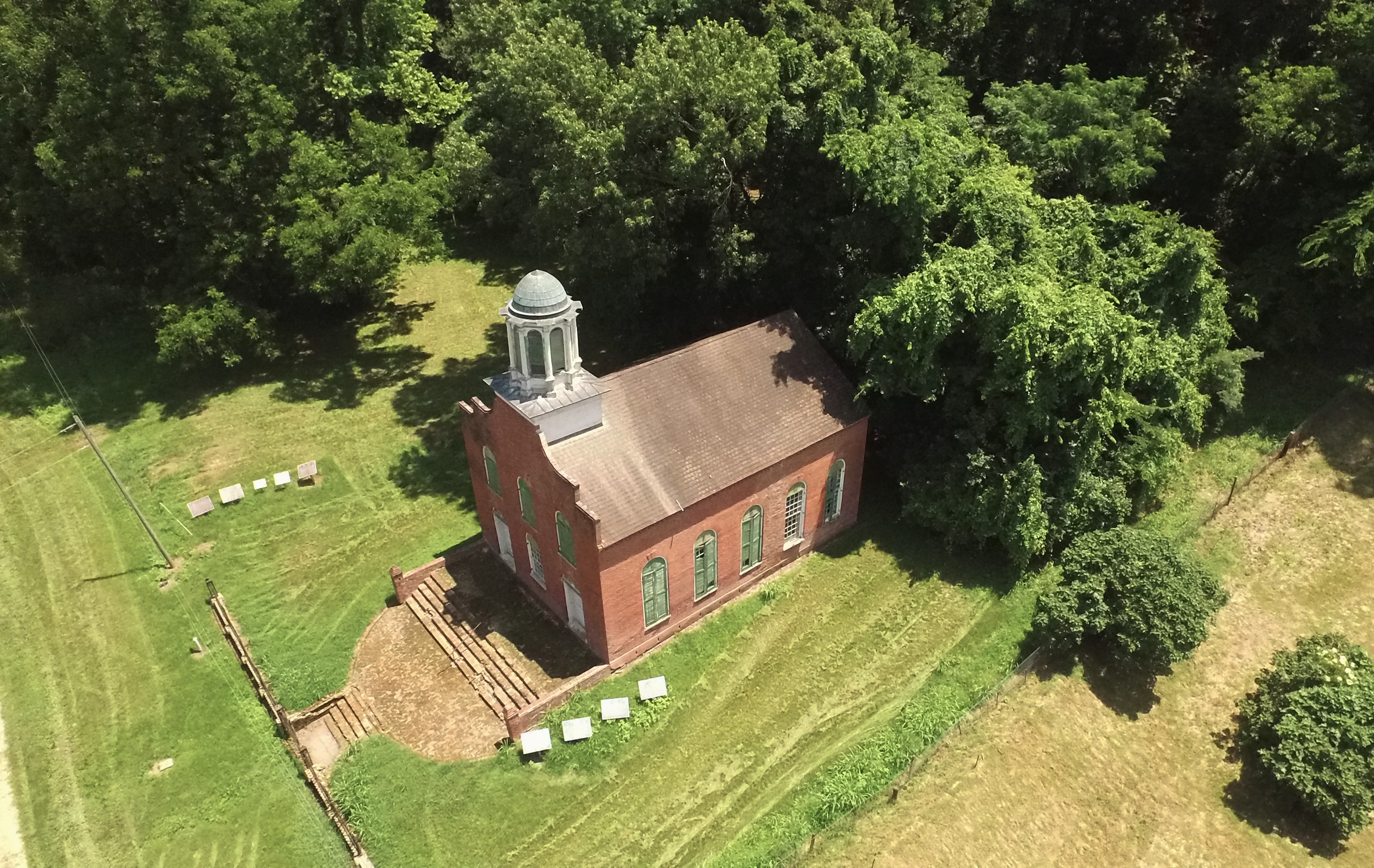
Rodney, Mississippi
In 1817, forty-eight delegates gathered at Jefferson College to choose a capital for the new state of Mississippi. Rodney lost by three votes. That razor-thin margin set the trajectory for a town that would spend the next two centuries being passed over -- first by politicians, then by the railroad, and finally by the Mississippi River itself. Today, a handful of crumbling structures cling to loess bluffs that once overlooked busy steamboat landings, and the river that made Rodney prosperous now flows miles to the west, leaving behind only wetlands and a lake tracing its former course.
Where Burr Met His Reckoning
Long before it bore its modern name, the landing at Rodney served as a key waypoint on Native American routes threading through the Mississippi Delta. After the French and Indian War delivered the region to Britain, land grants drew Anglo settlers into the loess hills. Spain took control in 1781, then ceded it back by 1798 when the Mississippi Territory was organized. In 1802, Delaware magistrate Thomas Rodney arrived as a Territorial Judge, and within a few years, the little settlement became the stage for national drama. In 1807, Secretary of the Territory Cowles Mead assembled a militia at nearby Coles Creek to capture former Vice President Aaron Burr, who was being investigated for conspiracy and treason. Burr was held at Thomas Calvit's home while Judge Rodney presided over the proceedings. The town was renamed in the judge's honor in 1814, forever linking its identity to that remarkable chapter of early American justice.
Cotton, Steam, and Spanish Coins
With the Mississippi River running parallel to its major streets, Rodney emerged as a thriving port where enslaved dockworkers loaded millions of pounds of cotton onto steamboats bound for New Orleans. Spanish picayunes and bits served as common currency. In 1830, resident Rush Nutt demonstrated new methods of powering cotton gins with steam engines, and the importation of different cotton seeds led to the breeding of Petit Gulf cotton, a disease-resistant hybrid that fueled a westward land rush. A red-brick Presbyterian church rose in 1829, and the Greek Revival Oakland Memorial Chapel began construction in 1838 at a nearby college. Zachary Taylor, the future twelfth president, built his Cypress Grove Plantation just south of town. Before the Civil War, Rodney supported two newspapers. The Southern Telegraph carried a defiant tagline in 1836: "He that will not reason, is a bigot; he that cannot, is a fool; and he that dare not, is a slave." Yet even then, a Mississippi guidebook noted the town's progress had slowed, its reputation for unhealthiness keeping new arrivals at bay.
Cannonball in the Church Wall
The Civil War struck Rodney hard. Union soldiers were captured at the Presbyterian church, and the side-wheel steamboat Rattler, retrofitted into a lightly armored warship, anchored near the landing in September 1863 after the fall of Vicksburg. The Union strategy to control the Mississippi River made every river town a strategic point. At its peak, thousands of people had called Rodney home, but many men who left for the war never returned, businesses shuttered permanently, and outbreaks of yellow fever ravaged those who stayed. When the Presbyterian church was later restored, the hole punched by Union cannonfire was deliberately preserved, and a replica cannonball was placed in the exterior wall -- a scar the town chose to keep as a memorial rather than erase.
The River Walks Away
What war began, nature finished. The Mississippi River, whose waters had given Rodney its purpose, gradually shifted its channel westward, leaving the town stranded miles from any navigable waterway. Without river commerce, there was no reason for merchants, no reason for growth. By the early twentieth century, Bob Smith -- an African American who had served as Rodney's marshal during Reconstruction -- ran a small wood-framed hotel known for its fried chicken, hot cakes, figs, and great stacks of savory frog legs. Around 1940, photographer Marion Post Wolcott documented Rodney for the Farm Security Administration and described it as a "fantastic deserted town." By 2010, only a handful of people remained. Today the Presbyterian church, listed on the National Register of Historic Places since 1972, still stands on high ground above the floodplain. A cemetery on the adjacent hill holds graves dating back over a century, including early settlers from across the river in Louisiana who sought high ground for their dead. Civil War earthworks crown the bluffs above, and sunflowers grow around unpainted shacks with tin roofs -- the last visible traces of a town that once very nearly became a state capital.
From the Air
Rodney sits at 31.86N, 91.20W on loess bluffs in Jefferson County, Mississippi, northeast of Natchez. The town site is visible as a small clearing amid dense vegetation along the eastern edge of the Mississippi floodplain. The river now flows several miles west of the original landing. Nearest airports include Natchez-Adams County Airport (KHEZ, ~25 nm southwest) and Vicksburg Municipal Airport (KVKS, ~45 nm north). Best viewed at 2,000-3,000 ft AGL. Look for the distinctive bend in the wetlands tracing the old river channel.