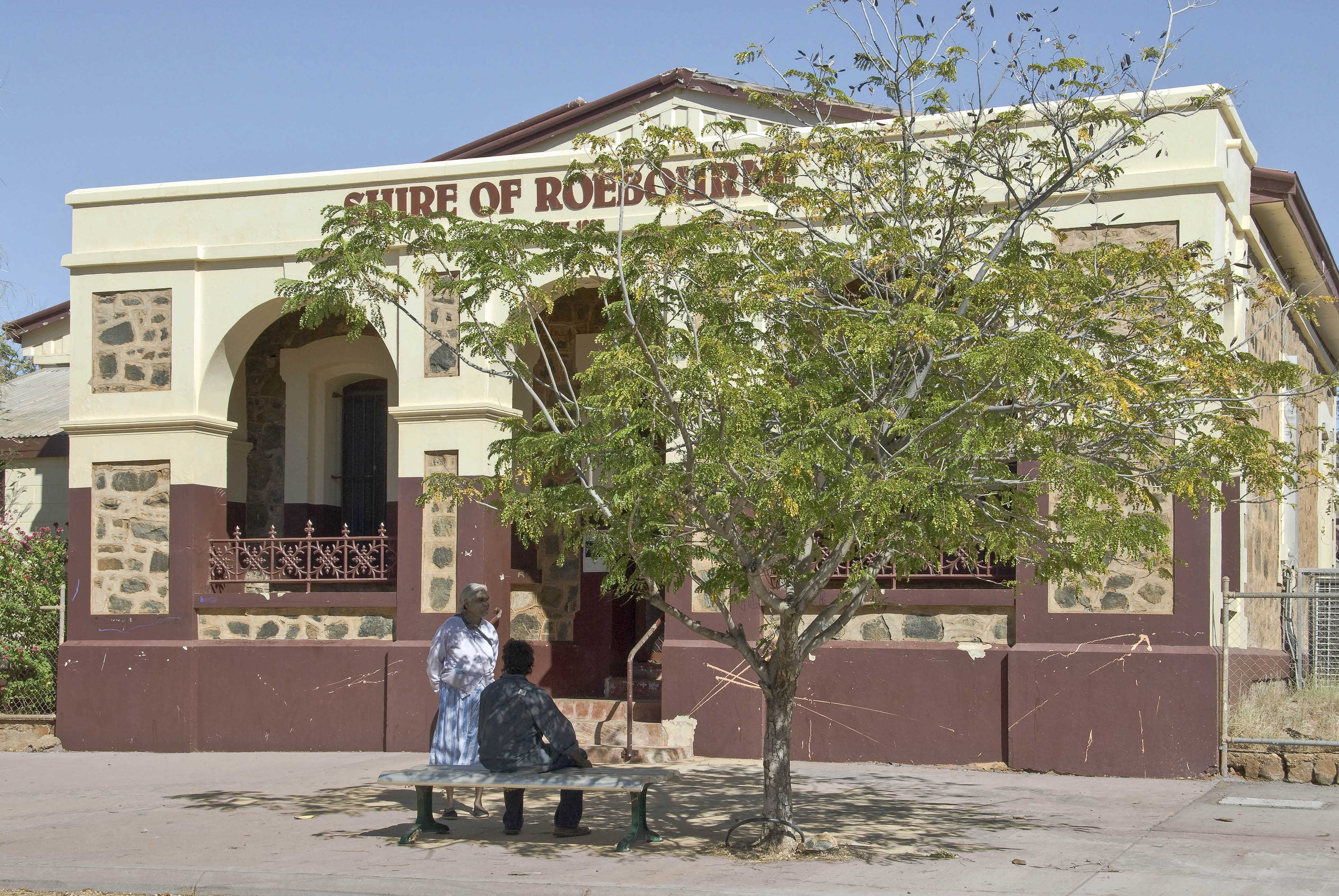
Roebourne, Western Australia
The Ngarluma people call it Ieramugadu -- the place of the native fig. Archaeological evidence puts human occupation of this stretch of the Pilbara at more than 40,000 years. European settlers arrived in the 1860s and gave it the name Roebourne, after John Septimus Roe, Western Australia's first Surveyor General. On 17 August 1866, after surveyor Charles Wedge drew a plan of 106 lots, Roebourne became the first gazetted town in the North West. It sits 35 kilometres from Karratha, 1,563 kilometres from Perth, and it is the only town on the North West Coastal Highway between Binnu and Fitzroy Crossing -- a stretch of more than 2,000 kilometres.
Gold, Cyclones, and Heritage Stone
Roebourne's European story begins with ambition and violence. The town prospered on gold discovered at Nullagine in 1878, and surrounding copper and tin mines fuelled growth through the 1880s and 1890s. At its peak, Roebourne was the largest settlement between Darwin and Perth. But the Pilbara was never gentle to its buildings. A cyclone destroyed the town in 1872, and another in 1925 ripped the Pope's Nose bridge from the riverbed and flattened the Port Samson jetty. What rose from the ruins were handsome stone structures designed by the eminent Public Works Department architect George Temple-Poole: the courthouse (1886), the post office (1887), the shire offices (1888), and the Holy Trinity Anglican Church. These heritage buildings survive today as testimony to a brief era of prosperity, their careful stonework enduring in a place where temperatures have reached 50.5 degrees Celsius.
Scars That Name the Streets
The colonial history of Roebourne is inseparable from violence against Aboriginal people. Many European men in the town during the late 1800s were directly or indirectly connected to the Flying Foam Massacre, committed against the Yaburrara people on the nearby Murujuga peninsula. Streets in Roebourne still bear the names of those involved, including Sholl Street. The Old Roebourne Gaol, constructed in 1896, was built by Aboriginal prisoners who quarried and laid its stones while detained in harsh conditions. The prison held Aboriginal people until 1923, reopened between 1975 and 1984, and its successor, Roebourne Regional Prison, remains controversial -- cells lack air-conditioning in a region where summer temperatures routinely exceed 45 degrees. Until the 1960s, strict curfews controlled Aboriginal movement to, from, and within the town, and most Aboriginal people were confined to camps and reserves kilometres away. These controls relaxed as iron ore mining reshaped the Pilbara and company towns like Dampier and Wickham drew away non-Indigenous residents.
Deaths in Custody and a Hotel Reborn
By the 1980s, Roebourne had become a majority Aboriginal town, and the relationship between its Indigenous residents and police had deteriorated badly. A federal report on Aboriginal deaths in custody documented that Roebourne, with a largely Aboriginal population of about 1,200, had police-to-citizen ratios five times higher than in more settled parts of Western Australia. In 1983, sixteen-year-old Yindjibarndi boy John Pat died in a police cell after an incident at the Victoria Hotel. His death became a landmark case in the national reckoning with Aboriginal deaths in custody. Today, that same hotel has been transformed into the Ganalili Centre, an Aboriginal-owned cultural space -- a reclamation that speaks volumes about Roebourne's capacity for reinvention.
Ieramugadu Rising
The Ngarluma Yindjibarndi Foundation Ltd (NYFL), formed in 1998 by the Ngarluma and Yindjibarndi peoples, has become the driving force of Roebourne's transformation. After near-collapse through financial mismanagement and voluntary administration in 2018, NYFL rebuilt under new leadership. By 2023, the Karratha Chamber of Commerce named it the best community organisation in the region. The foundation runs the Ieramugadu Store Maya, a social enterprise supermarket in the Old Roebourne General Store on the North West Coastal Highway, alongside an employment cafe where local Aboriginal people train and work. Its Warrgamugardi Yirdiyabura programme is recognised as the most successful Aboriginal-run employment programme in the West Pilbara. Meanwhile, collaborative arts projects have given Roebourne's children a voice -- the interactive comic Neomad and the television series Thalu, produced by local Weerianna Street Media, feature Roebourne children and elders telling their own stories. The Harding River still runs through town, reduced to a chain of waterholes since the construction of the Harding Dam, but the fig trees that gave Ieramugadu its name still grow along its banks.
From the Air
Roebourne lies at approximately 20.77S, 117.15E in the Pilbara region of Western Australia, 35 km east of Karratha. From altitude, the town is visible as a small settlement along the North West Coastal Highway, with the Harding River threading through the landscape. Heritage stone buildings cluster in the town centre. Nearest major airport: Karratha (ICAO: YPKA). The town is a gateway to Millstream-Chichester and other Pilbara national parks. Best viewed at 3,000-5,000 ft. Temperatures in summer can exceed 50C.