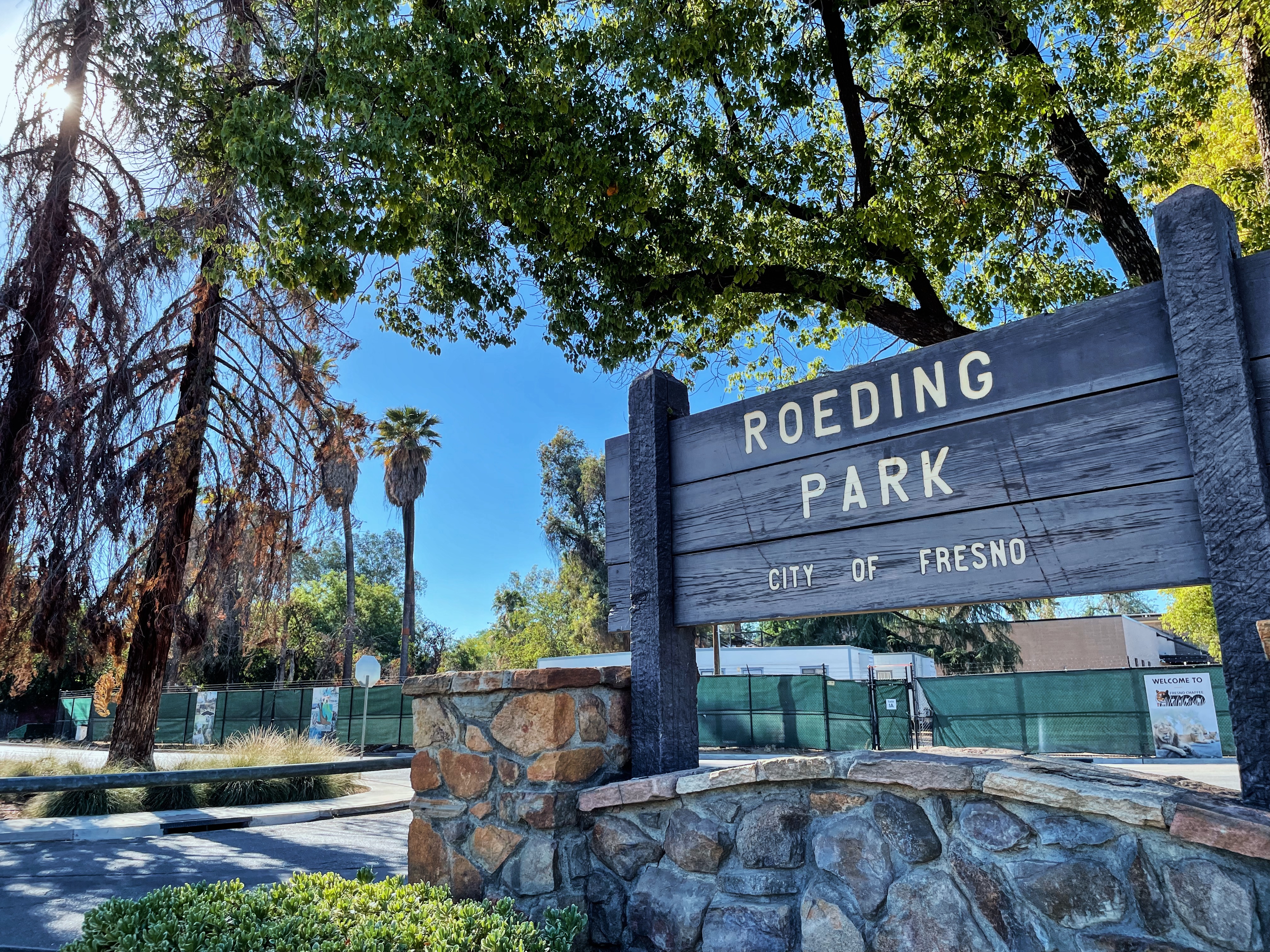
Roeding Park: A Family's Gift That Outlasted Everything
The Roeding family attached strings. When they handed 70 acres of land to the City of Fresno in 1903, the gift came with a condition: the city must spend $3,500 every year, for ten years, improving it as a public park. It was a modest demand from a family that could have asked for much more - or simply kept the land and let Fresno figure itself out. Five years later, the Roedings donated another 46 acres. Sixteen years after that, the city purchased 40 more acres from the family, bringing the total to 159. Over the next century, this single act of conditional generosity would spawn a zoo, two amusement parks, a Japanese War Memorial, and a legal dispute with the donors' own descendants. The Roedings wanted a public park. What they got was something far more complicated - and far more alive.
Roots Under Concrete
Roeding Park today is a 90-acre green island embedded in Fresno's urban grid, its canopy visible from miles away in a city that bakes through long Valley summers. The trees came first and still define the place: groves of ash, cedar, pine, eucalyptus, maple, and redwood shade the walking paths and picnic areas. Several ponds punctuate the landscape, and a lake sits near the southwest corner between what were once two small amusement parks. Tennis courts and a preserved Southern Pacific train engine round out the park's miscellaneous offerings. A Japanese War Memorial stands among the trees, a quiet monument in a park more associated with children's laughter than solemn remembrance. The National Register of Historic Places recognizes Roeding Park as significant in the areas of entertainment, community planning, and landscape architecture, with a period of significance spanning 1903 to 1953 - the half-century during which the park evolved from donated acreage into a regional landmark.
The Zoo That Swallowed the Park
A zoo arrived in the 1920s and never stopped growing. The Fresno Chaffee Zoo now occupies approximately one-third of the park's total acreage, spread across the middle of its southern half. For decades the zoo operated as a city department - a municipal amenity funded through general revenues and managed by city employees. That changed with the passage of Measure Z, which added a tenth of a cent to Fresno's sales tax and dedicated the proceeds to the zoo. The revenue allowed a transition to nonprofit management under the Fresno Chaffee Zoo Corporation, a 501(c)(3) organization that leases the land, exhibits, and animals from the city. The zoo secured AZA accreditation under director Lewis Greene, hired in 2006 from the Virginia Zoo after his predecessor, Donna Fernandes from the Buffalo Zoo, departed after just three months. Growth brought ambition, but ambition brought conflict. The Roeding family descendants have threatened legal action if the zoo expands further into parkland their ancestors donated for the purpose of a "public park" - not a zoological institution.
Storyland and the Steam-Outline Train
In 1955, Fresno's Rotary Clubs built Playland, a modest amusement park, on the park's southwest corner. Seven years later, Storyland joined it - a fairy-tale-themed park geared toward younger children, filled with interactive scenes from well-known stories. A miniature railroad connected the two, its locomotive a diesel engine costumed to resemble a steam engine, a charming fraud that no child ever questioned. During summer months, a troupe of local students performed plays in an amphitheater, bringing fairy tales to life in the shade of trees older than anyone in the audience. The two parks underwent a massive renovation in 2016, but Playland ultimately closed for good in March 2025 after seventy years of operation. Storyland's future remains uncertain. The miniature train may or may not run again. But the tracks are still there, curving through the trees between one park's memory and another's hope.
The Condition That Keeps Giving
What makes Roeding Park unusual is not its attractions but its origin story - and the legal tension that origin story still generates. The Roeding family's 1903 donation was not an unconditional gift. It was a contract: use this land as a public park, or the terms are violated. More than a century later, that condition still has teeth. When the Chaffee Zoo's expansion plans began encroaching on parkland, the Roeding descendants invoked their ancestors' intent, arguing that a zoo is not a public park in the sense their family meant. The dispute cuts to a question every growing city eventually faces: when a donor gives land for a specific purpose, how far can that purpose stretch before it snaps? The zoo brings revenue and visitors. The park brings shade and open space. Both serve the public, but they serve it differently, and in Roeding Park, those two visions of public good share the same 159 acres.
Green Island in a Hot City
From the air, Roeding Park reads as a dense patch of canopy in a city that radiates heat. Fresno's Central Valley location means summer temperatures regularly exceed 100 degrees, and the park's mature trees provide relief that no air-conditioned building can replicate - the kind of shade that slows your walk, lowers your voice, and makes you forget, briefly, that you are in one of the hottest cities in California. The park has outlasted streetcars and shopping malls, two world wars, and now an amusement park. Its period of historic significance officially ends in 1953, but significance is a living thing, renewed every time a family spreads a blanket under a redwood or a child discovers the old Southern Pacific locomotive. The Roedings asked Fresno to maintain a public park. The city has done that, imperfectly and sometimes contentiously, for over 120 years. The trees do not care about the arguments. They just grow.
From the Air
Located at 36.75°N, 119.82°W in western Fresno, California. The park is a prominent green rectangle visible from altitude, bounded roughly by West Olive Avenue to the north and Highway 99 to the east. Zoo structures and parking lots are visible in the southern portion. Fresno Yosemite International Airport (FAT) is approximately 7 miles northeast. Fresno Chandler Executive Airport (FCH) is about 3 miles south. Elevation is roughly 300 feet on the Central Valley floor. Visibility is generally good but summer haze and agricultural dust can reduce it, particularly in the San Joaquin Valley's characteristic temperature inversions.