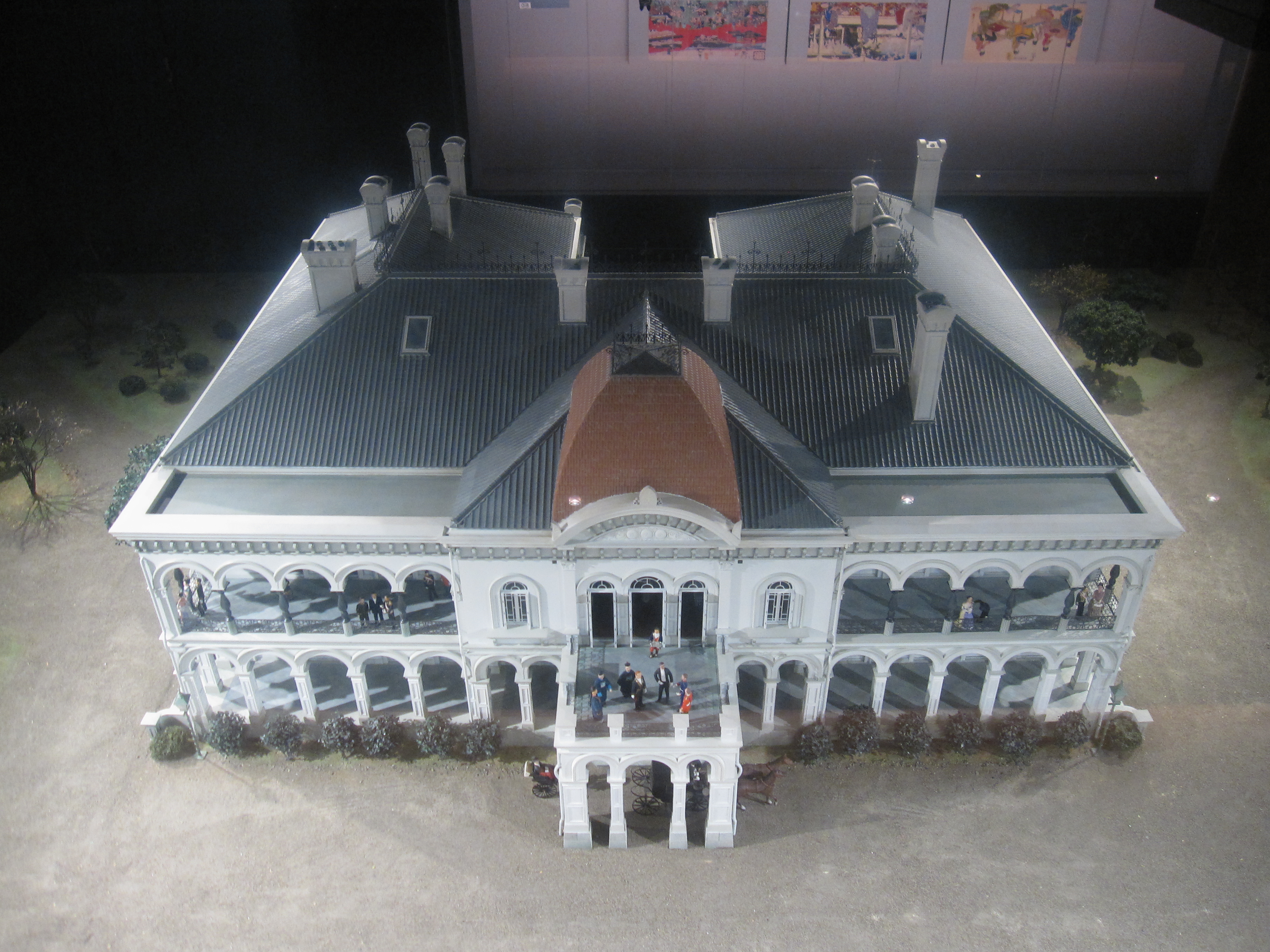
Rokumeikan
Japanese gentlemen in evening dress imported from London tailors danced the waltz, polka, quadrille, and mazurka with Japanese ladies in the latest Parisian fashions while an Army band played European songs. The year was 1883, the place was Hibiya, and the building was the Rokumeikan -- the Deer Cry Pavilion -- a name drawn from a Chinese poem about the pleasures of hospitality. Foreign Minister Inoue Kaoru had commissioned it, British architect Josiah Conder had designed it, and for a few dazzling, awkward, politically charged years, it became the most talked-about building in Japan. The Rokumeikan was demolished in 1941. Today, only a commemorative plaque in front of the NBF Hibiya Building marks the spot. But the building's ghost has never left Japanese culture.
A Pavilion Built on Strategy
The Rokumeikan was not built for pleasure. It was built for diplomacy. In the 1880s, Japan was trapped under a web of unequal treaties imposed by Western powers, and Foreign Minister Inoue Kaoru believed that demonstrating Western-style sophistication would convince European and American governments to renegotiate. The plan was architectural: build a grand Western-style reception hall, fill it with elegantly dressed Japanese hosts, and prove that Japan belonged at the table of civilized nations. Inoue chose a site in Hibiya, near the Imperial Palace, on land that had served as a Satsuma domain arsenal before the Meiji Restoration. Between 1875 and 1881, the site had housed the Yamashita Monnai Museum, a combined zoo and botanical garden, which was relocated to Ueno to clear space. The previous accommodation for foreign dignitaries, the Enryokan, had been a Tokugawa-era naval training facility repurposed and ultimately found wanting. Inoue wanted something grander.
Conder's Mansard Compromise
Josiah Conder, a British architect who had come to Japan as one of the government's hired foreign advisers, received the commission in 1880. He drew from the French Renaissance style, incorporating a Mansard roof, an arched portico with columns, and elaborate interior spaces suitable for ballrooms and banquet halls. Conder wanted to include Japanese design elements, but his patrons overruled him -- the entire point was to look Western. Only the garden, with its pine trees, stone lanterns, and ponds, was permitted to remain Japanese. Construction ran from 1881 to 1883, and costs ballooned from the original budget of 100,000 yen to 180,000 yen -- four and a half times what the Foreign Ministry building itself cost to construct. The grand opening on November 28, 1883 drew 1,200 guests: nobles, bureaucrats, and foreign diplomats, presided over by Inoue and his wife Takeko.
The Ballroom and the Mirror
The Rokumeikan's heyday was spectacular and brief. Banquets were served with menus written in French. The ballroom hosted charity balls, masquerade parties, and elaborate receptions designed to dazzle foreign visitors. Foreign residents of Tokyo were hired as dancing tutors. But the spectacle also drew sharp criticism. The liberal Freedom and People's Rights Movement attacked the Rokumeikan as expensive, tax-funded deference to Europeans and Americans. French artist Georges Ferdinand Bigot published a cutting cartoon depicting a stylishly dressed Japanese couple admiring themselves in a mirror, only for their reflection to show a pair of monkeys. The satire stung because it captured the central tension: was Japan modernizing, or merely performing modernity? By the late 1880s, the diplomatic strategy had failed to produce treaty revisions, and Inoue resigned. The building was sold in 1890 to an association of Japan's kazoku peerage, who renamed it the Peers' Club.
Afterlife in Ink and Memory
The building that Conder designed was demolished in 1941, but the Rokumeikan refused to stay dead. Its destruction so disturbed architect Taniguchi Yoshiro that he eventually created the Meiji-mura museum in 1965, dedicated to preserving surviving Meiji-period buildings. In literature, the Rokumeikan became a recurring symbol of Japan's complex relationship with the West. Akutagawa Ryunosuke wrote about its ballroom in his 1920 short story 'The Ball.' Mishima Yukio set an entire 1956 play inside its walls. Tanizaki Junichiro referenced it in his 1924 novel 'Naomi.' Manga artists from Kazuo Koike to Takako Shimura have drawn its halls. The site in Chiyoda-ku, Uchisaiwaicho 1-chome, now bears only a plaque, but the Rokumeikan endures as the defining metaphor for the Meiji era's central question: what does a nation lose when it remakes itself in another's image?
From the Air
Located at 35.672N, 139.758E in Hibiya, Chiyoda ward, central Tokyo. The original building no longer exists -- demolished in 1941 -- and the site is now occupied by the NBF Hibiya Building near Uchisaiwaicho. From the air, the site is identifiable by its proximity to Hibiya Park and the Imperial Palace grounds, in the heart of Tokyo's government and business district. Nearest airports: Tokyo Haneda (RJTT) approximately 8 nm south, Narita International (RJAA) approximately 37 nm east-northeast. Best viewed at 2,000-4,000 feet AGL. Hibiya Park's green rectangle provides a strong visual reference point adjacent to the site.