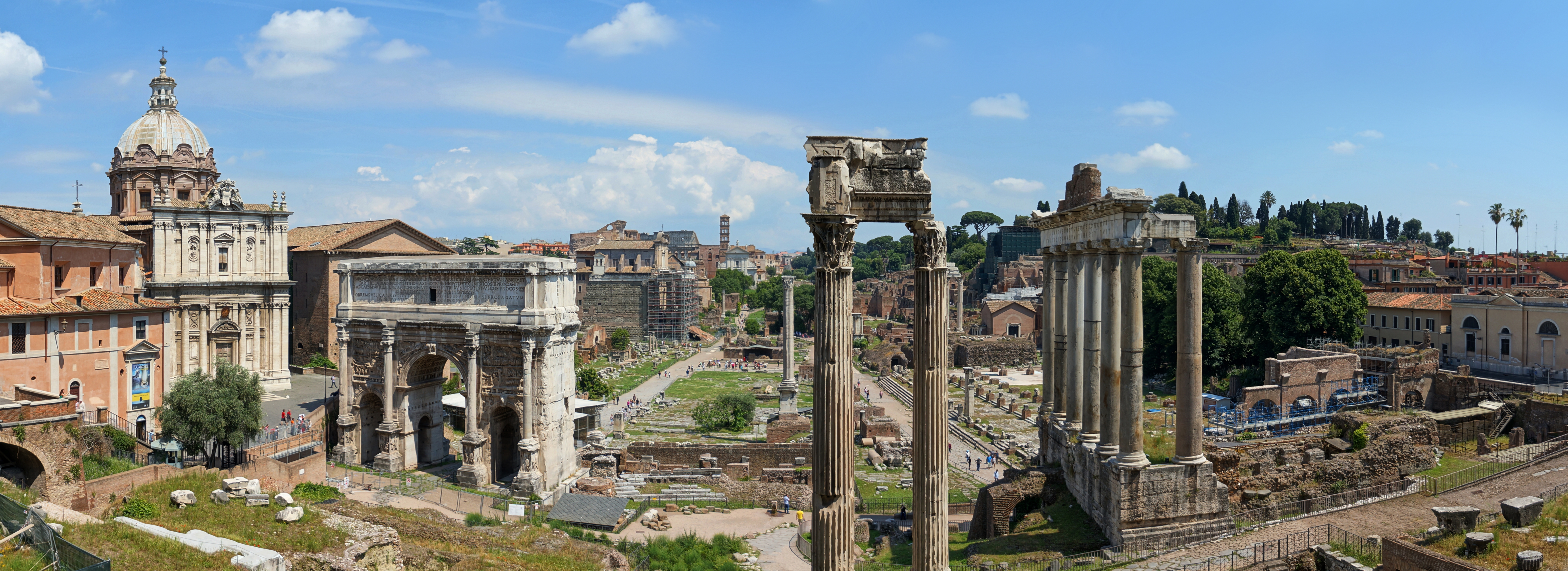
The Roman Forum: Where a Swamp Became the Center of the World
Every word spoken in the English word "forum" traces back to this rectangle of broken stone between the Palatine and Capitoline Hills. It measures roughly 130 by 50 meters today, but for more than a thousand years, this was the center of the known world - the site where triumphal processions ended, where criminal trials drew crowds, where senators debated the fate of provinces they had never visited. The Roman Forum began not as a grand civic gesture but as a drained swamp. In the 7th century BC, the Cloaca Maxima - one of the world's earliest sewer systems - channeled water out of this low-lying wetland and into the Tiber, turning soggy ground into buildable land. What Romans did with that land changed civilization.
From Mud to Monument
Archaeological evidence shows that thatch-and-timber huts stood along what would become the Via Sacra as late as the mid-7th century BC. Within decades, rectangular stone buildings replaced them. The earliest shrines clustered along the southeastern edge: the Regia, traditionally the royal residence dating to the 8th century BC, and the Temple of Vesta from the 7th century BC, where the sacred flame of Rome burned under the watch of the Vestal Virgins. At the northwestern end, the Vulcanal and the Comitium took shape - the assembly area where the Senate first convened and Republican government was born. Unlike the later imperial fora, which were designed as unified public squares in the Greek tradition, the Roman Forum grew organically over centuries, each generation layering its ambitions atop the last. The ground level itself rose steadily as sediment from Tiber floods and hillside erosion accumulated, burying earlier floors beneath newer ones.
The Republic's Stage
For centuries the Forum served as Rome's living room. Elections were held here. Generals returning from conquest paraded through on triumphal processions that ended at the Temple of Jupiter on the Capitoline above. Cicero delivered his orations from the Rostra, the speakers' platform decorated with the prows of captured warships - the very word "rostrum" descends from this place. Criminal trials unfolded in the open air, and gladiatorial matches entertained crowds before the Colosseum existed. The Temple of Saturn, one of the Forum's oldest structures, doubled as the state treasury, its underground vaults holding Rome's reserves of gold and silver. Commercial life thrived alongside the political: shops lined the basilicas, and merchants conducted business in the shadow of monuments commemorating the city's greatest leaders.
Imperial Ambitions in Stone
Julius Caesar began reshaping the Forum to match his vision of Rome, but it was Augustus who truly transformed it. He built the Temple of the Divine Julius on the spot where Caesar's body had been cremated, turning an assassination site into sacred ground. The Arch of Titus, erected after AD 81, commemorated the conquest of Jerusalem and still stands at the Forum's southeastern entrance, its relief carvings showing Roman soldiers carrying the Temple's menorah. The Basilica Julia on the south side and the Basilica Aemilia on the north defined the Forum's final rectangular form. By the Imperial period, the open space had shrunk dramatically as temples, arches, and government buildings crowded the central square. Each emperor added his mark, until the Forum became a dense palimpsest of power - every stone a political statement, every column a dynasty's claim to permanence.
Silence and Rediscovery
After the fall of the Western Roman Empire, the Forum's fate mirrored Rome's own decline. Buildings were quarried for their stone and marble. Churches rose inside former temples. Flooding resumed as the drainage systems collapsed, and centuries of silt gradually buried the ancient pavement. By the medieval period, locals called the area Campo Vaccino - the cow field - because cattle grazed among the half-buried columns. From the 17th through the 19th century, Northern European artists traveling to Rome sketched what remained, their drawings preserving details that further decay would erase. Systematic excavation began in the 18th century and intensified after Rome became Italy's capital in 1871. Today the Forum is a sprawling open-air museum where visitors walk paths that Julius Caesar walked, past columns that Cicero would recognize, above drainage channels that the Etruscan kings engineered three millennia ago.
From the Air
Located at 41.892N, 12.485E in the heart of Rome, between the Palatine and Capitoline Hills. The Forum appears from the air as an elongated field of ruins oriented northwest-southeast, immediately northwest of the Colosseum. The Arch of Titus is visible at the southeastern end. Best viewed at 1,500-2,500 feet to appreciate the Forum's relationship to the surrounding hills, the Colosseum, and the Palatine palaces. Nearest major airport: Leonardo da Vinci-Fiumicino Airport (LIRF), approximately 30 km southwest. Roma Urbe Airport (LIRU) is closer at about 8 km north. The Tiber River curves past the site to the west.