Roman Ruins of Milreu
Squid tentacles curl across the floor in tiny stone tiles, each one placed by hand nearly two thousand years ago. The mosaic artisans who decorated the villa at Milreu chose the sea as their subject -- fish, octopi, crustaceans rendered in such precise detail that you can identify the species. These floors have outlasted the empire that commissioned them, the religion that repurposed the temple above, and the centuries of agricultural life that buried everything under Algarvean soil. Near the village of Estoi, a few kilometers north of Faro, the ruins of Milreu stand as the most prominent evidence of Roman presence in southern Portugal.
A Villa Built on Abundance
Milreu was first constructed and inhabited in the 1st century, part of the wave of Roman settlement that transformed the Iberian coast into a network of productive estates. But this was no simple farmstead. The villa distinguished itself through sheer ambition -- extensive mosaic decorations, imperial busts, a temple devoted to a water deity, gardens, and both winery and oil-processing mills. By the end of the 3rd century, the house had been reorganized around a grand central peristyle ringed by 22 columns, surrounding an open courtyard with gardens and elaborate thermal baths. The thermae followed the full Roman bathing sequence: apodyterium, frigidarium, a circular cold plunge pool, tepidarium, and caldarium, each space decorated with mosaics, including one featuring oblong fish that seem to swim through the stone floor.
Sacred Waters and Shifting Faiths
South of the main residence stood a temple dedicated to an aquatic deity -- fitting for an estate so obsessed with the sea. When Christianity arrived, the temple was not demolished but adapted. A baptismal pool was added, and the structure served as a paleo-Christian church, its pagan altar quietly absorbed into the new faith. A small mausoleum occupied a corner of the patio. Among the archaeological finds are busts of Emperor Gallienus and Agrippina the Younger, suggesting the villa's owners cultivated connections to imperial power. The site shows traces of continuous occupation spanning from the 1st century all the way to the 10th, a remarkable persistence through the fall of Rome, the Visigothic period, and the early centuries of Moorish rule in the Algarve.
From Ruin to Rediscovery
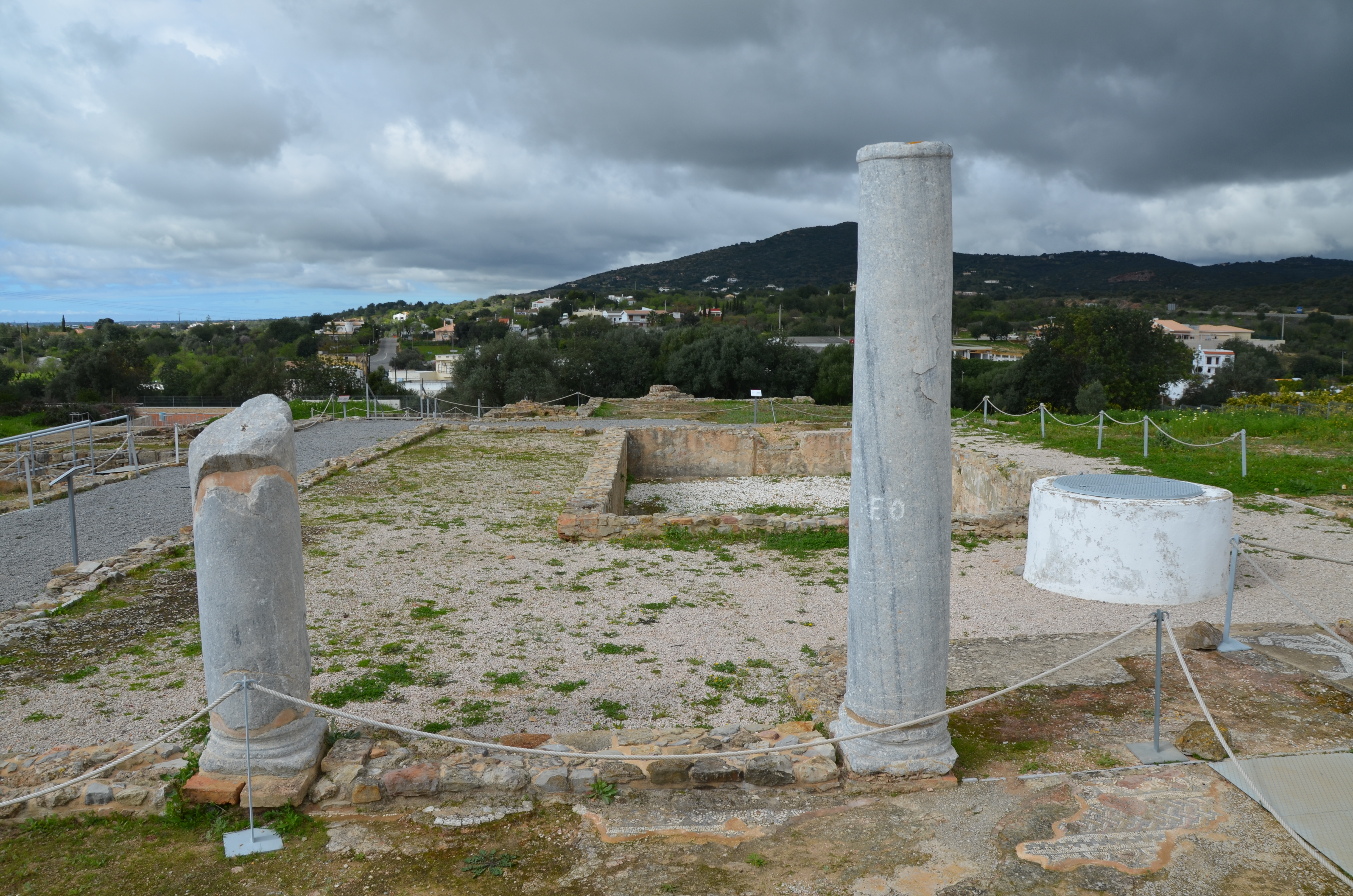
For centuries, the villa lay beneath layers of rural soil, its mosaics and marble columns forgotten. A 16th-century farmhouse was built nearby, its inhabitants perhaps unaware of the Roman city sleeping beneath their fields. Modern excavation and conservation efforts culminated when the site was included in Portugal's 1999 Tourism Appreciation and Dissemination Program as part of an archaeological itinerary linking the Alentejo and Algarve regions. The old farmhouse itself was remodeled by architects Ditza Reis and Pedro Serra Alves into an interpretive center, which opened on 19 November 2003 with a permanent exhibition. Today, two standing columns from the original peristyle still frame the Algarvean sky, while the exposed walls trace the outlines of rooms where Romans once bathed, feasted, and pressed their olives.
A View from Above
From the air, Milreu reads as a geometric interruption in the rolling agricultural countryside east of Faro. The excavated foundations describe rectangles and courtyards with the unmistakable regularity of Roman planning, set against the organic curves of the surrounding landscape. The white interpretive center and its cylindrical corner buttresses sit adjacent to the exposed ruins, and on clear days the site stands out sharply against the red-brown earth. It is a quiet place, far from the tourist crowds of the Algarve coast, but it tells a story that connects this sun-warmed corner of Portugal to the furthest reaches of the Roman world.
From the Air
Located at 37.095N, 7.904W near Estoi, north of Faro, Portugal. Best viewed below 3,000 ft AGL. The ruins appear as geometric foundations in agricultural land. Nearest airport: LPFR (Faro Airport, ~8 km south). The Algarve coastline is visible to the south.