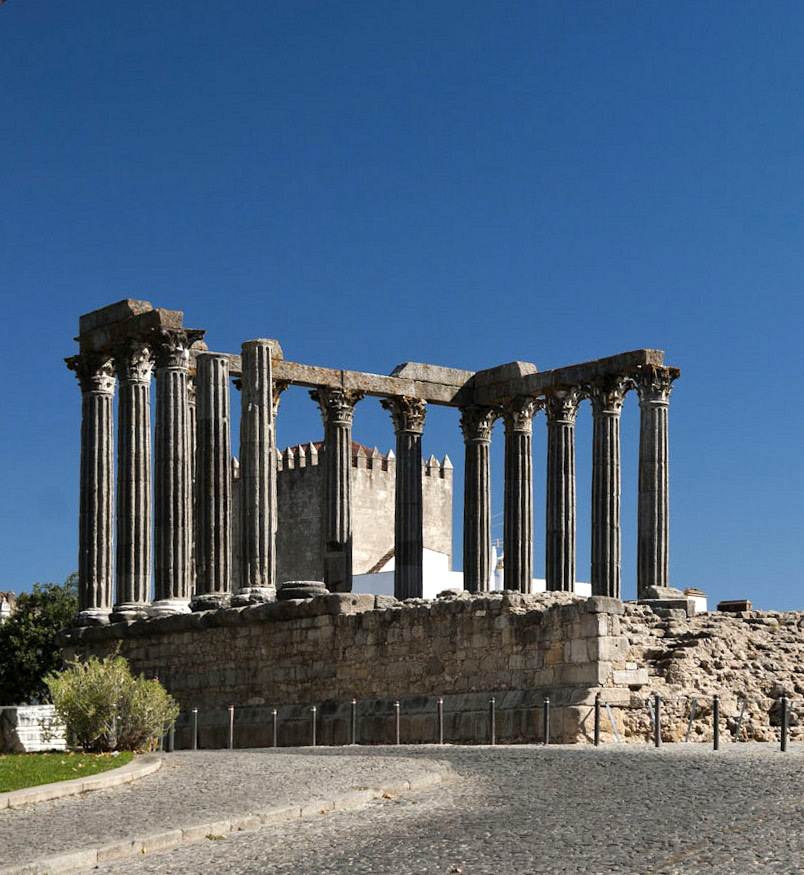
Roman Temple of Evora
Everyone in Evora calls it the Temple of Diana, and everyone is probably wrong. The fourteen Corinthian columns that still stand in the city's central square were almost certainly raised in the 1st century CE to honor Augustus, the first Roman emperor, who was venerated as a god during and after his rule. Some scholars suggest Jupiter instead. But Diana -- goddess of the moon, the hunt, and chastity -- is the name that stuck, attached to the ruin by an 18th-century myth and too romantic to dislodge. Whatever deity it honored, the temple is the best-preserved Roman structure on the Iberian Peninsula and one of the most striking ancient monuments in all of Portugal.
Marble and Granite on the Forum
The temple stood at the center of Liberalitas Iulia, as the Romans called Evora -- a city in the province of Hispania Baetica, part of the territory of the Lusitanians. Its podium measures 25 meters long, 15 meters wide, and 3.5 meters high, a granite base topped with masonry. The columns rise from circular pedestals of white marble quarried in Estremoz, about 40 kilometers to the northeast. Their fluted Corinthian shafts vary in height from 1.2 to 6.2 meters, topped by carved capitals decorated with flower motifs -- marigolds, sunflowers, and roses -- in three orders of detail. The entablature above is granite. This interplay of warm granite and cool white marble gives the ruin its distinctive character, an equilibrium of color and texture that survives even in fragments.
A Pool to Reflect the Gods
Late 20th-century excavations revealed traces of a reflecting pool that once surrounded the temple, a feature designed to double the columns' image in still water and amplify the building's visual impact on worshippers approaching across the forum. The pool is gone now, its outline visible only in the archaeological record. But the temple's placement -- elevated on its high podium at the center of the city's most important public space -- remains legible. The square around the temple today holds manicured gardens, the former archbishop's palace (now a museum), and the northern tower of the Cathedral of Evora. Roman, medieval, and modern Evora converge in a single view.
Centuries of Other Uses
The temple was not preserved by reverence but by reuse. After the Roman era ended, the structure was incorporated into later buildings -- its walls filled in, its spaces repurposed. For centuries it served as part of a medieval tower and slaughterhouse, its classical lines hidden behind later masonry. This practical enclosure saved the columns from the stone robbers who stripped so many Roman monuments across Europe. The temple was not recognized as a classical ruin until it was gradually exposed in the late 18th and 19th centuries. What visitors see today is partly the result of a Romantic-era restoration by the Italian architect Giuseppe Cinatti, who cleared away the medieval additions and re-presented the columns as freestanding classical elements. His restoration followed the aesthetic theories of his time -- a 19th-century vision of what a Roman temple ought to look like.
Standing in the World Heritage City
The temple is part of Evora's historic center, which UNESCO inscribed as a World Heritage Site in 1986 for its exceptional collection of monuments spanning two millennia. Within a few hundred meters of the columns stand the Gothic cathedral, the Jesuit university, a Moorish-era city wall, and Renaissance palaces. The Roman temple anchors this layering of civilizations. It is the oldest visible structure in a city where every era left its mark, a fragment of the empire that connected Iberia to Rome, North Africa, and the wider Mediterranean. The columns cast long shadows across the garden in the late afternoon, their Estremoz marble still glowing faintly against the granite, still holding the proportions their builders intended twenty centuries ago.
From the Air
Located at 38.57N, 7.91W in the historic center of Evora, Portugal, immediately adjacent to the Cathedral of Evora. The temple's freestanding columns are not individually distinguishable from high altitude, but the open square and garden surrounding them are visible. Nearest airports: Evora (military, LPEV); Lisbon-Humberto Delgado (LPPT), approximately 130 km northwest. Best viewed at 500-1,500 ft AGL. The entire historic center is a UNESCO World Heritage Site.