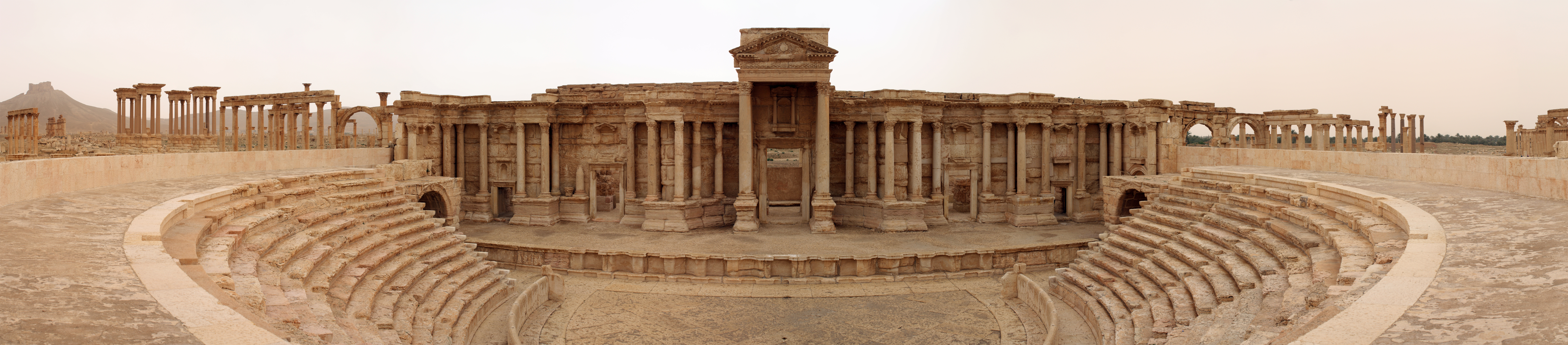
Roman Theatre at Palmyra
On 5 May 2016, the Mariinsky Theatre orchestra of St. Petersburg performed a 20-minute concert of classical music on a stage where, eleven months earlier, ISIS had lined up 25 captives and shot them in the head. The Roman Theatre at Palmyra has always been a place where power performs. Built in the second century AD, never completed, buried under sand for centuries, then cleared and restored in the 1950s to host folk music festivals -- it has cycled through uses that its Severan-era architects could never have imagined. What happened between 2015 and 2023 compressed centuries of such reinvention into eight violent years.
A Theatre Never Finished
The theatre dates to the second century AD, built in the center of a semicircular colonnaded piazza that opened toward Palmyra's South Gate. Its builders never completed it. The cavea -- the seating area -- consists only of the ima cavea, the lowest section, with eleven wedge-shaped seating blocks of twelve rows each. The full upper tiers were never constructed, giving the structure an oddly truncated profile. Below, the stone-paved orchestra measured 23.5 meters in diameter. The proscenium wall was decorated with alternating curved and rectangular niches -- ten curved, nine rectangular -- and the scaenae frons had five doors, its columns carved in the Corinthian order. Emperor Nero reportedly placed his own statue in the central niche. After centuries buried under desert sand, the theatre was excavated in the 1950s and subsequently restored. It became the venue for the annual Palmyra Festival, hosting folk music performances that drew visitors from across Syria.
The Stage as Killing Ground
ISIS took full control of Palmyra on 21 May 2015. Within weeks, the theatre became an instrument of terror. In early July, ISIS released a video showing 25 teenage members forcing 25 adult male captives to kneel on the ancient stage. The teenagers then executed all 25 simultaneously with gunshots to the head. The Syrian Observatory for Human Rights reported that the executions had actually taken place on 27 May. Mamoun Abdulkarim, Syria's director of antiquities and museums, responded with a statement that cut to the core of what ISIS was doing: "Using the Roman theatre to execute people proves that these people are against humanity." The theatre was not merely a location. It was chosen precisely because of what it represented -- civilization, culture, the idea that human beings create beautiful things and gather to experience them together.
Dueling Concerts
When the Syrian Army, backed by Russian airstrikes, recaptured Palmyra in March 2016, drone footage showed the theatre largely intact. Two months later, on Syria's Martyrs' Day, Russia staged its statement. Conductor Valery Gergiev led the Mariinsky orchestra through European and Russian classical music, with cellist Sergei Roldugin as soloist. The concert was dedicated to Alexander Prokhorenko, a Russian special forces soldier killed near Palmyra while directing airstrikes. President Putin addressed the audience by video link. The Economist observed that Putin "did everything he could to underline the concert's message that Russia is leading the fight for Western civilisation." A second concert that evening featured a Syrian orchestra and choir. The audience included military officials, UNESCO representatives, and locals. British Foreign Secretary Philip Hammond called the event a "tasteless attempt to distract attention" from Russian airstrikes on a refugee camp in northern Syria that had killed at least 28 civilians.
Destruction as Reprisal
ISIS recaptured Palmyra in December 2016 and immediately made good on a promise. Following the Russian concert, ISIS radio had threatened to stage a new "concert" of its own. Instead, the group destroyed the theatre's facade. Mikhail Piotrovsky, director of the Hermitage Museum, called it an act of reprisal. Drone footage from the Russian Ministry of Defence confirmed the damage: the proscenium, the central part of the stage, had suffered severe destruction. UNESCO head Irina Bokova characterized the demolition as a "war crime." Palmyra was retaken by Syrian government forces in early March 2017, and this time the recapture held. Antiquities official Wael Hafyan assessed the damage to the theatre's facade as less catastrophic than initially feared.
Restoration Complete
On 23 July 2023, the Syrian Directorate-General of Antiquities and Museums and the Institute for the History of Material Culture of the Russian Academy of Sciences signed an agreement for comprehensive restoration. The work moved quickly. By the end of 2023, the theatre's facade had been rebuilt, its stage restored, its seating repaired. Two thousand years after Severan architects left it unfinished, the Roman Theatre at Palmyra is now more complete than they ever made it. Whether it will again host performances -- folk music, classical concerts, or something entirely new -- remains uncertain. But the stage is set.
From the Air
Located at 34.5505°N, 38.2687°E within the Palmyra archaeological complex, on the south side of the Great Colonnade. The theatre's semicircular cavea is visible from above as a distinctive curved form within the rectangular grid of ruins. Situated 215 km northeast of Damascus in the Syrian Desert. Nearest airfield is T4/Tiyas Airbase (OSTY), approximately 60 km west. Flat desert terrain with excellent visibility in clear conditions.