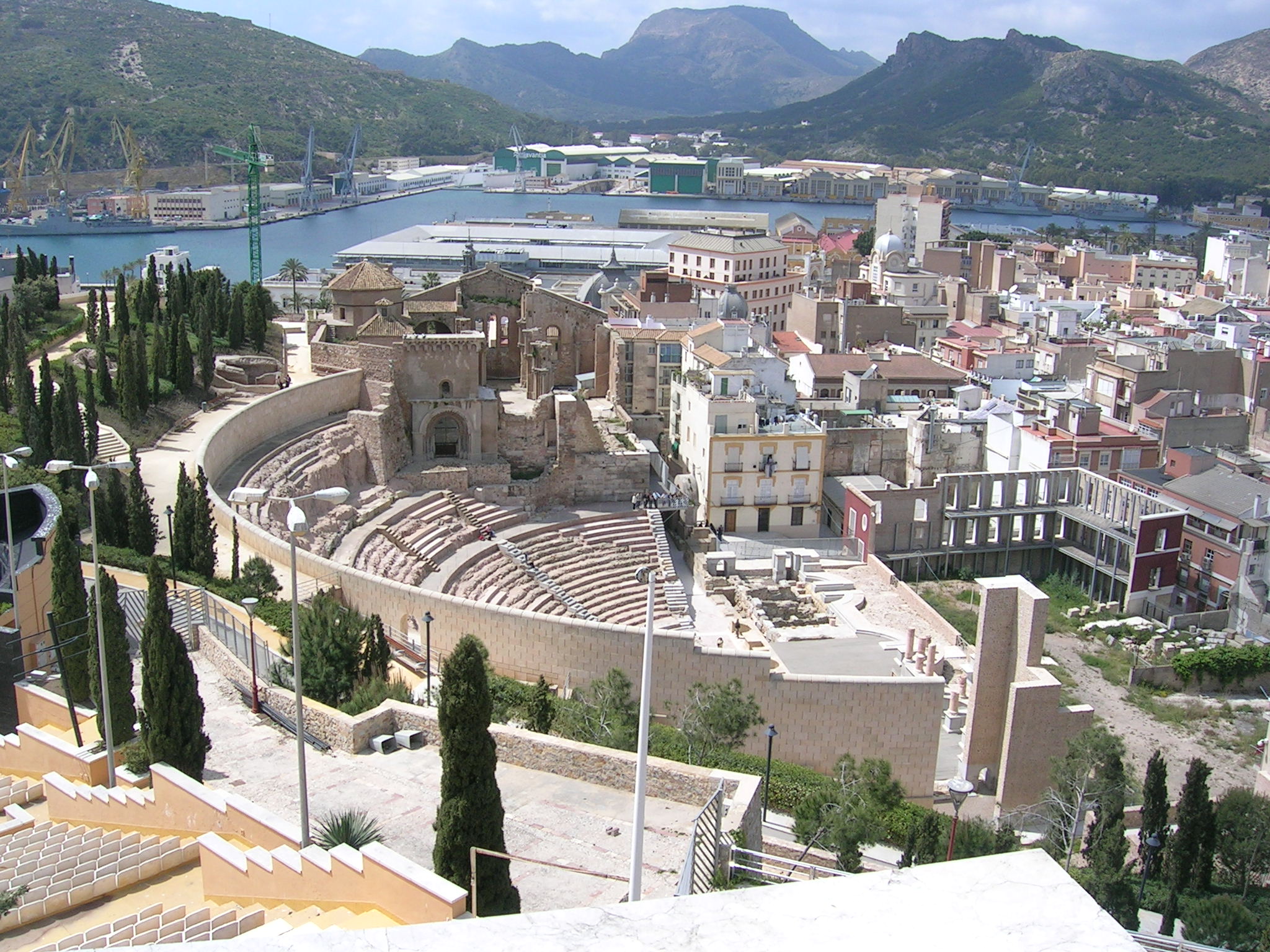
Roman Theatre of Cartagena
They were digging foundations for a crafts center in one of Cartagena's most neglected neighborhoods when the excavators hit something unexpected: carved stone columns, Corinthian capitals of Carrara marble, fragments of an inscription dedicating the building to Lucius Caesar. What emerged over the next fifteen years was a complete Roman theater built between 5 and 1 BCE, with seating for 6,000 spectators, its stage oriented to catch the sunrise at the winter solstice. The theater had been buried for more than a thousand years beneath layers of market, Byzantine district, medieval church, and working-class housing. Its rediscovery in 1988 transformed not just archaeological understanding of ancient Carthago Nova but the physical and economic life of the modern city above it.
Augustus's Statement in Stone
When Augustus ruled the Roman Empire, Cartagena was Carthago Nova -- a prosperous colonial city on the southeastern coast of Hispania, its deep natural harbor making it one of the most important ports in the western Mediterranean. The theater was built into the slope of the Hill of La Concepción, positioned so that arriving ships would see the grand building rising above the harbor, a visual declaration of Roman power and cultural sophistication. The architects oriented the axial axis toward the winter solstice sunrise and placed the seating to face north, sheltered from the prevailing easterly winds. Before the theater, a Roman house from the late 2nd century BCE occupied the site; it was deliberately demolished to make way for the larger structure. The theater functioned for about two centuries before a fire destroyed much of its architectural framework.
A Millennium Underground
After the fire, the theater's decline became its preservation. In the 5th century, the remaining standing elements were dismantled and their stones reused to build a commercial market. Byzantine settlers built a trading district over the ruins in the 6th and 7th centuries. After the Christian reconquest, the church of Santa Maria la Vieja -- the Old Cathedral -- was constructed partly atop the theater's seating tiers, its foundations literally resting on Roman stones. By the 20th century, the neighborhood above the buried theater had become one of the most depressed areas of the old town. Wealthier residents left in the 1960s and 70s, and the area deteriorated into abandonment -- which, ironically, prevented the kind of deep modern construction that might have destroyed the Roman remains entirely.
Moneo's Promenade
In 2003, the Roman Theater Foundation commissioned Pritzker Prize-winning architect Rafael Moneo to design an integrated museum and restoration project. Moneo conceived the museum not as a static exhibition space but as a journey -- a promenade from sea level to the higher ground where the theater stands. Visitors enter near the port and ascend through exhibition spaces illuminated by skylights, past display cases holding Corinthian capitals carved in Rome from Carrara marble, red travertine column shafts, and altars recovered during excavation. The route builds anticipation, moving through corridors and elevators, until the theater's imposing semicircle appears unexpectedly at the summit. In Moneo's words: "The museum has been designed as a promenade from sea level to the higher ground of the city, climaxing with the unexpected appearance of the theatre's imposing space." The project opened in 2008 and now draws over 200,000 visitors annually.
Restoring Without Erasing
The restoration team faced a fundamental tension: how to make the theater comprehensible to visitors without sacrificing its archaeological integrity. They chose minimum intervention. Missing sections of the cavea were rebuilt in rubblework, clearly distinguishable from the original stone. Highly eroded surviving areas were left essentially untouched. Where the stage had been dismantled and its stones reused for a 5th-century market, that section was preserved as found -- a visible record of the theater's second life. The principal building material, a local yellow sandstone called Tabaire, is soft and porous, easy to quarry but vulnerable to wind, salt, and humidity. The conservators used ethyl silicate and nanolime treatments -- chemically compatible with the original stone -- applied in ways that can be reversed without damaging the substrate. New work was separated from original work by strips of geotextile fiber, ensuring that everything modern could be removed if future techniques offered better options.
A City Reborn Around Its Ruins
The theater's recovery accomplished what its Roman builders intended, though through different means: it remade the identity of its surroundings. The abandoned neighborhood has been revitalized, the integration of ancient ruins with modern urban fabric turning a depressed zone into one of Cartagena's most visited areas. The Old Cathedral's ruins remain partly superimposed on the theater's seating, a visible reminder of the building's layered history. Parts of the pre-theater Roman house survive inside the museum. Since 1975, Cartagena's annual Christmas nativity scene has been set up in a nearby plaza, and it is a local tradition to include the Roman Theatre among the scene's anachronistic buildings. The theater stands today as it did two millennia ago -- beside the cathedral, the medieval castle, the town hall, and the port -- at the center of a city that has never stopped building on top of itself.
From the Air
Located at 37.60°N, 0.98°W in central Cartagena on the Mediterranean coast, southeastern Spain. The theater is built into the Hill of La Concepción near the port. Nearest airport: LEMI (Region of Murcia International Airport), approximately 25 km west, or the military airfield LECT. Best viewed at 2,000-4,000 ft AGL, where the theater's semicircular form is visible alongside the Old Cathedral ruins and the port facilities.