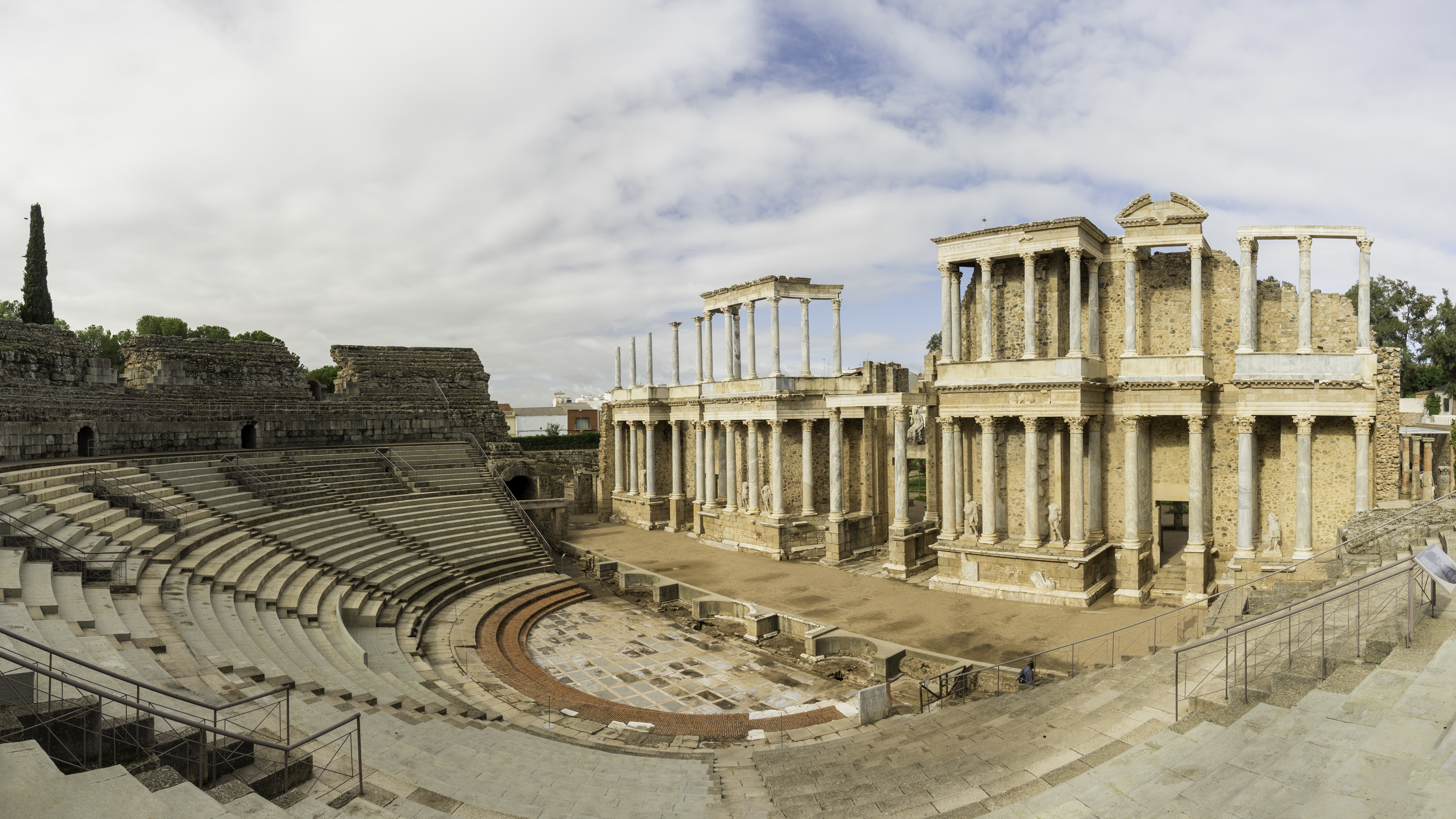
Roman Theatre (Mérida)
For centuries, the people of Merida walked past a hill called the Cerro de San Albin without knowing what lay beneath it. A few stone tips protruded from the earth at the summit -- seven curved sections that local folklore christened Las Siete Sillas, the Seven Chairs. According to tradition, Moorish kings once sat there to decide the fate of the city. The truth, when archaeologists began digging in 1910, was older and grander than any legend. Buried under centuries of accumulated earth was one of the most complete Roman theatres in the world, its marble and granite preserved by the very oblivion that had hidden it.
A Gift From Agrippa
The theatre was built in 16-15 BC under the patronage of Marcus Vipsanius Agrippa, Augustus's right-hand man and son-in-law -- one of the most powerful figures in the Roman world. As the capital of Lusitania, Emerita Augusta required public buildings that announced its status, and Agrippa provided them. The theatre was constructed in strict accordance with the architectural principles of Vitruvius, following the same design grammar as theatres in Dougga, Orange, Pompeii, and Rome itself. The semicircular cavea was built into the natural gradient of San Albin hill, reducing the amount of structural support needed and seating 6,000 spectators across three tiers: the ima cavea for the elite, the media cavea for the middle classes, and the summa cavea for everyone else.
The Scaenae Frons
The theatre's most spectacular feature is its stage front, the scaenae frons -- a monumental marble wall 17.5 meters tall and 63 meters long, articulated with Corinthian columns of blue-veined marble on white bases. Between the columns stand sculptures: Ceres, Pluto, Proserpina, and figures in togas and armor interpreted as imperial portraits. The originals are now in the nearby National Museum of Roman Art, replaced by careful reproductions, but the effect remains breathtaking. Three doors pierce the wall -- the central valva regia for principal actors and two lateral valva hospitalium for supporting cast. The present facade dates from a renovation under Emperor Trajan, around the late 1st or early 2nd century AD, replacing an earlier stage front whose appearance remains unknown. A further renovation under Constantine I between 330 and 340 AD added decorative elements and a walkway around the monument.
Behind the Stage
A peristyle garden stretches behind the scaenae frons, surrounded by a quadrangular portico of columns -- a recreation area where audiences could stroll during intermissions. At the garden's far end, aligned with the stage's central door, a small room was dedicated to the imperial cult. Archaeologists found a sculptural portrait of Augustus dressed as pontifex maximus, a reminder that Roman entertainment and imperial propaganda were never far apart. In the garden's northern corner, above the landscaping, sit the remains of Roman latrines. To the west, a house built after the theatre's abandonment features its own columned courtyard and rooms decorated with murals of life-sized human figures -- evidence that even as the theatre fell silent, people continued living in its shadow.
Resurrection in Stone
Archaeologist Jose Ramon Melida began excavations in 1910, but limited resources slowed progress for decades. In 1933, before the full extent of the theatre was even uncovered, the first theatrical production was staged in the excavated ruins -- inaugurating the Merida Classical Theatre Festival, now the oldest of its kind in Spain. Reconstruction of the scaenae frons took place in the 1960s and 1970s, restoring the colonnade and wall to something approaching its ancient grandeur. Today the theatre is not merely the most visited monument in Merida but a living performance space, chosen as one of the 12 Treasures of Spain. Each summer, the orchestra fills with the sound of Greek tragedies and Roman comedies performed where they were first heard two thousand years ago -- in a theatre that Roman veterans built so they could enjoy in retirement the culture of the empire they had served.
From the Air
Located at 38.92N, 6.34W in Merida, Extremadura. The semicircular theatre is clearly visible from the air adjacent to the elliptical amphitheatre on the eastern side of the city. The Cerro de San Albin hill into which the seating is built provides a distinctive profile. Nearest airport is Badajoz (LEBZ), approximately 60 km west.