Rome
The Roman Forum started as a swamp. In the 7th century BC, engineers drained the marshy valley between Rome's hills by constructing the Cloaca Maxima - a sewer so well-built it still functions today. Where stagnant water once bred disease, they laid paving stones and built temples, and the political heart of the Roman Republic began to beat. Here senators debated, generals celebrated triumphs, merchants traded, and citizens gathered to hear orators who shaped the language lawyers still use. The Forum expanded for eight centuries, monument piling on monument, until the Empire fell and the stones were quarried for medieval buildings. What remains is archaeological stratigraphy - layers of civilization stacked atop each other, each generation building on ruins it no longer understood. This is Rome's fundamental condition: a city of 2.8 million people living on top of two millennia of their ancestors' ambitions.
The Arena of Blood
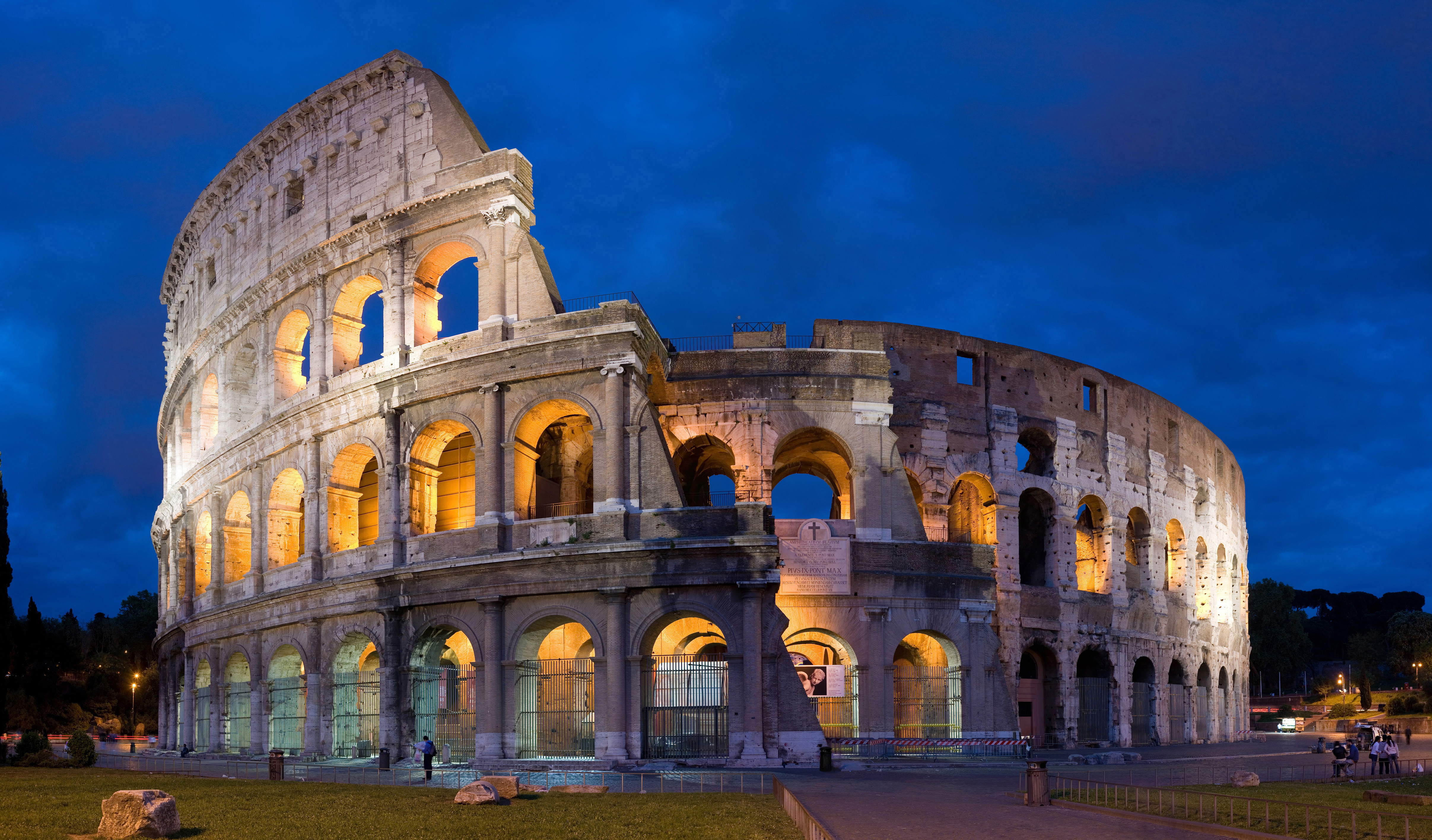
The Colosseum rose from conquest. Construction began under Emperor Vespasian in 72 AD, paid for with plunder from his son Titus's sack of Jerusalem two years earlier, built by enslaved Jewish prisoners of that war. The elliptical amphitheatre - 189 by 156 meters, four stories of stone and concrete - could hold 50,000 spectators. It was completed in 80 AD, inaugurated with 100 days of games that killed thousands of animals and countless gladiators.
The building that symbolizes Rome was designed for death as entertainment. Wild beast hunts in the morning, executions at midday, gladiatorial combat in the afternoon - the schedule ran like clockwork. Water could flood the arena for naval battles. Trapdoors released animals from underground chambers. The efficiency was engineering applied to spectacle. The Colosseum hosted games for four centuries until the Christian emperors grew uncomfortable with the violence. It became a quarry, a fortress, a shrine. Today it draws over four million visitors annually, including pilgrims who believe early Christians were martyred there - though historians find no evidence for that tradition.
The Forum's Echoes
The Roman Forum today is a confusion of broken columns and partial walls that requires imagination to populate. This was once the center of the known world - the Senate met here, the treasury was kept here, triumphal processions ended here, Julius Caesar was cremated here. The Via Sacra that runs through its length carried every emperor from his coronation to his funeral.
What survives tells only fragments. The Temple of Saturn held Rome's state treasury; only eight columns remain. The Arch of Septimius Severus commemorates victories over Parthia; the inscriptions are still legible. The Temple of Vesta, where the sacred flame was kept burning for eleven centuries, is recognizable by its circular foundation. Across the road, the Curia Julia - the Senate House - stands nearly intact because it was converted to a church in the 7th century. Christianity saved what paganism built. The Forum draws 4.5 million visitors yearly, but comprehending what they're seeing requires knowing what's missing.
The Vatican State
The Vatican is the world's smallest independent nation - 49 hectares, population around 800 - entirely surrounded by Rome but constitutionally separate since the 1929 Lateran Treaty. The Pope rules as absolute monarch over territory that includes St. Peter's Basilica, the Sistine Chapel, the Vatican Museums, and the administrative buildings of a global church with 1.3 billion members.
St. Peter's stands on the site where tradition says the apostle was buried after his crucifixion in Nero's circus. The current basilica, completed in 1626 after 120 years of construction, is the largest church in the world. Michelangelo designed the dome. Bernini designed the colonnade. The Pietà sits in a side chapel. The scale is deliberately overwhelming - the dimensions calculated to make humans feel small before God. During 2025's Jubilee Year, the Vatican reported 33 million pilgrims crossing the Holy Door. The tiny state's influence extends far beyond its walls; the Pope's words reach a quarter of humanity.
The City of Churches
Rome has over 900 churches - more than any other city in the world. Some date to the 4th century, when Constantine legalized Christianity and believers could finally build openly. Some are baroque extravaganzas dripping with gold. Some are small neighborhood parishes where the same families have worshipped for generations. Together they represent the entire history of Christian architecture.
Santa Maria Maggiore preserves 5th-century mosaics above Renaissance additions above baroque chapels - centuries of belief in one structure. San Clemente layers a 12th-century church atop a 4th-century church atop a 1st-century Mithraic temple - you can descend through all three. Caravaggio's most violent paintings hang in churches that commissioned them when he was a wanted murderer. The faith that shaped Western art remains visible everywhere, even as tourist buses and gelato shops surround the doors. Practicing Catholics are now a minority of Rome's population, but the churches persist, maintained by a state that recognizes their heritage even when it no longer shares their belief.
The Living Layers
Every construction project in Rome encounters archaeology. The new metro station at the Colosseum, opened in December 2025 after years of delays, displays artifacts found during excavation - the digging revealed remains that couldn't simply be removed. This is routine. Builders budget for archaeological discoveries that will halt their work. Sometimes they find mosaics; sometimes tombs; sometimes foundations that require redesigning the entire project.
Romans have adapted to living with their past. Restaurants occupy medieval buildings built into ancient walls. Apartments look out on ruins. The Tiber River, channeled between 19th-century embankments, flows past bridges that date from antiquity. The city never had the catastrophic destruction that cleared other European capitals for modernization - no Great Fire of London, no WWII firebombing to wipe the slate clean. Instead Rome accumulated, each generation adding rather than replacing, until the present became inseparable from everything that preceded it. The Eternal City earns its name by refusing to let anything truly pass.
From the Air
Rome (41.90°N, 12.48°E) lies on the Tiber River in central Italy, approximately 24km from the Tyrrhenian Sea coast. The city sprawls across the original seven hills and well beyond, covering about 1,285 sq km. Two major airports serve Rome: Leonardo da Vinci-Fiumicino (LIRF/FCO) 32km southwest is Italy's busiest with four runways, the main being 16R/34L (3,900m); Ciampino (LIRA/CIA) 15km southeast handles low-cost carriers with a single runway (15/33, 2,208m). From altitude, the distinctive bend of the Tiber through the city center is visible, with Vatican City's elliptical St. Peter's Square on the west bank. The Colosseum's oval shape is identifiable in the historic center. The Aurelian Walls, built in the 3rd century, still trace portions of the ancient city boundary. The Appian Way extends southeast as a straight line through suburbs - the oldest Roman road still visible from above. The Alban Hills rise to the southeast (highest point 956m). Weather is Mediterranean - hot dry summers, mild winters with occasional rain. Occasional flooding of the Tiber basin occurs during heavy rainfall. Air traffic is heavy with converging European and intercontinental routes.